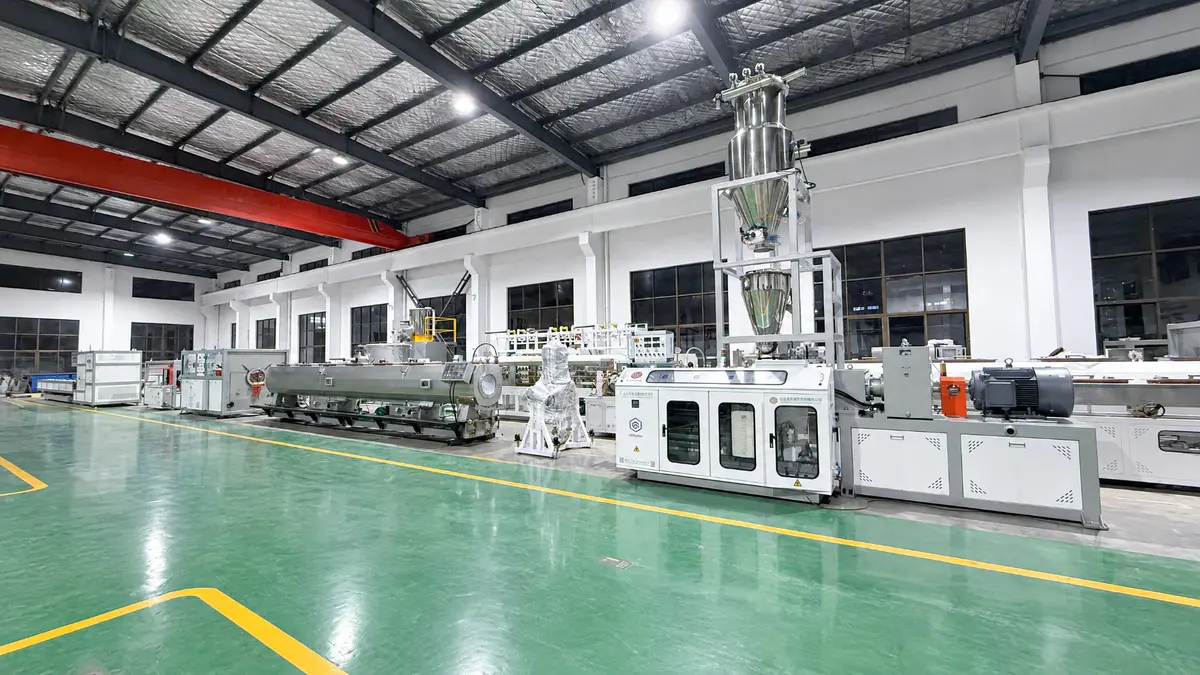
China PVC Pipe Extrusion Line Factory
Complete uPVC and CPVC pipe lines built around a conical twin screw extruder. Mixing, die head, vacuum calibration, spray cooling, haul-off, cutting and inline belling are matched as one line, for pipe from 16mm to 630mm on a single or twin strand.
Send your formulation, size list and target kg/h. QTech Machinery plans every station around the pipe you sell, then runs the line in our Zhangjiagang workshop before it is crated.
Four Things Every PVC Line We Build Shares
The rest is set by your recipe, your sizes and the socket your market uses.
Extruder
Conical Twin Screw
Parallel twin screw where output or filler share calls for it.
Pipe Range
16mm To 630mm
Each line covers a size group by swapping die tooling and sleeves.
Strands
Single Or Twin Strand
Two pipes from one extruder through a dual outlet die.
Sockets
Inline Belling
Smooth, gasket seat or integrated seal sockets formed after the cutter.
Plan Your PVC Line Station By Station
Follow the material from the mixer to the stacker, or jump to the decision on your desk today: which twin screw, one strand or two, which socket, and what a delivered 110mm to 315mm line actually carried.
Line Flow
Ten stations, mixer to stacker
PVC Compound
Hot and cold mixing, powder feeding
Twin Screw Choice
Conical or parallel for your recipe
Single Or Twin Strand
One pipe or two per extruder
Die And Cooling
Die head, vacuum tank, sizing sleeves
Haul-Off And Cutting
Grip, pull, cut, chamfer
Inline Belling
Sockets formed at line speed
Size Range
How setups shift from 16mm to 630mm
Quality Checks
Surface, sockets, black spots
Project Case
A 110mm to 315mm line in detail
Project Steps
Pipe list to first production
FAQ
Output, sizes, CPVC, testing
Send Your Pipe List
Formula, sizes, sockets, kg/h
Ten Stations Between Dry Blend And A Stacked Pipe
A PVC line works as a chain: each station takes the pipe at the pace the extruder sets and hands it on. That is why we size the stations together. Here is the order the material travels, and the job each machine does on PVC. Every name opens its own machine page.
Mixing Unit
A hot mixer heats resin, CaCO3, stabilizer and lubricant by friction. A cooling mixer then brings the dry blend down before storage.
Dosing And Feeding
Loaders, hoppers and powder feeders picked for how your blend really discharges, so the screw is neither starved nor flooded.
Twin Screw Extruder
A conical or parallel twin screw feeds, compresses, plasticizes and vents the blend at a controlled melt temperature.
Pipe Die Head
Flow channels without dead zones, one outlet or two, with forming tooling for each diameter on your list.
Vacuum Calibration Tank
The sizing sleeve and vacuum set the outside diameter while the wall is still soft enough to shape.
Spray Cooling Tank
Spray rings pull out the heat left in the wall so the pipe reaches the haul-off round and firm.
Haul-Off
Caterpillar tracks pull at a constant rate. Wall thickness holds only as long as that rate holds.
Pipe Cutter
Chipless, planetary or saw cutting to length, with a chamfer where the end will be socketed.
Belling Machine
Heats the cut end and forms the socket on the line, so pipe leaves ready to join on site.
Added When Needed
Options For PVC Lines
A printer adds the marking your standard asks for, and a crusher and pulverizer reduce rejected pipe to regrind and powder you can reuse. Building HDPE or PPR pipe as well? The pipe extrusion lines overview covers every line family we build.
Every station after the hopper inherits whatever leaves the mixer, so the compound is where a PVC line really starts.
Get The Dry Blend Right Before It Meets The Screw
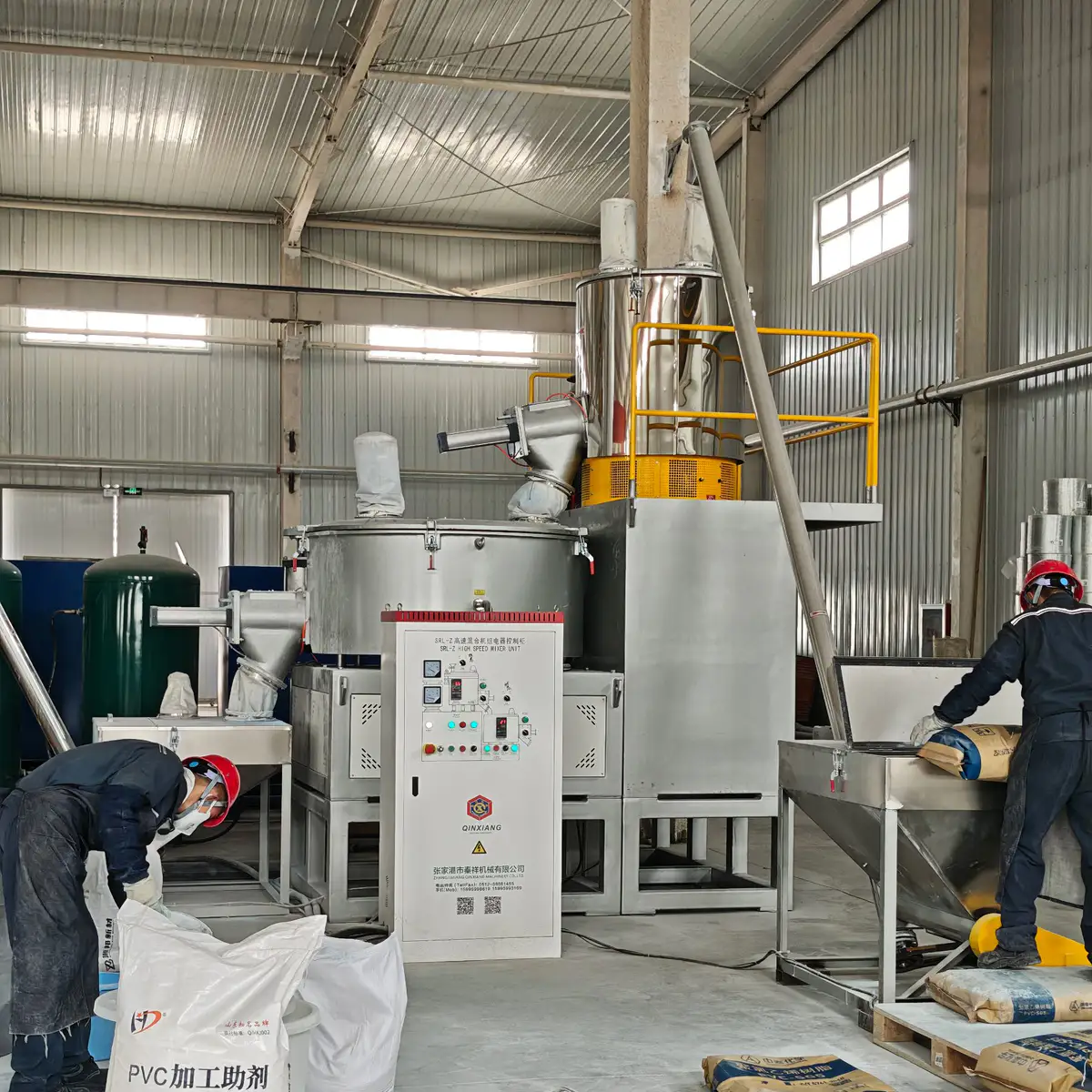
Plenty of the defects people find at the cutter were made at the mixer. A twin screw can only plasticize the blend it receives, so we size mixing and feeding from your recipe and your line's kg/h, never from vessel volume alone.
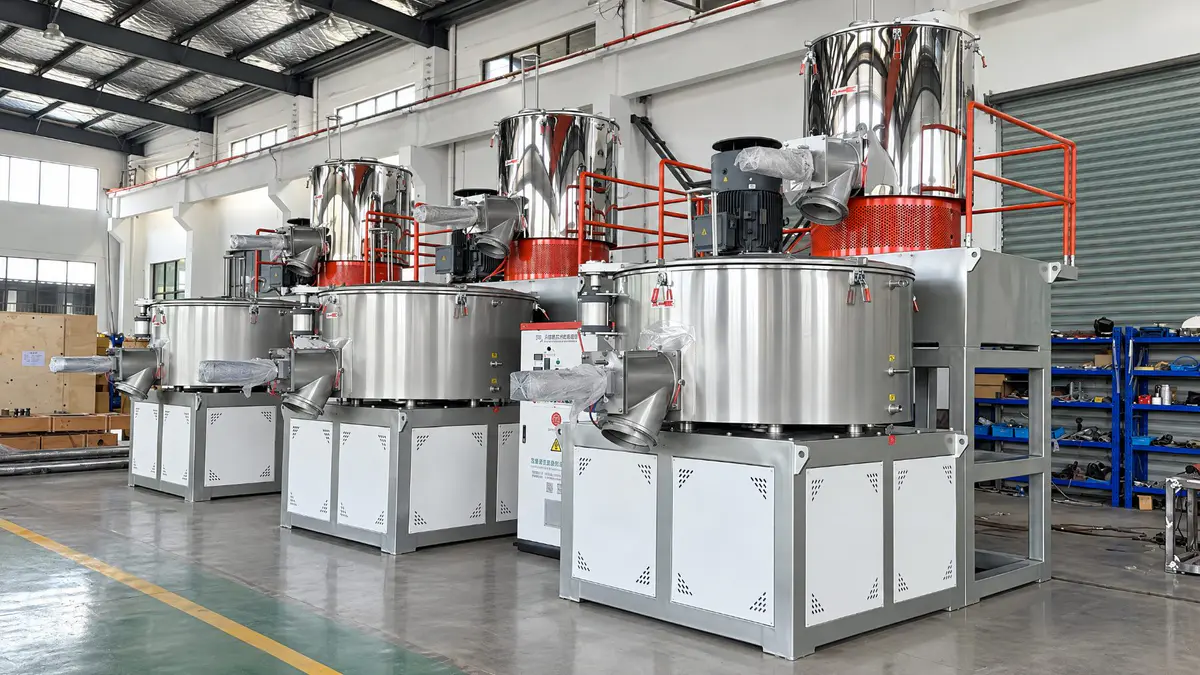 Hot And Cold Mixer Unit
-
1
Hot Mixing To A Set Temperature
High-speed blades heat the batch by friction. Stabilizer and lubricant melt onto the resin grain and the filler is worked in. The batch drops when it reaches the discharge temperature set for your formula, not when a timer runs out, so each batch leaves in the same state.
-
2
Cooling Before Storage
A larger cooling mixer with a water jacket receives the hot batch and brings it down quickly. Warm blend left in a silo is where caking and moisture pickup start, and the hot mixer can begin the next batch while this one cools.
-
3
Feeding A Powder, Not A Pellet
Dry blend with a high CaCO3 share bridges and compacts where pellets would flow. When that risk is there, we change the hopper geometry, outlet size, agitation or feeder screw to suit the way your blend discharges.
The Capacity Check We Run
With margin. When a mixing system falls short, the cooling stage is usually the side that slows the cycle, which is why the hot and cold mixers are sized as a pair.
On the case line: SRL500/1000 and SRL800/2000 high-speed mixer units in 304 stainless steel, with 500L and 800L hot mixers feeding 1000L and 2000L coolers.
Once the recipe is fixed, the next choice is the twin screw that will plasticize it, and conical and parallel designs answer different recipes.
Conical Or Parallel Twin Screw For Your PVC
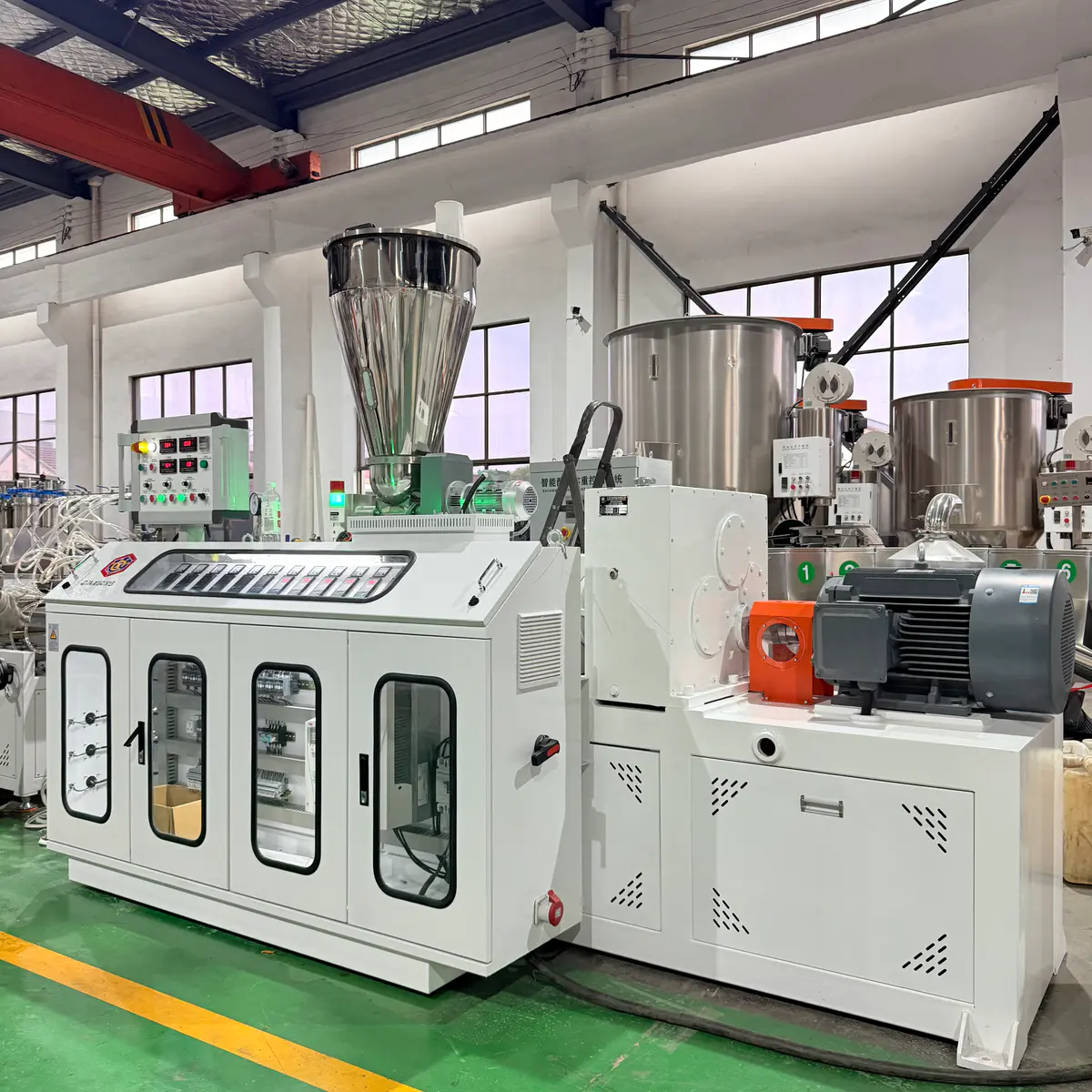
PVC pipe runs on a twin screw because dry blend has to be fed, compressed, mixed and heated evenly along the whole barrel without being overheated on the way. Both twin screw designs do that job. Your formulation, filler share, size range and kg/h decide which one belongs on your line.
| Point | Conical Twin Screw | Parallel Twin Screw |
|---|---|---|
| Where It Fits | Our starting point for uPVC and CPVC pipe made from dry blend | Higher-throughput PVC pipe and recipes carrying more filler |
| What It Does Best | Gentle, low-shear plasticizing with high torque and close temperature control | Strong mixing and degassing, with torque in reserve for filled blends |
| We Check | Formula, filler share, stabilizer system, venting, screw cooling, expected wear | Filler type, moisture, additive package, degassing need, target kg/h |
| Models | For example SJZ65/132, SJZ80/156 and SJZ92/188. The case line ran an SJSZ80/156. | Configured against your recipe and output target |
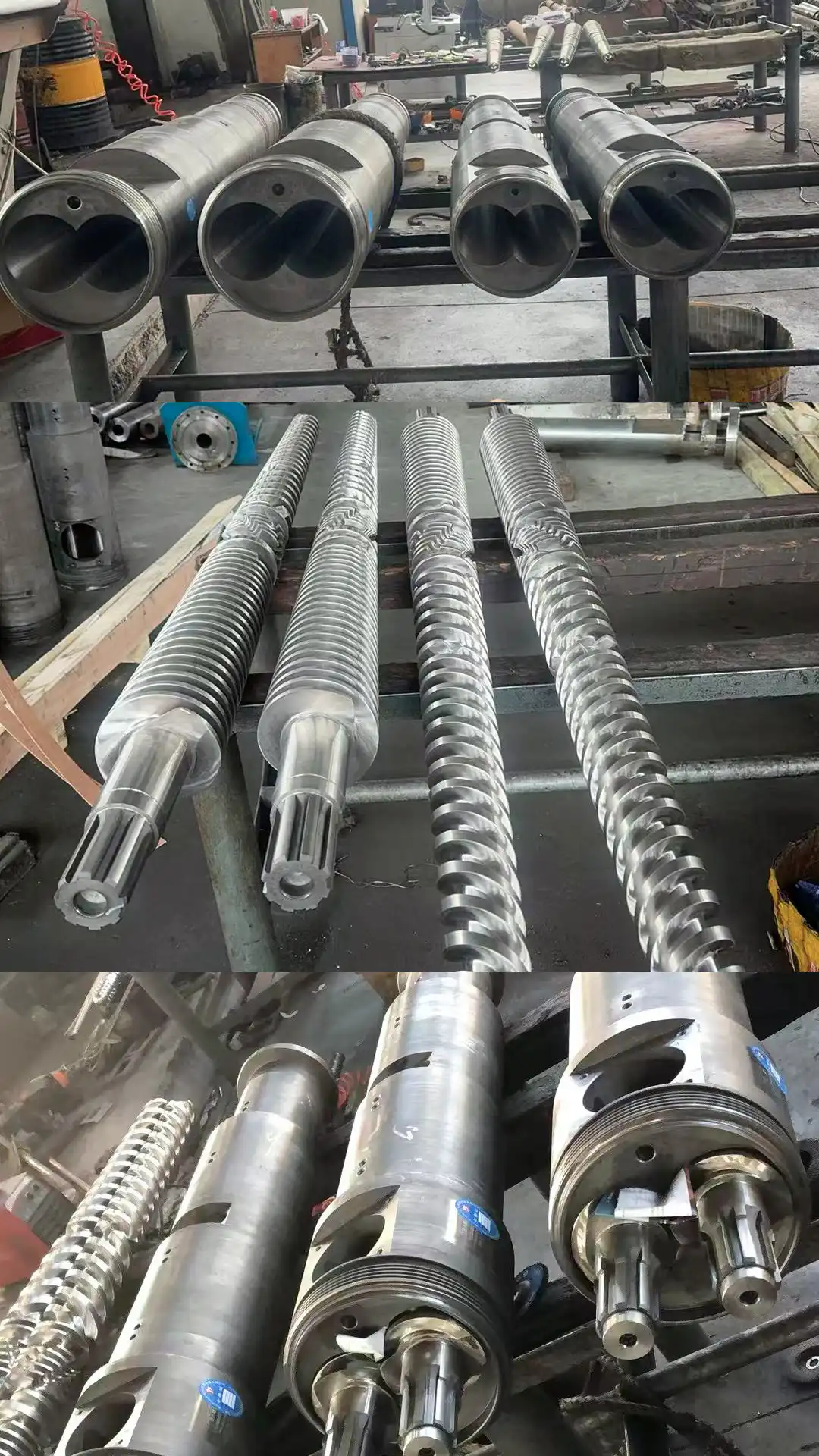
Filler Changes The Screw
A blend heavy in CaCO3 should not borrow the screw specification of a standard recipe. Filler moves the screw geometry, the torque the drive must deliver and the wear protection the barrel needs, so send the approximate composition with your inquiry.
A kg/h Figure Needs A Condition
Our PVC lines run from 120 to 800 kg/h depending on the extruder model. We tie that number to a reference pipe, wall and formula, because a catalogue maximum rarely holds once a real recipe goes through the barrel.
Compare kWh Per Kg, Not kW
A motor's kW tells you installed capacity, not what it draws. If energy figures are available, compare kWh for each kilogram of good pipe, and check whether they cover the extruder alone or the full line.
Plan For Screw And Barrel Wear
Filler, regrind and running hours set the wear rate, so protection is chosen from your recipe. The case extruder used a nitrided 38CrMoAlA screw with 36KW of cast aluminum heaters and cooling fans.
Replacing an extruder on a running PVC line? Send the die connection, center height and current output too.
One Extruder, One Pipe Or Two?
With the extruder chosen, decide how many pipes it should feed at once, because that choice reaches every machine from the die to the stacker.
One Pipe Or Two From The Same Extruder
A twin strand line splits the melt through a dual outlet die and runs two pipes side by side. The kilograms per hour can stay the same, yet the number of finished pipes arriving at the belling machine and the stacker doubles. That is the part buyers tend to underestimate.

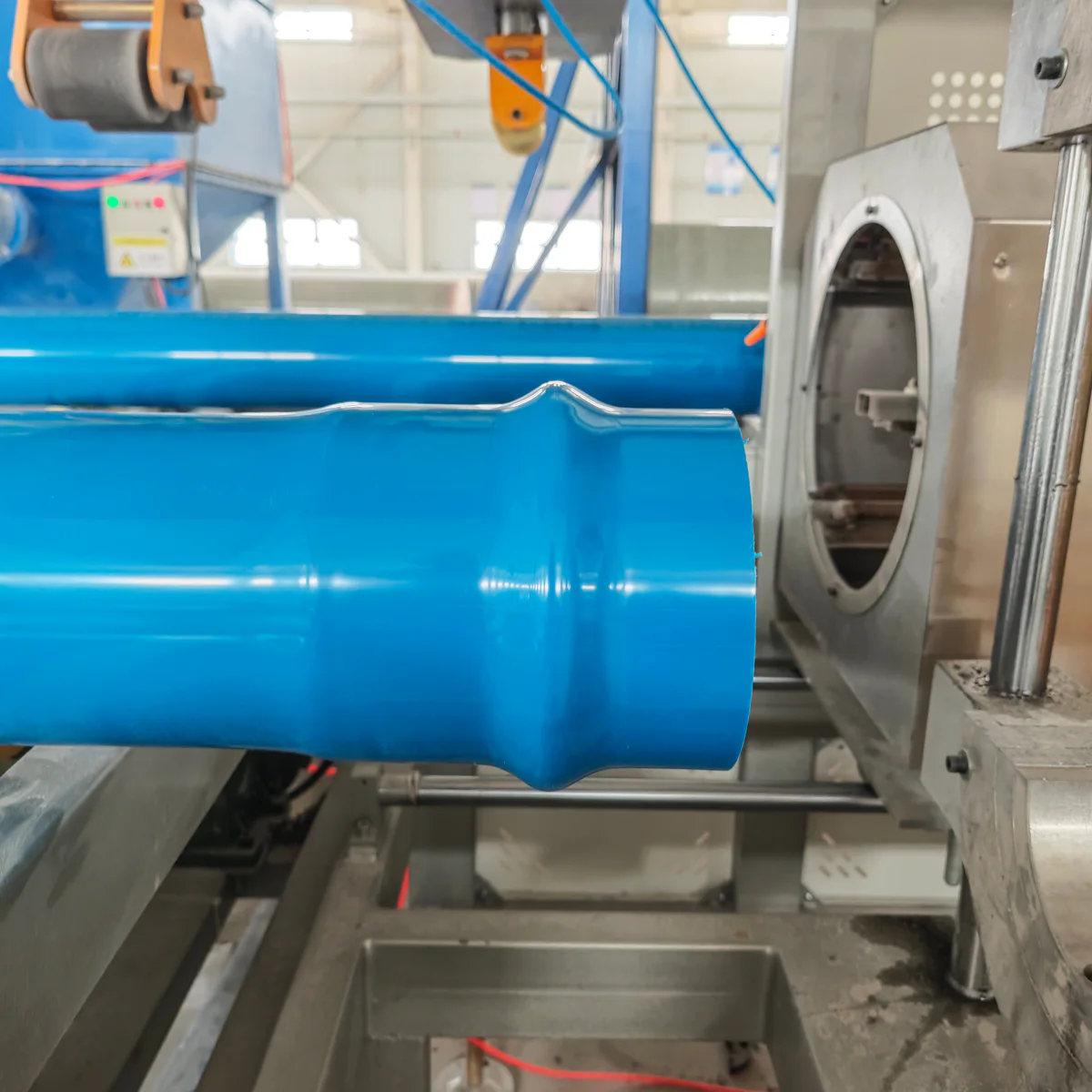
Two pipes reaching the belling station together: the downstream has to be built for this from the start.
Single Strand
One die outlet and one pipe through every station. A size change touches one set of tooling, and calibration, pulling, cutting and belling all work at the pace of a single pipe.
Twin Strand
A multi strand die feeds two pipes from one extruder. You gain pieces per hour without a second extruder, and every station after the die is planned for two pipes moving together.
| Station | Single Strand | Twin Strand |
|---|---|---|
| Die Head | One outlet | Multi strand die with two outlets |
| Calibration Tank | Sized for one pipe | Dual pipe stated when tank length and vacuum are sized |
| Belling | Single pipe processing | Dual pipe handling, extra or parallel heating stations |
| Stacker | Single lane | Two lanes, with discharge order and collection space for pipes that land together |
Our PVC lines use a modular downstream so the change between single and double strand production stays quick. Send your diameters and the pipes per minute you need, and we tell you whether a second strand pays for itself before the die is drawn.
One strand or two, the size you get measured on is fixed in the first few meters after the die.
Die Head, Vacuum Tank And Sizing Sleeves, Matched Together
PVC does not forgive melt that stops moving. Wherever material can rest inside the head it begins to degrade, and you see it later as yellow streaks or black specks. After the die, the sizing sleeve and the vacuum tank decide the diameter and roundness your customer will measure.
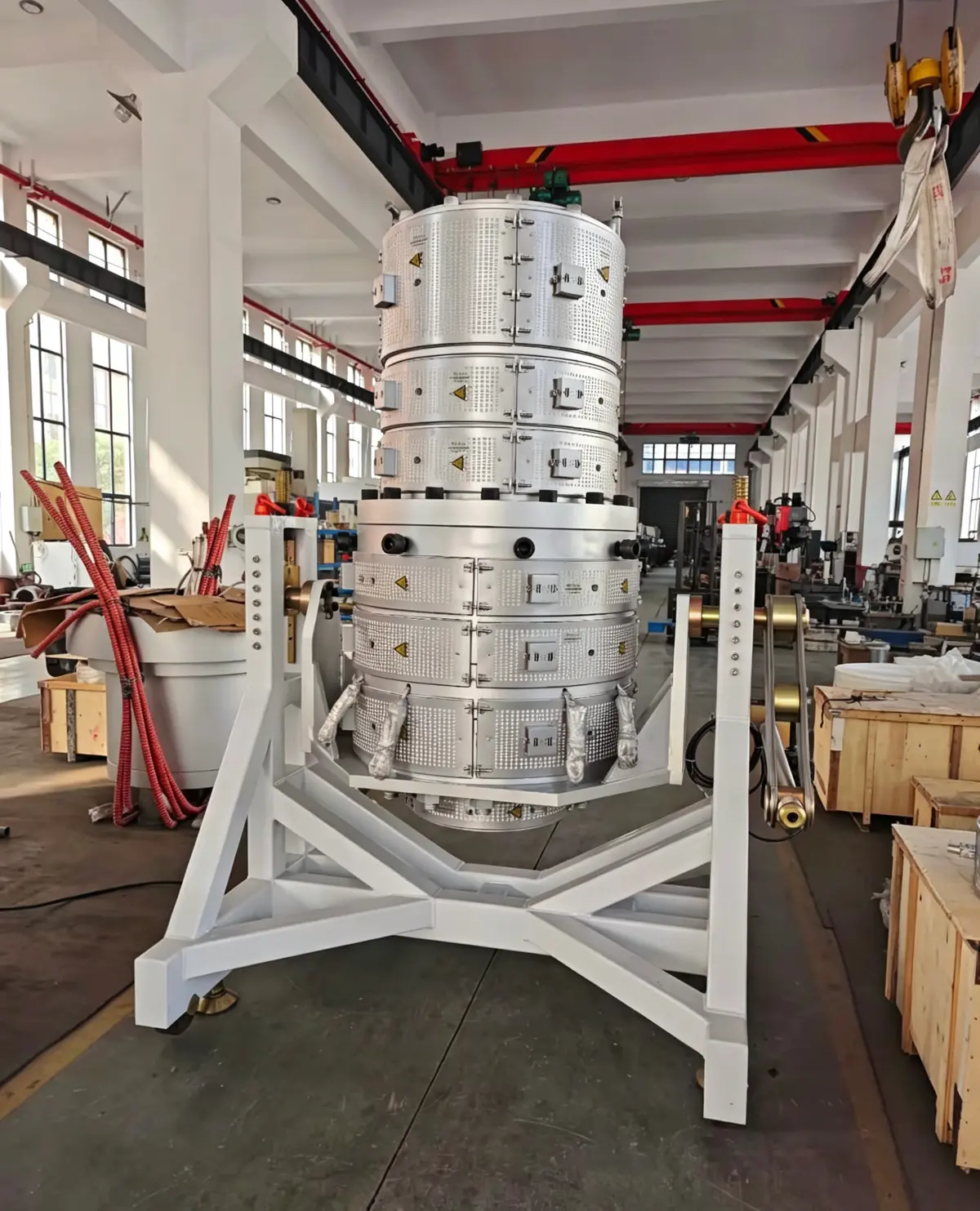
Forming
Pipe Die Head
Its flow channel is designed for PVC: melt keeps an even pace all the way to the die gap at your real running output, leaving no pocket where it can stall and burn.
- Whole diameter list reviewed before any steel is cut
- One die body can serve a group of sizes, with forming tooling and sleeves changed between them
- Case line: two die sets, 110mm to 160mm and 160mm to 315mm
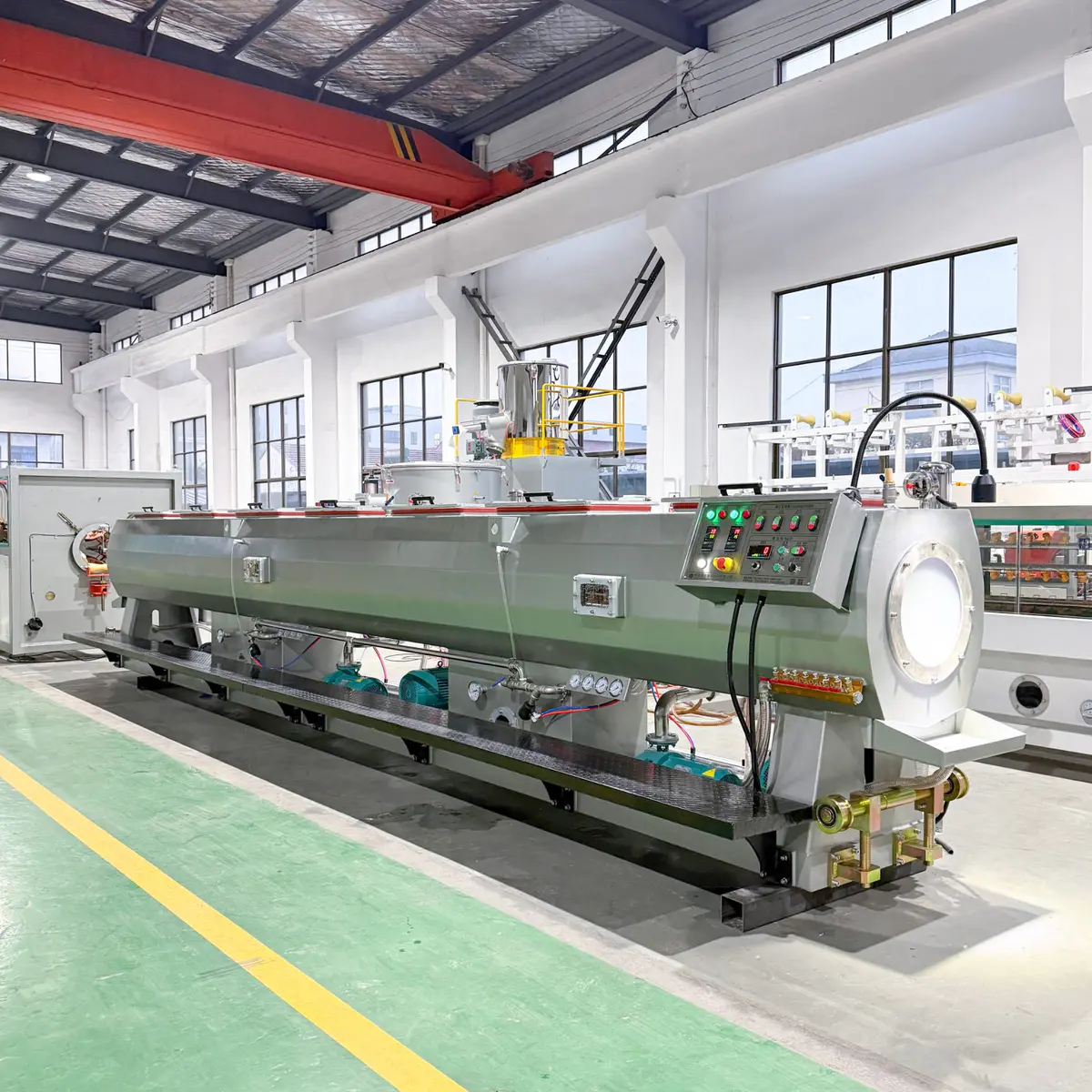
Sizing
Vacuum Calibration Tank
The sleeve and vacuum lock in the outside diameter while the wall is still soft. Length and vacuum capacity follow your wall thickness and line speed, not the diameter by itself.
- Tanks built 3m to 12m long, in one stage or several
- Double chamber build where vacuum and cooling need separate control
- Case line: 8m tank in 5mm stainless steel, 5.5KW and 4.5KW vacuum pumps

Tooling
Custom Sizing Sleeves
The sleeve gives the pipe its outside diameter as it leaves the die. It is made for each size you run and works with the vacuum tank as one sizing system, so vacuum, water and alignment are confirmed together.
- Bore and length set for each pipe size in your range
- Vacuum and water connections matched to the calibration tank
- Replacements made from your sleeve drawing, pipe spec and mounting photos
Seven details, one review
- /Material and formulation
- /Smallest and largest OD
- /Wall thickness or SDR range
- /Maximum line speed
- /Single or dual pipe
- /Cooling water temperature
- /Floor length available for the line
A pipe that leaves the tanks at the right size still has to be pulled at an even rate and cut cleanly, and both jobs get harder as rigid PVC gets bigger.
Steady Pulling And Clean Cuts On Rigid PVC
Haul-off speed is part of the wall thickness: let the pull drift and the wall follows it. The cutter then has to keep pace with the line and leave an end that the belling machine, or your customer, can use without rework.

Haul-Off: Traction Without Marks
We pick the contact length and clamping method from your pipe weight, wall and speed range, not from the number of tracks. More contact spreads the pull so you do not have to clamp harder.
Case line: a servo four-claw belt haul-off for 110mm to 315mm, 0.1 to 3 m/min, four 1.1KW servo motors, 28,000 N of traction and pneumatic clamping.
Haul-Off Machines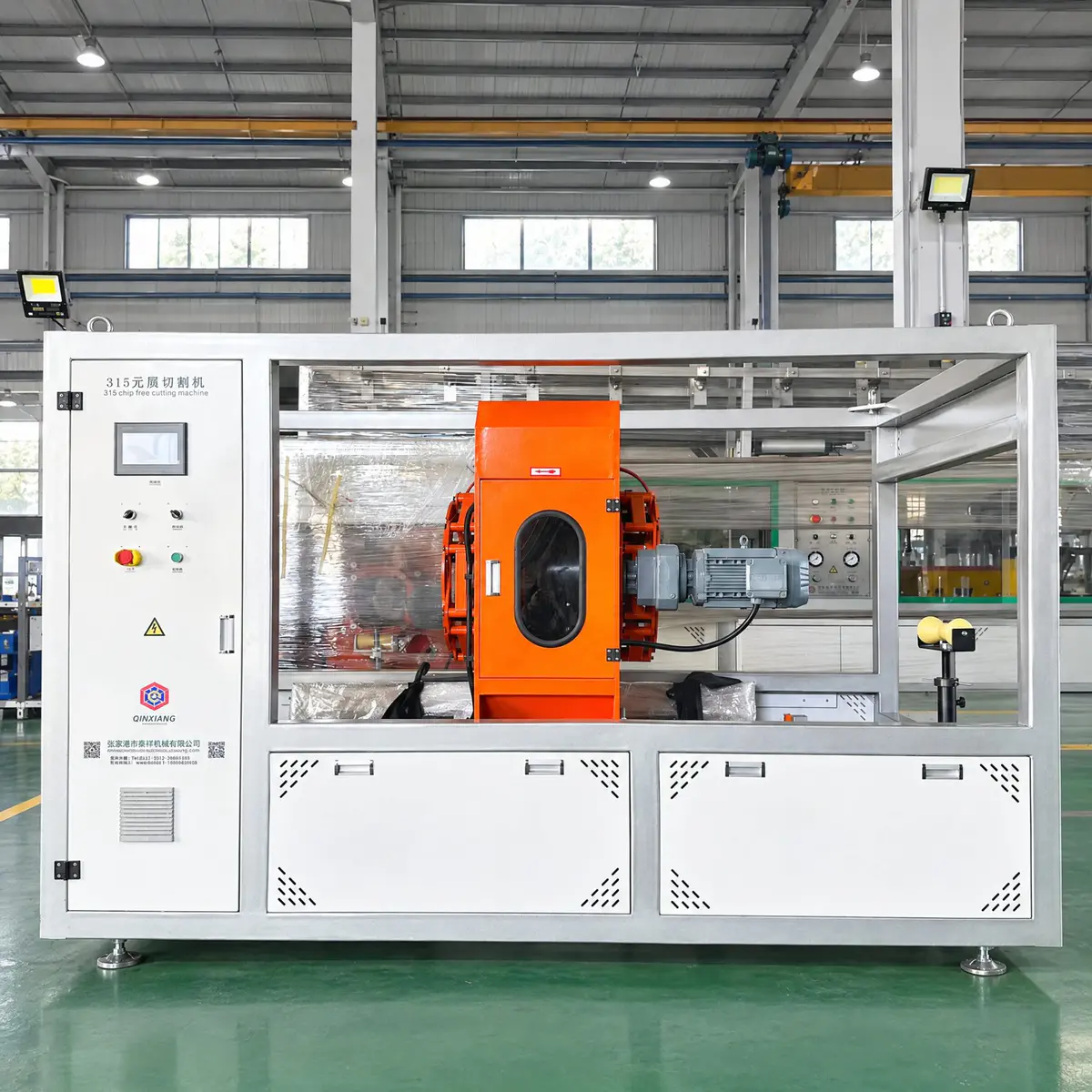
Cutter: Length, Face And Chamfer
There is no rule that PVC has to be sawn. Wall thickness, line speed, cut length and the end you need decide the method, and where the end will go into a socket, cutting and chamfering can happen in one cycle.
Case line: a ring-type chipless cutter for 110mm to 315mm and walls up to 25mm, 4KW with an Inovance servo, chamfering built in and a Siemens PLC.
Pipe Cutting MachinesIf your pipe ships with a socket, the belling machine is the next station and it has to finish every pipe the cutter sends it.
Form The Socket On The Line, At Line Speed
Pressure, drainage, sewer and conduit pipe are often joined through a socket on one end. Forming it inline saves a separate operation, provided two things hold: the socket meets your standard, and the belling cycle is never slower than the cutter feeding it.
Smooth Socket
A plain formed bore. The fit with the mating spigot is what the tooling has to hold.
Gasket Seat
A groove formed around the rubber ring you actually buy, so send its profile with the drawing.
Integrated Seal
The seal goes in during forming and must stay put after cooling and handling.
Before Tooling Is Machined
Seven Answers Shape The Belling Machine
- Application: pressure, drainage, sewer or conduit
- Standard: EN, ISO, ASTM or your local code
- Joint type: smooth, gasket seat or integrated seal
- Socket depth, entry angle and seat profile
- Ring type, groove size and seal placement
- OD and wall thickness or SDR
- Sockets per hour, matched to your line speed
What Sets The Belling Cycle
Longest stage winsHeating grows with diameter and wall thickness. Once it decides the cycle, more forming force or a faster transfer changes nothing; extra heating positions or parallel heating do.


The Slowest Station Sets Your Output
Size the belling machine from the pipes your cutter delivers each hour, not from kg/h. Dual outlets, short lengths and small diameters all raise that count without moving the kg/h at all.
Cutter Delivers
240
pipes per hour
Line Needs
240
sockets per hour
Belling Delivers
180
so the line ships 180
Case line: belling for R-type and U-type sockets, electric heating with air cooling, Siemens PLC control.
Pipe Belling MachinesWith every station defined, here is how the balance between them moves as the pipe grows from 16mm to 630mm.
How The Line Changes From 16mm To 630mm
The station list stays the same across the range, but the weight of each decision moves. Small pipe is a question of speed and piece count. Large pipe is a question of heat, traction and cutting force. Treat these bands as a starting point, then send us your real size list.
Small Diameter
16mm To 110mm
- Line speed and pieces per hour lead the design, so a twin strand die is worth reviewing
- Belt or 2 caterpillar haul-off for higher line speeds
- Flying knife or high-speed cutting for short lengths and frequent cuts
- Belling and stacking sized by pipes per minute, not kg/h
- Cooling time can become the limit as pipe passes the nozzles faster
Mid Range
Case Range110mm To 315mm
- SJSZ80/156 conical twin screw rated 300 to 650 kg/h on the delivered line
- Die tooling split into two size groups, 110mm to 160mm and 160mm to 315mm
- 8m vacuum calibration tank with dual-circuit, temperature-controlled water
- Servo four-claw haul-off and ring-type chipless cutter with chamfering
- Belling for R-type and U-type sockets
Large Diameter
315mm To 630mm
- Thicker walls carry more heat, so calibration and cooling grow longer and may need two or more spray stages
- 6 and 8 caterpillar haul-off to grip heavier pipe from several sides
- Planetary saw cutting for rigid, thick-wall pipe, with chip extraction
- Belling heating time grows with diameter and wall, so heating positions are planned early
- Extruder sized to the kg/h a heavier wall demands at your line speed
Bands overlap in practice. One line covers several neighboring sizes through die tooling and sleeve changes. When a list runs from small to large pipe, the cooling, pulling and cutting needs can differ enough that two lines are the better plan, and we will say so before quoting.
Whatever the diameter, buyers judge finished PVC pipe on the same short list of checks.
The Checks That Decide Whether PVC Pipe Sells
PVC pipe is judged on its surface, its bore, its cut and its socket. Most rejects lead back to heat: too much temperature, shear or time somewhere between the mixer and the belling oven.
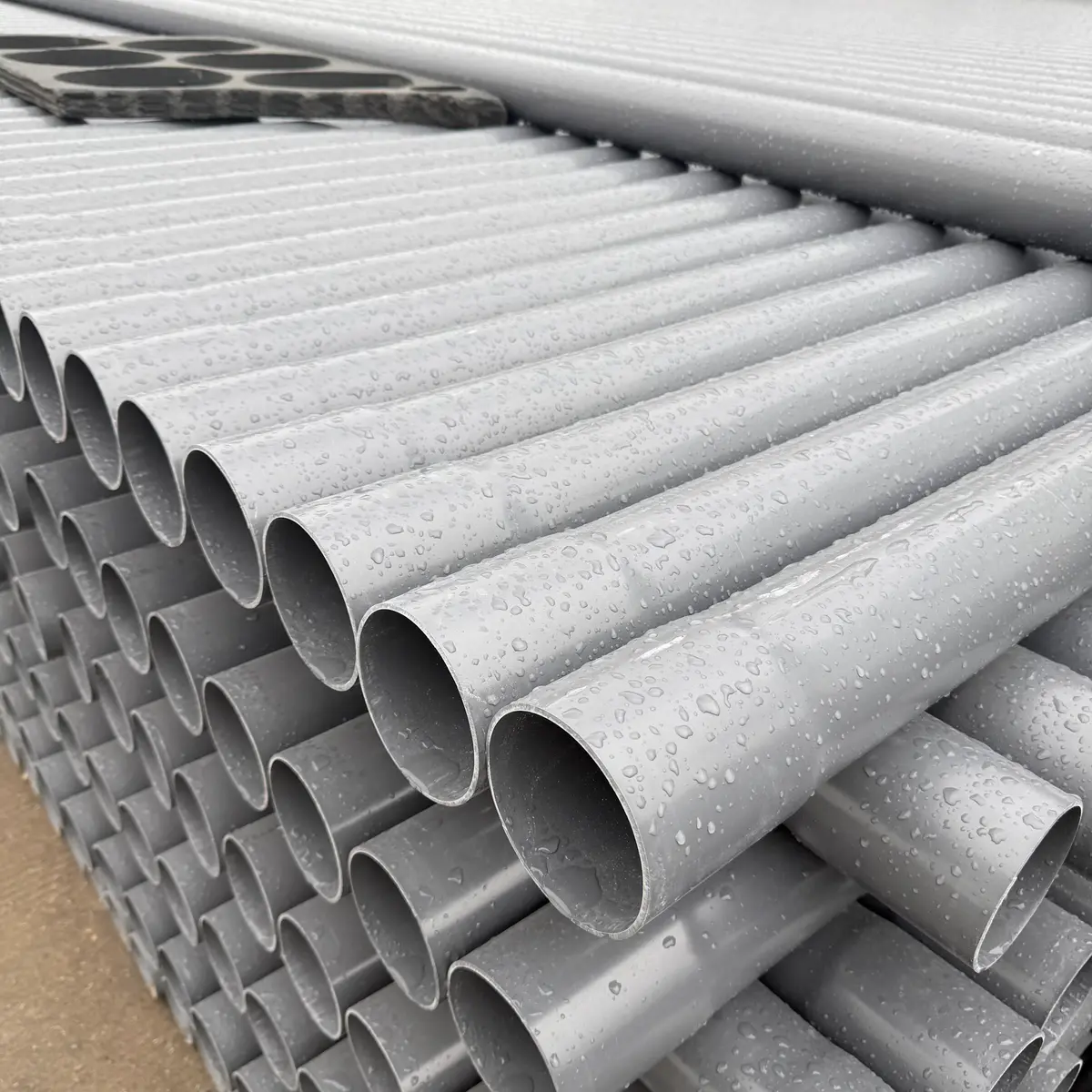
What Your Customers Inspect
- Steady size and wall over a long run
- Smooth, even outer surface
- Clean inner wall
- Square cut ends without burrs
- Sockets that keep their dimensions
- No black specks in the wall
- No yellowing or burnt streaks
- Marking that stays legible
Judge sockets after cooling. Measure them off the forming tool, over consecutive cycles, with your own gasket and mating spigot. One good sample proves the machine can form the socket; a run of them proves the line will.
Trace The Defect Back Up The Line
Start at the pipe and work upstream, one station at a time.
Mixer
Stabilizer and lubricant spread unevenly through the batch, so the extruder sees a slightly different recipe every few minutes and conditions never settle.
Extruder
Melt temperature, shear or residence time drifts past what the formula tolerates. Reaching full plasticization should not depend on extra heat.
Die Head
A dead zone in the flow channel holds melt long enough for it to degrade, then releases it into the wall.
Belling Oven
Heating temperature, exposure time and heating distance overdo the pipe end, discoloring the socket.
The same review covers rough inner walls, jumpy output and cracked sockets: we confirm your formula, filler share, sizes, standard and socket before the screw, die, cooling and belling machine are specified.
To see how all of this comes together, here is what one delivered PVC line carried, machine by machine.
A 110mm To 315mm PVC Line, Machine By Machine
A pipe manufacturer asked for a line producing 110mm to 315mm water supply pipe at a throughput of 300 to 650 kg/h, with energy use, accuracy and international quality benchmarks in focus. This is the configuration QTech Machinery built and tested for that project.
- Pipe Range
- 110mm To 315mm
- Throughput
- 300 To 650 kg/h
- Extruder
- SJSZ80/156 Conical
- Die Sets
- 110–160 And 160–315
- Sockets
- R-Type And U-Type
Reported Result
The case write-up records a 20% reduction in the client's production costs after the line went into service.
Extruder
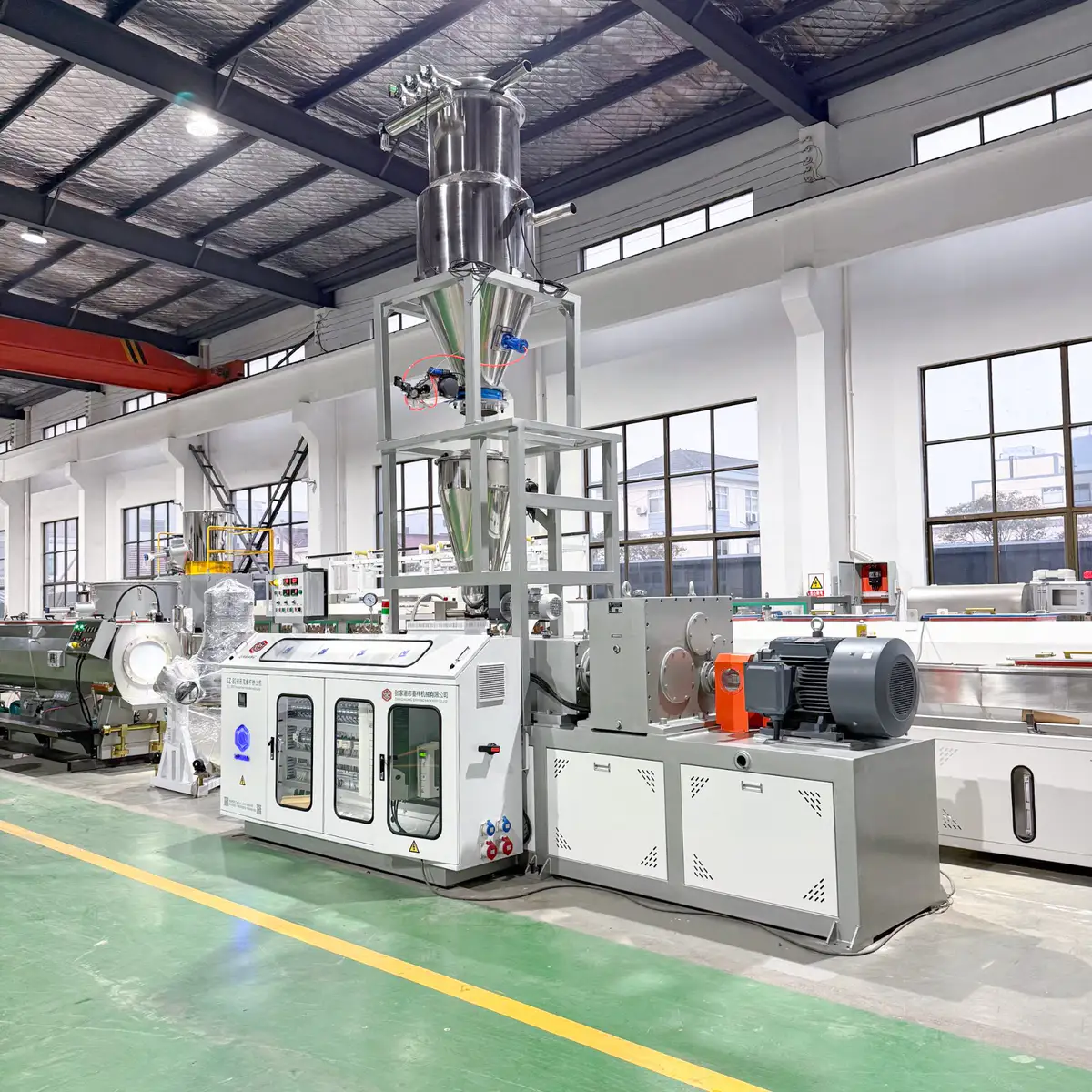
SJSZ80/156 Conical Twin Screw
- Screw diameter Φ80/156mm, rated 300–650 kg/h
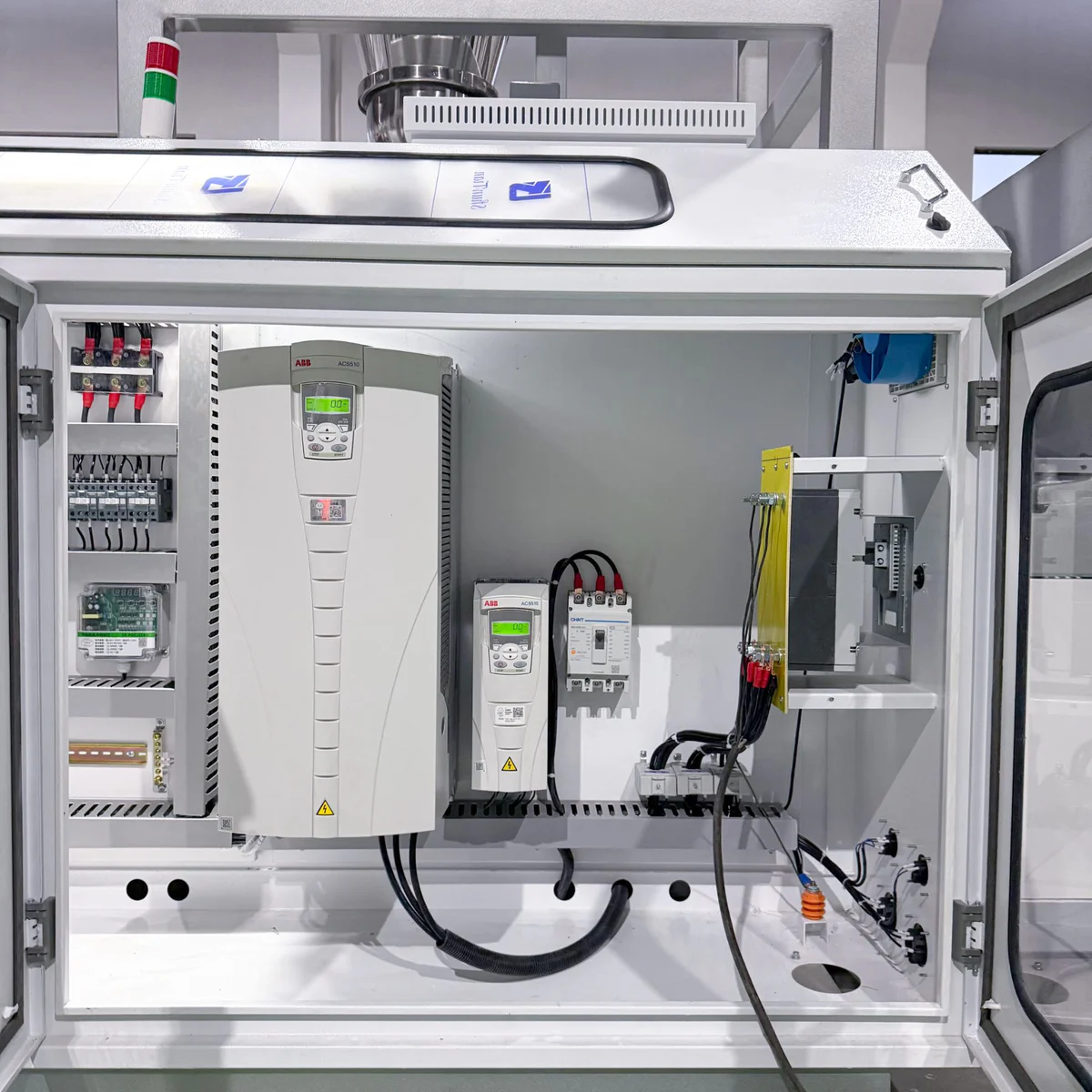
- 55KW Siemens main motor, ABB inverters
- 38CrMoAlA screw with nitrided surface
- 36KW cast aluminum heaters, fan cooling
- Jiangyin (Dooling) gearbox, Schneider and Siemens electrics
Die Heads
Two Mould Sets
- 110, 125, 140, 160, 200, 250 and 315mm
- 40Cr forged steel, chrome-plated channels
- 304 stainless steel sizing sleeves
- Mould car with electric 3D rotation
- Built to GB/T 10002.1
Sizing
8m Vacuum Calibration Table
- 5mm stainless steel construction
- Vacuum pumps 5.5KW and 4.5KW
- Water pumps 5.5KW and 4.5KW
- Dual-circuit, temperature-controlled water
- Vertical and horizontal adjustment, 0–50mm
Pulling
Four-Claw Belt Haul-Off
- Φ110–315mm, 0.1–3 m/min
- Four 1.1KW servo motors
- 28,000 N traction
- Pneumatic clamping
- Length 2800mm
Cutting
Ring-Type Chipless Cutter
- Φ110–315mm, wall up to 25mm
- 4KW drive, Inovance servo control
- Blade with chamfering
- Pneumatic control and movement
- Siemens PLC
Belling And Mixing
Sockets And Dry Blend
- R-type and U-type sockets
- Electric heating, air cooling, Siemens PLC
- SRL500/1000 and SRL800/2000 mixer units
- 500L and 800L hot, 1000L and 2000L cold
- 304 stainless steel construction



Your Line Follows The Same Path
Whatever the size range, a PVC line project with us moves through the same eight steps, from your first pipe list to a running line on your floor.
From Your Pipe List To A Running Line
Eight steps take a PVC line from the first pipe list to support after start-up. You see the configuration, layout and price before anything is built.
-
01
Send The Pipe List
Formula and filler share, diameters, wall or SDR, standard, socket type, target kg/h and your voltage.
-
02
Configure The Line
Extruder, die, tanks, haul-off, cutter, belling and stacking matched to each other, one strand or two decided.
-
03
Layout And Quotation
A machine list and line layout checked against your floor, with the price in the same reply.
-
04
Build In Our Workshop
Screw and barrel, gearbox and die machining in house, with assembly and the run test under one roof in Zhangjiagang.
-
05
Run Test
The line runs under conditions agreed with you, the results are recorded, and a test video is available on request.
-
06
Pack And Ship
Each machine crated for export, with the recommended spare parts packed in the same shipment.
-
07
Installation And Training
An engineer visit or a remote start-up, plus operator training so your team runs the line itself.
-
08
Parts And Support
Heaters, thermocouples, seals, haul-off pads, blades and belling molds, plus help with faults and process settings.
PVC Pipe Line Questions
The questions PVC pipe producers and importers ask most before they commit to a line. Anything not covered here, ask Maggie directly.
PVC goes into the line as a powder dry blend rather than pellets. It has to be fed steadily, compressed, mixed and brought to melt temperature evenly, and it degrades if it is overheated or held too long. A twin screw gives that control with the torque PVC needs. Single screw machines suit pellet materials such as PE and PPR.
For most uPVC pipe projects we start from a conical twin screw, which treats dry blend gently with high torque and close temperature control. A parallel twin screw comes in when the plan calls for higher throughput or a filled recipe that needs stronger mixing and degassing. Send the formula, filler share, size range and kg/h, and we explain the recommendation before quoting.
Our PVC lines cover 16mm to 630mm across the model range. One line handles a group of neighboring sizes: the die body stays, and the forming tooling and calibration sleeves change between diameters. When a list spans small and large pipe, cooling, pulling and cutting needs can differ enough that two lines make more sense.
When you need more pipes per hour from one extruder rather than more kilograms. A dual outlet die sends two pipes through calibration, cooling, pulling and cutting, and the belling machine and stacker are built to receive two at once. Send your sizes and the pipes per minute you need, and we check whether the second strand earns its cost.
From 120 to 800 kg/h, depending on the extruder model. That figure only means something next to a pipe size, wall thickness, formula and filler share, so we state output against your reference pipe. The 110mm to 315mm case line was configured for 300 to 650 kg/h on an SJSZ80/156 conical twin screw.
Yes. An automatic belling machine after the cutter heats the pipe end and forms a smooth socket, a gasket seat or an integrated seal socket to your drawing and standard. It is sized in sockets per hour so it never holds the cutter back. The case line formed R-type and U-type sockets with electric heating and air cooling.
Usually heat history. Melt resting in a dead zone of the die, temperature or shear running too high in the extruder, or a belling oven that heats the pipe end too long can all degrade PVC. We confirm your formula and filler share before the screw, die and heating are specified, then check surface and color during the run test.
Our PVC lines are built for uPVC, CPVC and PVC-U/PVC-M pipe, and the conical twin screw covers PVC, UPVC and CPVC formulations. If you plan to run more than one material, say so at the quotation stage, so the screw, die and heating are specified for every recipe you will run, not only the first.
Your formula with its filler share, the diameter list, wall thickness or SDR, the pipe standard and socket type, a target in kg/h or pipes per hour, single or twin strand, and your voltage and frequency. A pipe or socket drawing, a workshop layout or photos of an existing line all speed up the configuration.
Yes. The line is assembled and run in our workshop under conditions agreed with you, and the results are recorded so your team has a reference at commissioning. A test video is available on request. Our machines are CE, ISO 9001 and SGS certified.
Send Your PVC Pipe List To Maggie
Share what you have, even if it is only a formula and a size range. Maggie answers in person within 24 hours with a first line outline, the questions still open, and the next step.

Maggie
PVC Pipe Line Sales, QTech Machinery
Replies within 24 hoursI read every inquiry from this page myself. Give me your formula, your sizes and the output you are aiming for, and you get a station-by-station proposal back.
Helpful To Include
- Formula and CaCO3 share
- Diameter list with wall or SDR
- Pipe standard and socket type
- Target kg/h, strands and voltage
Maggie
Sales, Zhangjiagang Qinxiang Machinery Co., Ltd.
Tell Us About Your PVC Pipe
Fields marked are required.