A Consistent Dry Blend, Before It Reaches Your Extruder
We build plastic material mixing systems for PVC pipe extrusion and other plastic processing lines. Your mixer is configured to your formulation, batch weight, required throughput and cooling process, from a high-speed mixer alone to a heating and cooling unit or a complete mixing system.
Send your material formula, batch weight and required kg/h. We match the mixing capacity to your extrusion line instead of sizing the machine by mixer volume alone.
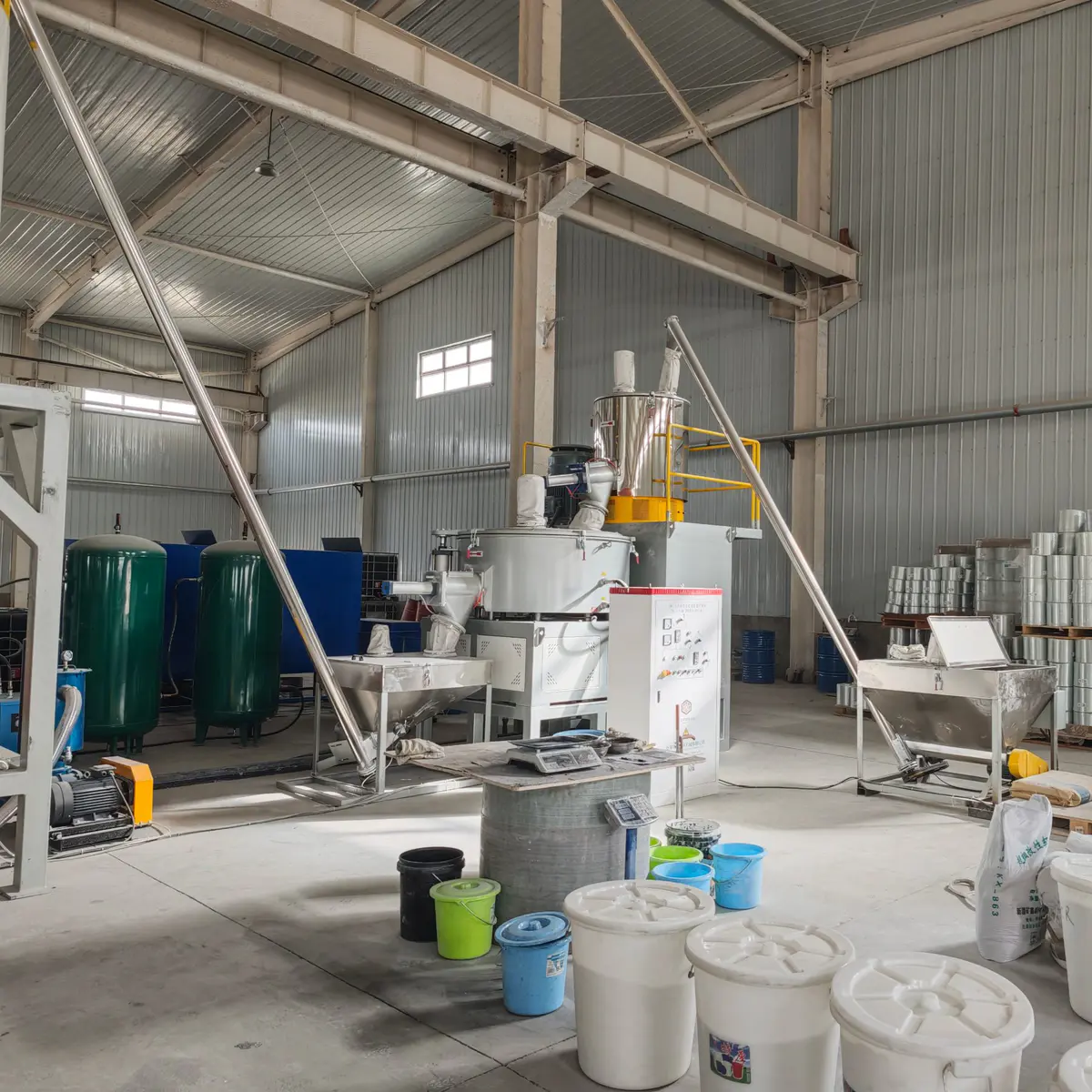
Four Details Size The Right Mixer
Rough numbers are fine. We confirm the rest with you before quoting.
Material / Formula
PVC Resin, CaCO3, Stabilizers, Additives
Batch Weight
kg / batch
Required Throughput
kg / h
Mixing System
High-Speed Mixer, Hot And Cold Mixer, Complete System
Get To The Right Mixing Setup Faster
Jump to whatever matters first, whether you are sizing a mixer to your extruder throughput, sorting out cooling and batch handling, or getting your formula in front of us for a configuration.
Material & Formula
PVC resin, CaCO3, stabilizers, additives
Mixing Equipment
High-speed, hot and cold, complete systems
Mixing Process
Heating, dispersion, cooling, discharge
Mixing Quality
Even dispersion, stable bulk density
Mixing Problems
Caking, uneven color, moisture, dust
Capacity Matching
Batch weight and kg/h to your line
Cooling & Handling
Cool the blend, store it, convey it
Cleaning & Changeover
Formula or color change in minutes
System Upgrade
Add or replace mixing on the line you run
Factory & Inspection
Built and run tested before shipment
FAQ
Voltage, lead time, warranty
Send Requirements
Send your formula, configuration in 24 hours
Start With Your Material Formula
The same mixer size performs very differently with different formulations. Before we recommend equipment, we look at what you are mixing, how much goes into each batch, and how the prepared blend reaches your extrusion line.
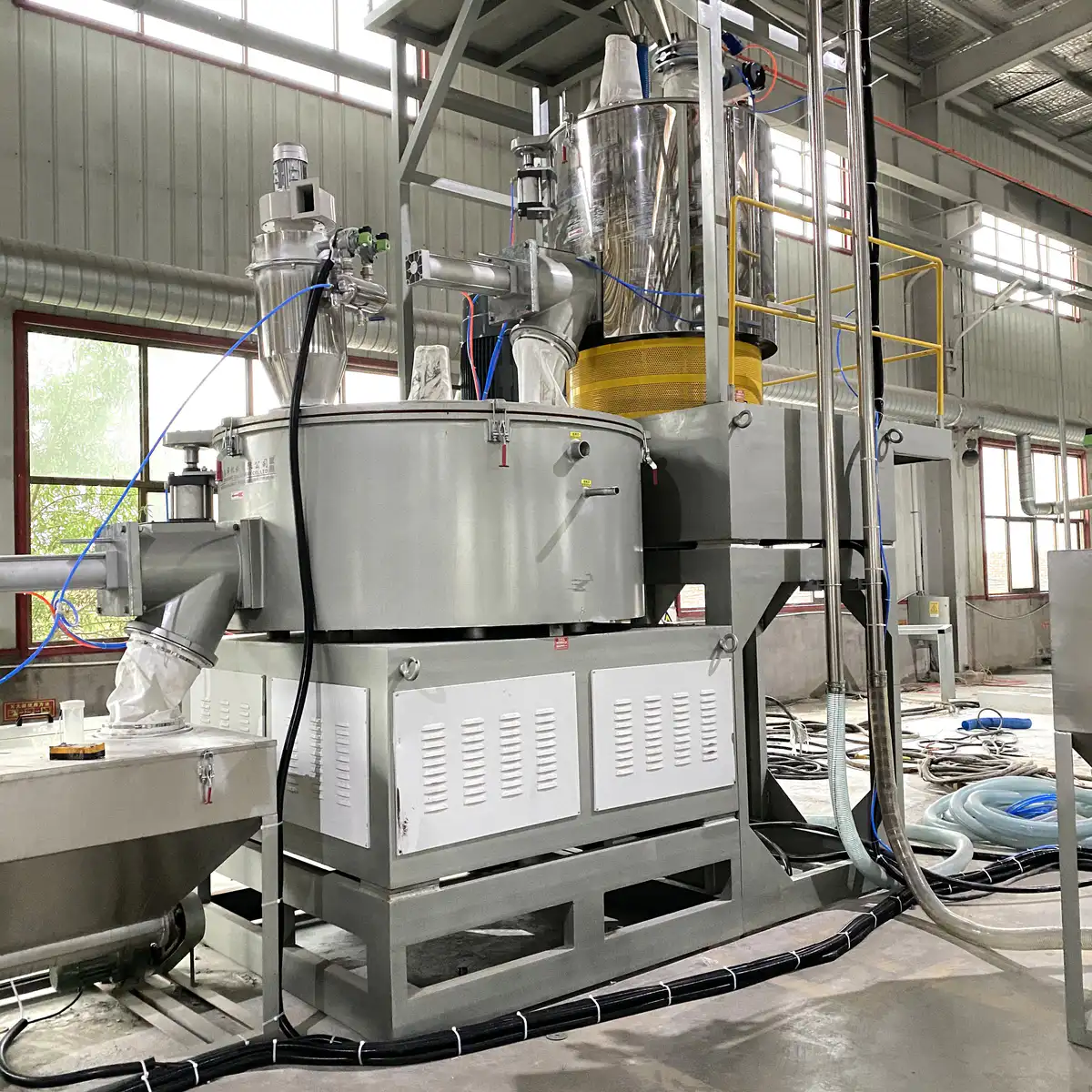
Resin, filler and additives weighed for one batch. The proportions decide the mixer size, the heating curve and the cooling time.
Formula Inputs
Typical PVC Dry Blend
PVC Resin
Base material, the largest share of every batch
High-Speed Mixing
Resin and additives are dispersed at high shear. Friction raises the batch temperature and drives the stabilizer and lubricant into the resin grain.
Heating & Cooling Process
The batch is heated to its discharge temperature, then dropped into the cooling mixer and brought down before it can cake or absorb moisture.
Dry Blend For Storage Or Extrusion
A free-flowing blend with stable bulk density, ready to go where your line needs it.
What We Need From You
Six details. Rough figures are fine, we confirm the numbers with you before the configuration is final.
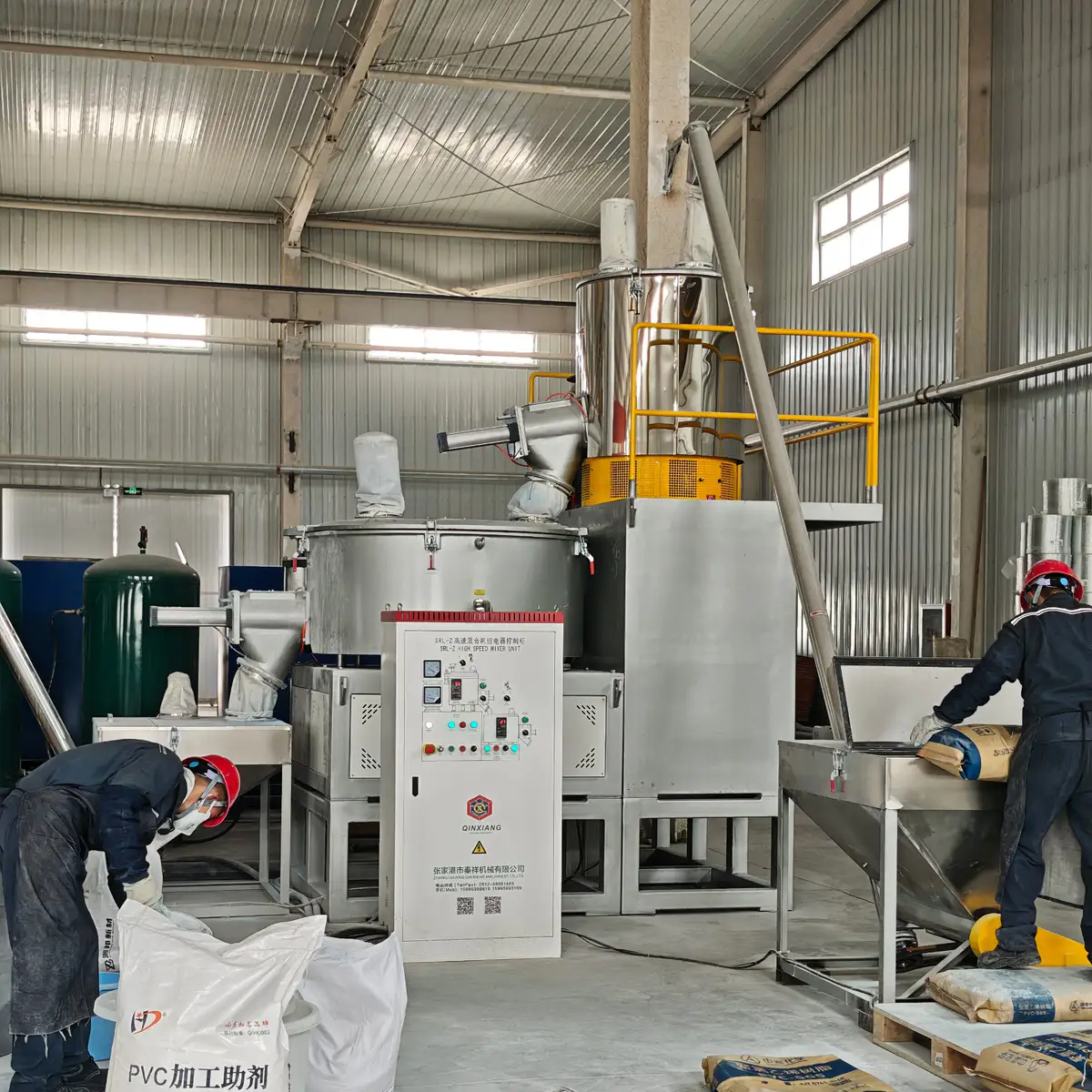
Send a photo of your formula sheet if that is easier than typing it out.
Base Material
PVC resin, PE, PP or another plastic. Rigid and soft PVC behave differently in the mixer, so say which one.
Formula & Filler Content
The main ingredients and their approximate proportions. This matters most when your formula carries a high share of CaCO3 or other fillers, because filler changes bulk density and the heat the batch generates.
Material Form
Powder, pellets, liquid additives, or a combination. Liquid feeding needs its own dosing point on the mixer lid.
Batch Weight
How many kilograms you want to prepare in one batch. Together with your formula, this sets the working volume of the hot mixer.
Required Throughput
The kg/h of mixed material your line consumes in continuous production. Batch weight divided by cycle time has to stay above this figure.
Extruder Capacity
Your downstream extrusion output, or the extruder model. It tells us whether one mixing cycle keeps the line supplied or whether you need a larger unit or a buffer silo.
Mixer Selection Starts From The Formulation, Batch Process And Required Throughput, Not Vessel Volume Alone
Two factories can buy the same 500 L mixer and get different results. Send us the formula and the numbers, and we size the mixer to what your line actually consumes.
Choose The Right Mixing Equipment For Your Process
Different mixing stages need different machines. What you configure depends on whether you need intensive blending, controlled heating, fast cooling, or the full hot and cold cycle before the blend goes to storage or extrusion.
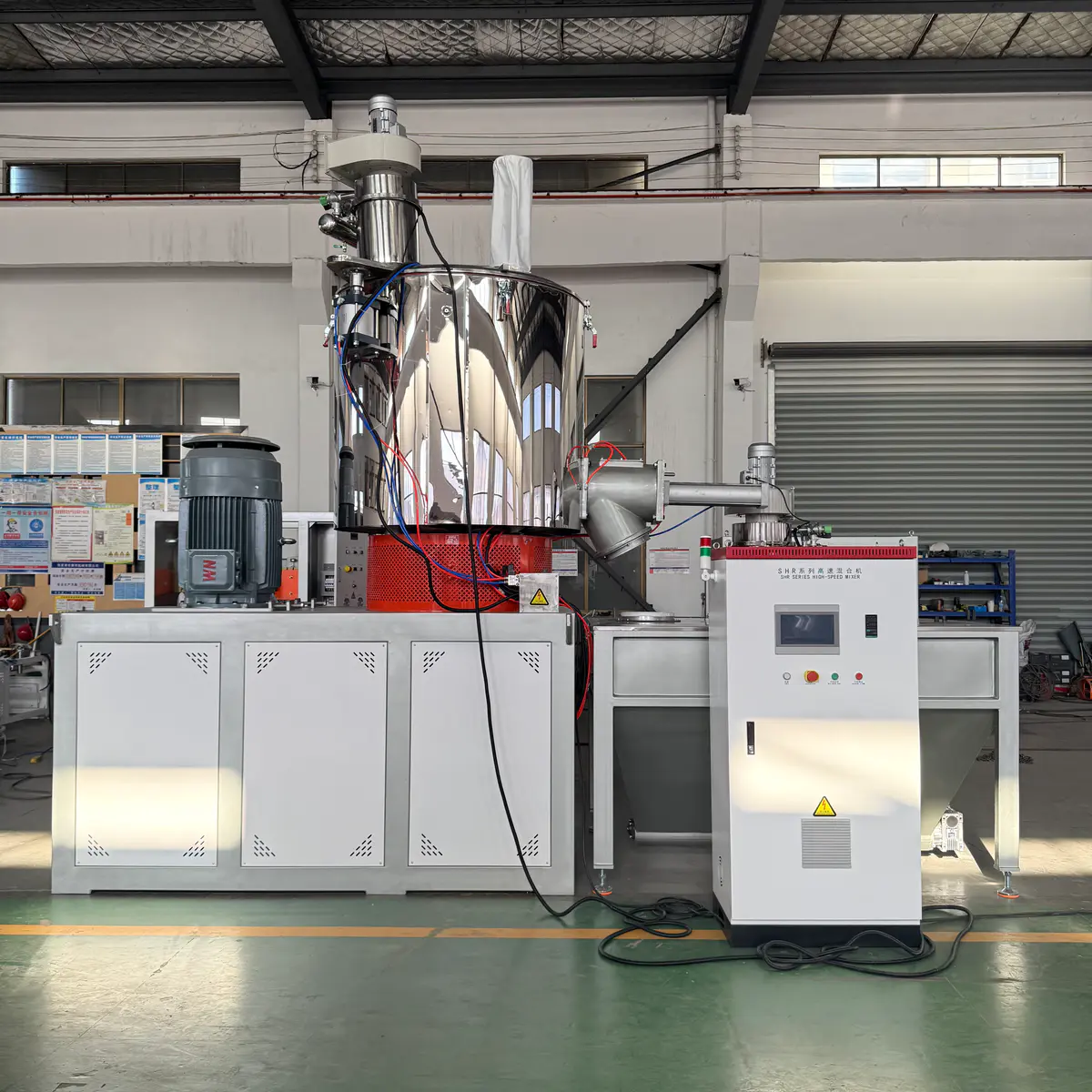
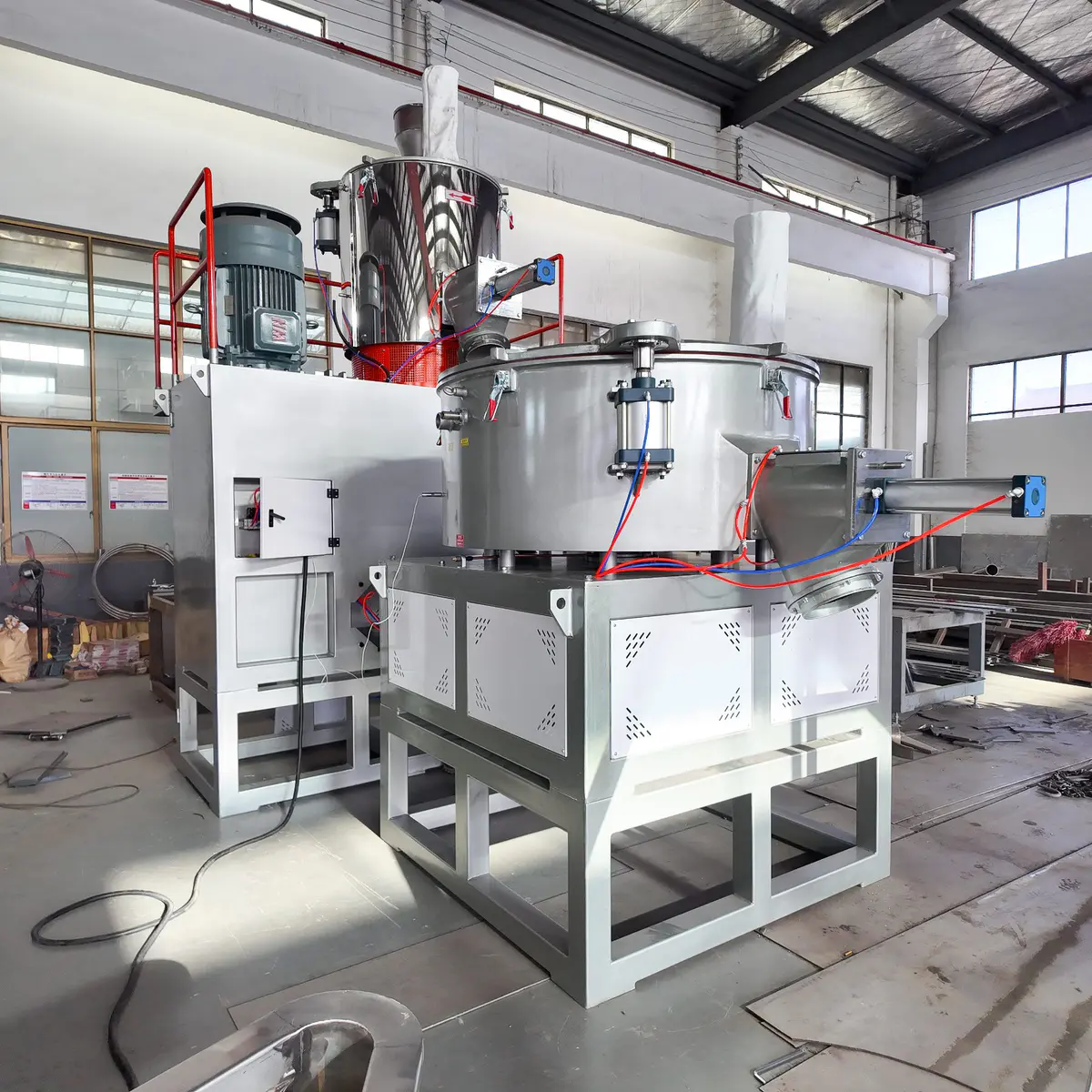
High-Speed Heating Mixer
Built for intensive mixing, additive dispersion and a controlled temperature rise while you prepare the dry blend.
You use a high-speed mixer when resin, filler, stabilizer, lubricant, pigment and other additives have to be distributed evenly inside one batch, fast. The blade speed and the friction it creates do the heating, no external jacket needed for most PVC formulas.
Best Suited For
Heating & Cooling Mixer Unit
High-speed hot mixing paired with a separate cooling stage, the standard setup for PVC pipe compound.
The hot mixer prepares and disperses your formula, then discharges into the cooling mixer, which pulls the accumulated heat out before the blend moves to storage, conveying or the extruder. Cooling stops caking and lets the next hot batch start while the previous one is still cooling.
Best Suited For
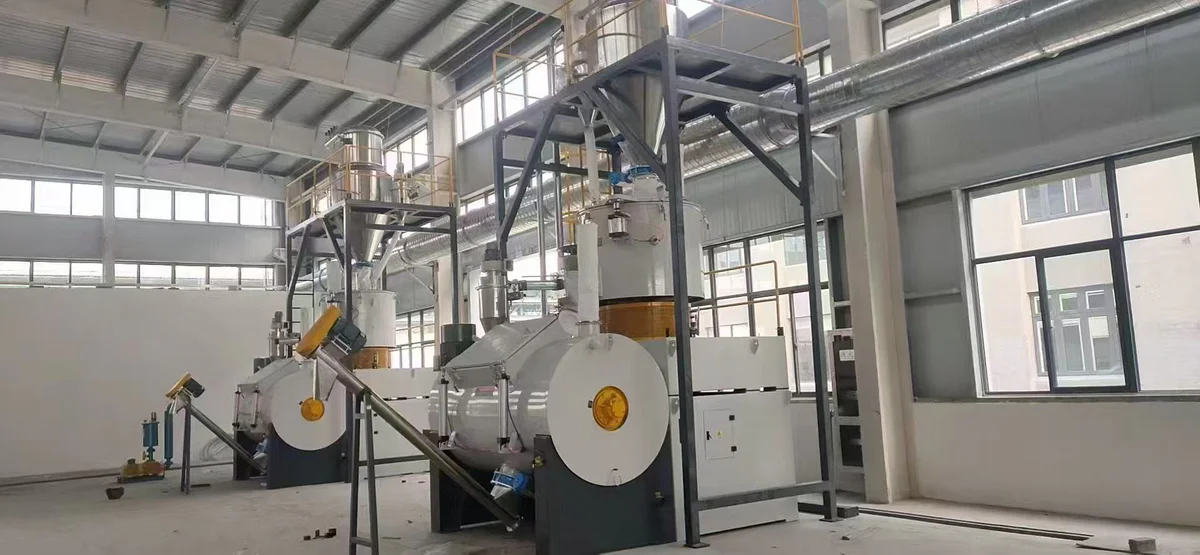
Horizontal Cooling Mixer
For lines where cooling capacity, not hot mixing, is what limits the cycle.
When your throughput goes up or your batches get larger, the cooling stage is usually the first to fall behind. A horizontal cooling mixer gives you more jacket surface and a larger working volume, so it pairs with a high-speed mixer when you need faster heat removal between batches.
Best Suited For
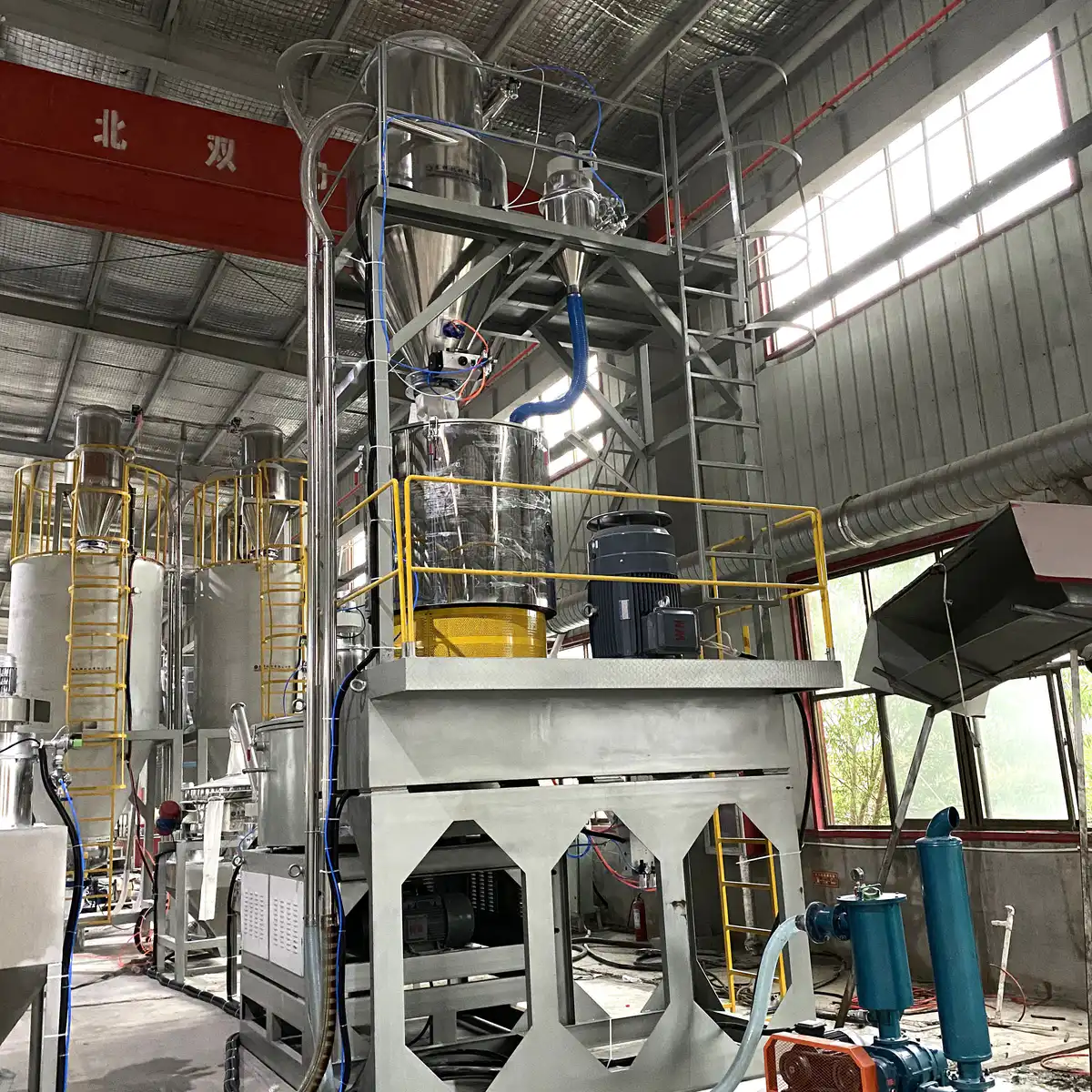
Vertical Cooling Mixer
A compact cooling setup for plants where floor space, access and easy cleaning matter.
The vertical vessel takes less floor area and opens from the top, so cleaning between formulas is quicker and the operator can reach the blades without dismantling anything. Paired with a high-speed mixer, it completes the full heating and cooling cycle in a smaller footprint.
Best Suited For
Not sure which combination fits your batch weight and kg/h? Send the formula and we recommend the pairing.
How Hot And Cold Mixing Works
For PVC dry blend, mixing is not just combining ingredients. Your material has to be dispersed under a controlled process, discharged at the right condition, then cooled before it moves to storage, conveying or extrusion. Tap a numbered point to follow the batch.
Raw Materials
PVC resin, fillers, stabilizers, lubricants, pigments and additives go in through the lid, in sequence. Resin first, powders next, liquid additives once the batch is warm enough to absorb them.
Watch: charging sequence and fill level. Overfilling kills circulation.
High-Speed Mixing
The blades run at high speed and set up an intensive vortex, pulling material up the vessel wall and back down the center. Every particle passes the blade zone many times per minute.
Watch: blade speed and motor load. Two speeds let you charge gently and mix hard.
Dispersion & Controlled Heating
Friction raises the batch temperature along a curve. Stabilizer and lubricant melt onto the resin grain, filler is worked in, and the blend gains bulk density as it heats.
Watch: temperature against time. A flat curve means poor circulation or a wet formula.
Process Endpoint Reached
The batch reaches its discharge condition. That endpoint is set by temperature for your formula, not by a fixed timer, so every batch leaves the hot mixer in the same state.
Watch: discharge temperature setpoint. It changes with resin grade and filler share.
Automatic Discharge
The pneumatic discharge valve opens and the whole batch drops into the cooling mixer within seconds. The hot mixer is empty and ready for the next charge while cooling continues below.
Watch: discharge time and valve seal. A slow drop cools the batch in the wrong vessel.
Cooling Mixer
A larger, slower vessel with a water-cooled jacket receives the hot batch. The bigger working volume spreads the blend thin over cooled surface, which is what makes heat removal fast.
Watch: cooling volume to hot volume ratio. Too small and the cycle waits on cooling.
Controlled Cooling
Slow paddles turn the blend against the jacket while chilled water circulates. Heat leaves the batch before it can cake, pick up moisture, or arrive in the silo still warm.
Watch: cooling water temperature and flow. Warm water in summer stretches every cycle.
Dry Blend Ready
A free-flowing blend at storage temperature discharges to the silo, the conveying system, or straight to the extruder hopper. The next hot batch is already on its way down.
Watch: discharge temperature into storage. Warm blend in a silo is where caking starts.
What Each Stage Has To Achieve
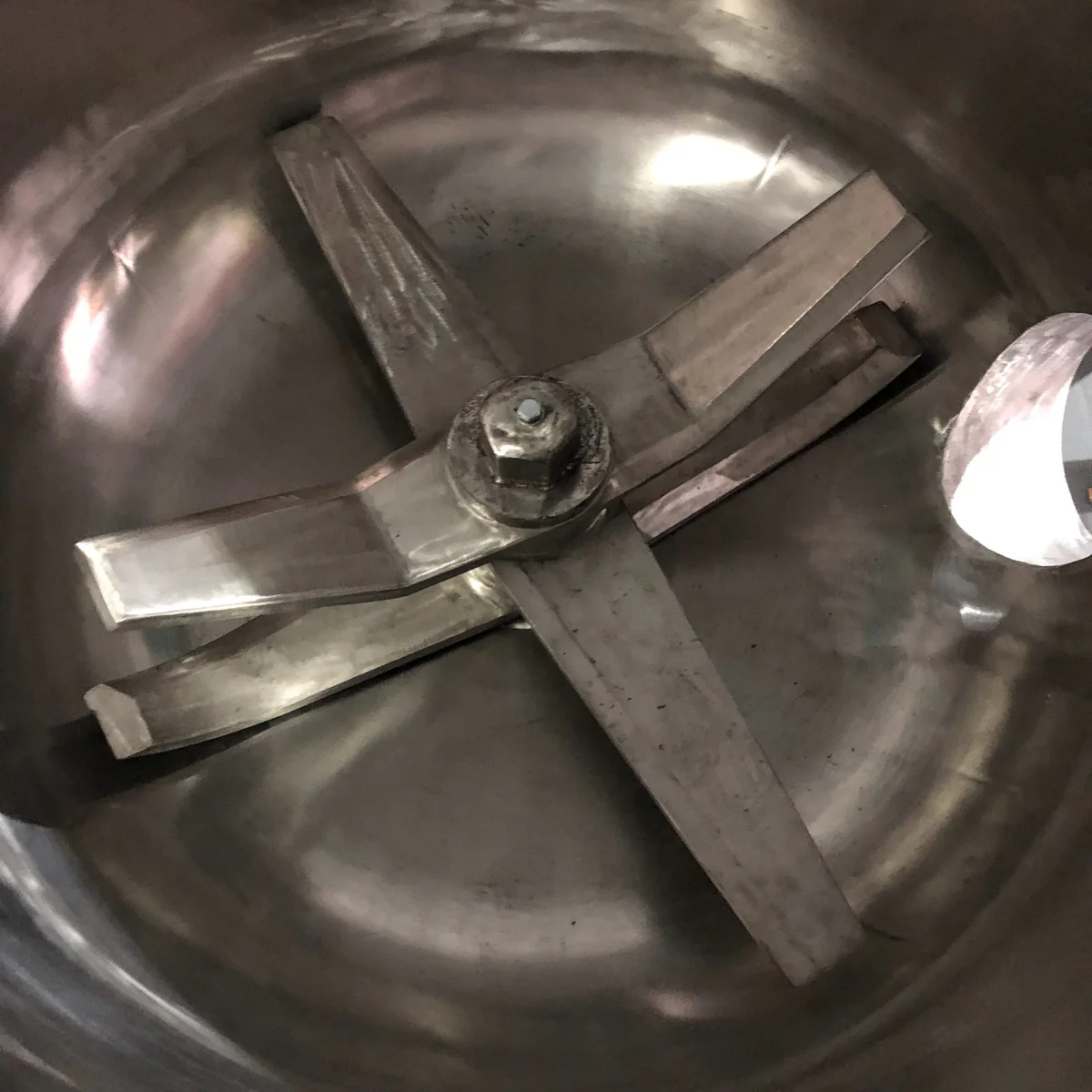
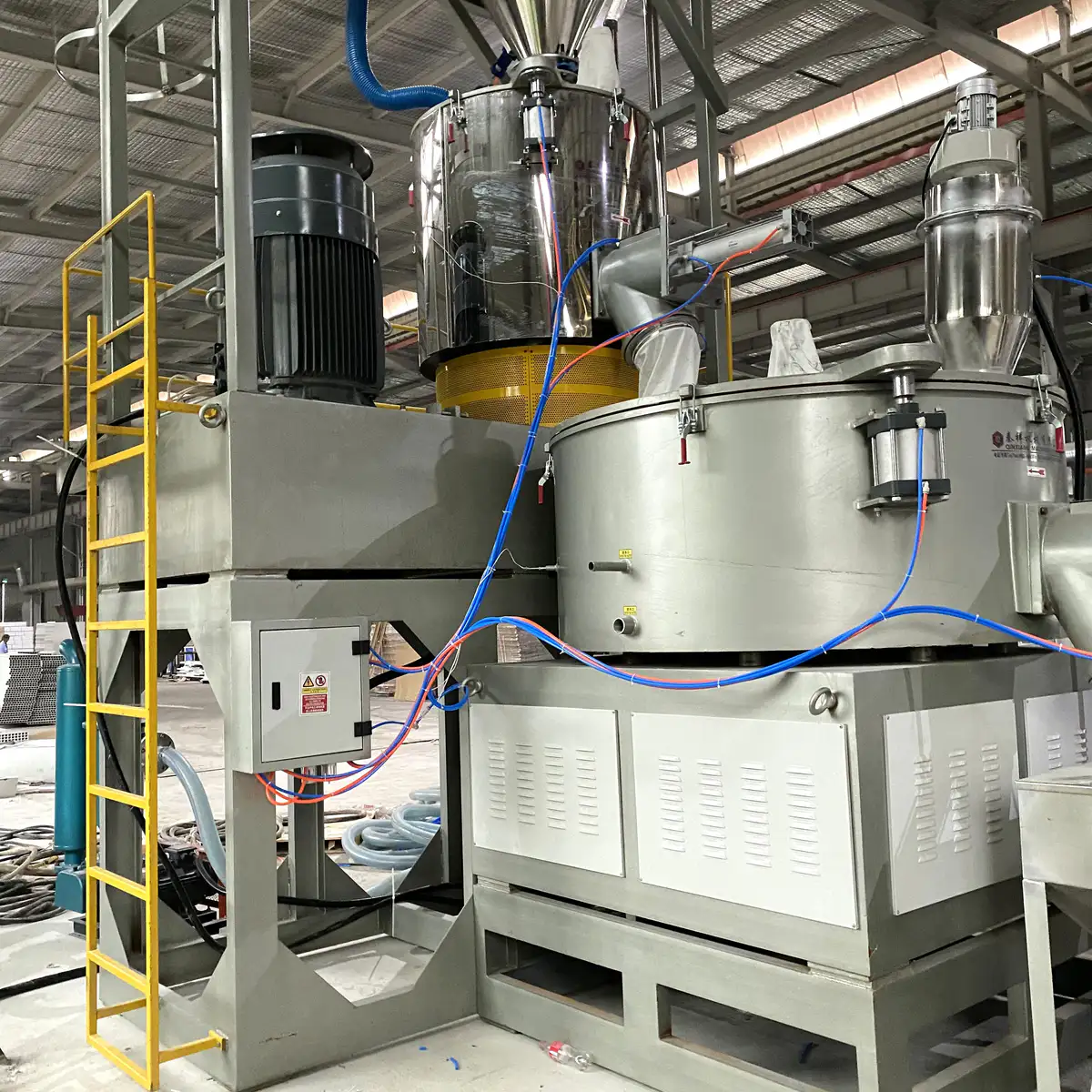
Hot Mixing
The high-speed mixer creates intensive circulation so resin, fillers and additives are distributed through the whole batch, not just around the blades.
The process is controlled around your formulation, not around a fixed time. Mixing speed, fill level, charging sequence, mixing time and temperature all change the condition of the finished blend, so the recipe for the mixer matters as much as the recipe for the material.
Main Objectives
- Uniform distribution
- Additive dispersion
- Controlled temperature rise
- Repeatable batch condition
Cooling
The blend still carries most of the heat from hot mixing when it drops. Cooling takes that heat out before the dry blend reaches a silo, a conveying line or the extruder.
An undersized or slow cooling stage stretches your whole batch cycle, because the hot mixer has to wait. It can also leave warm material sitting at a temperature that is wrong for storage or transfer, which is where caking and moisture pickup start.
Main Objectives
- Heat removal
- Stable discharge condition
- Reduced agglomeration risk
- Faster batch turnover
The Mixing Cycle Must Work As One Process
Hot mixing capacity alone does not set the output of your system. Charging, mixing, discharge and cooling time together decide how many batches you get per hour.
So the heating mixer and cooling mixer are matched as one process. Pick them independently and the slower stage quietly sets your output, usually the cooling side.
One Batch Cycle
Charging
Resin, powders, then liquids
Hot Mixing
Run to the endpoint temperature
Discharge
Seconds, if the valve is right
Cooling
Usually the longest segment
Batches Per Hour
60 ÷ Total Cycle Time (min)
System Output (kg/h)
Batch Weight (kg) × Batches Per Hour
Your extruder kg/h has to sit below the second number with margin. That is the check we run before quoting.
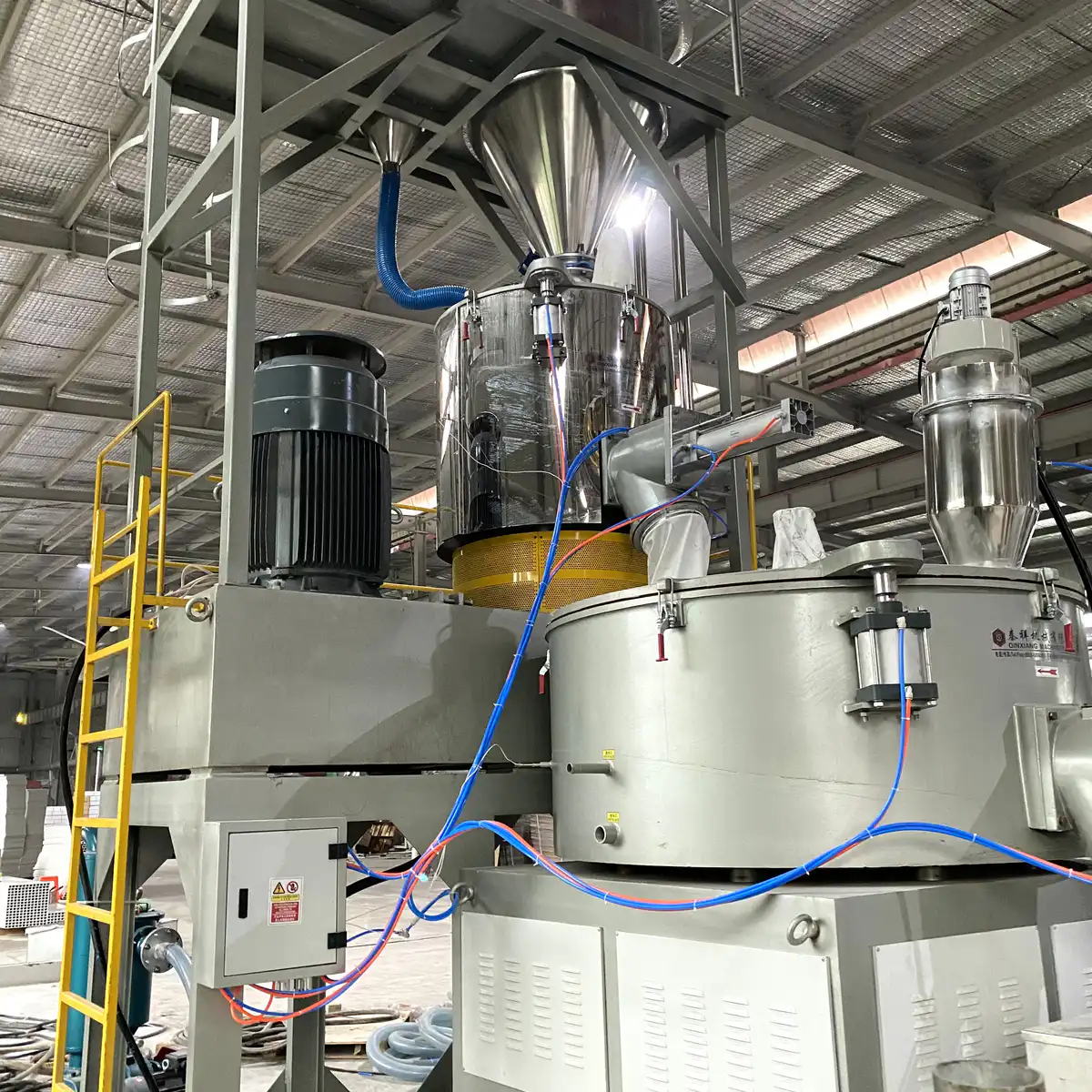
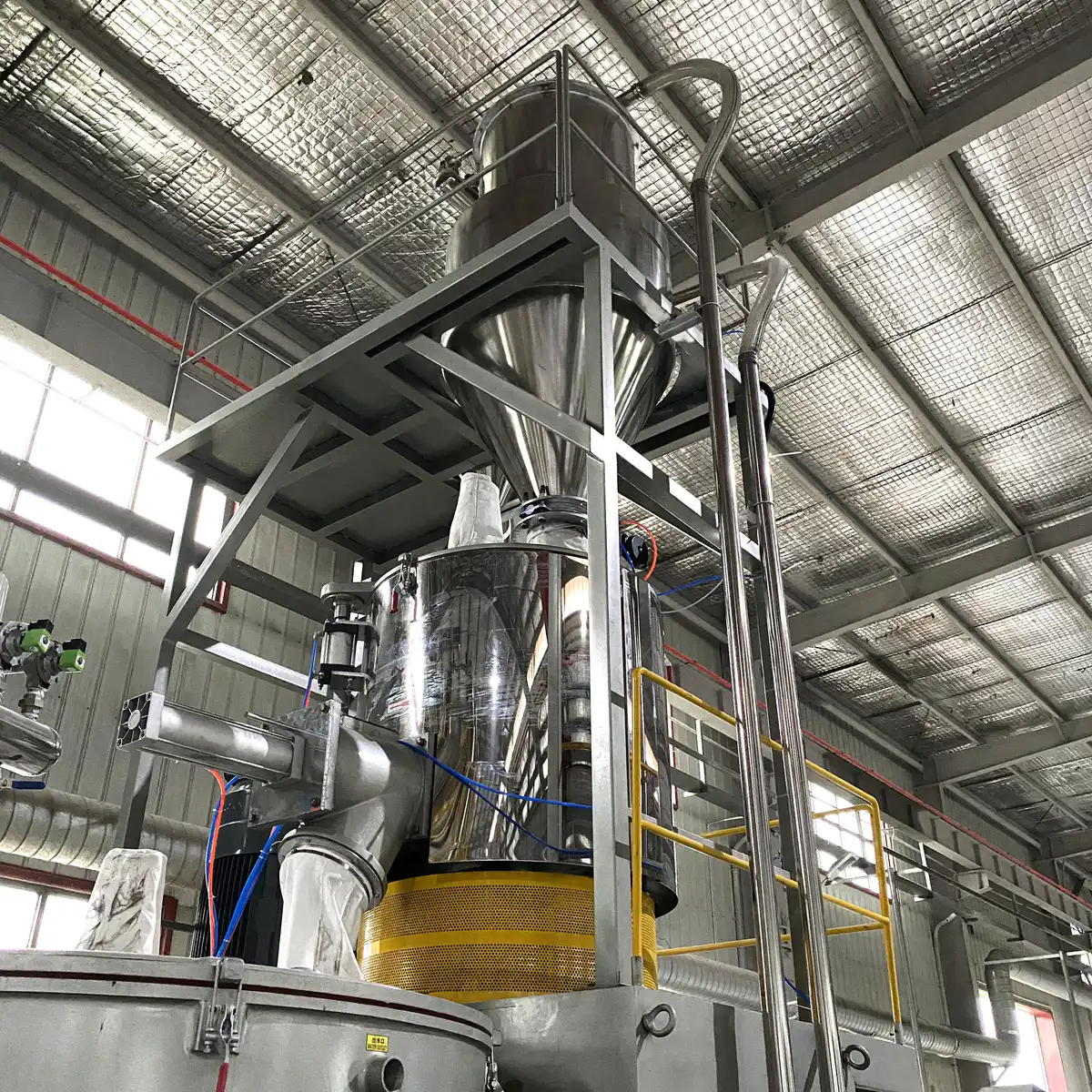
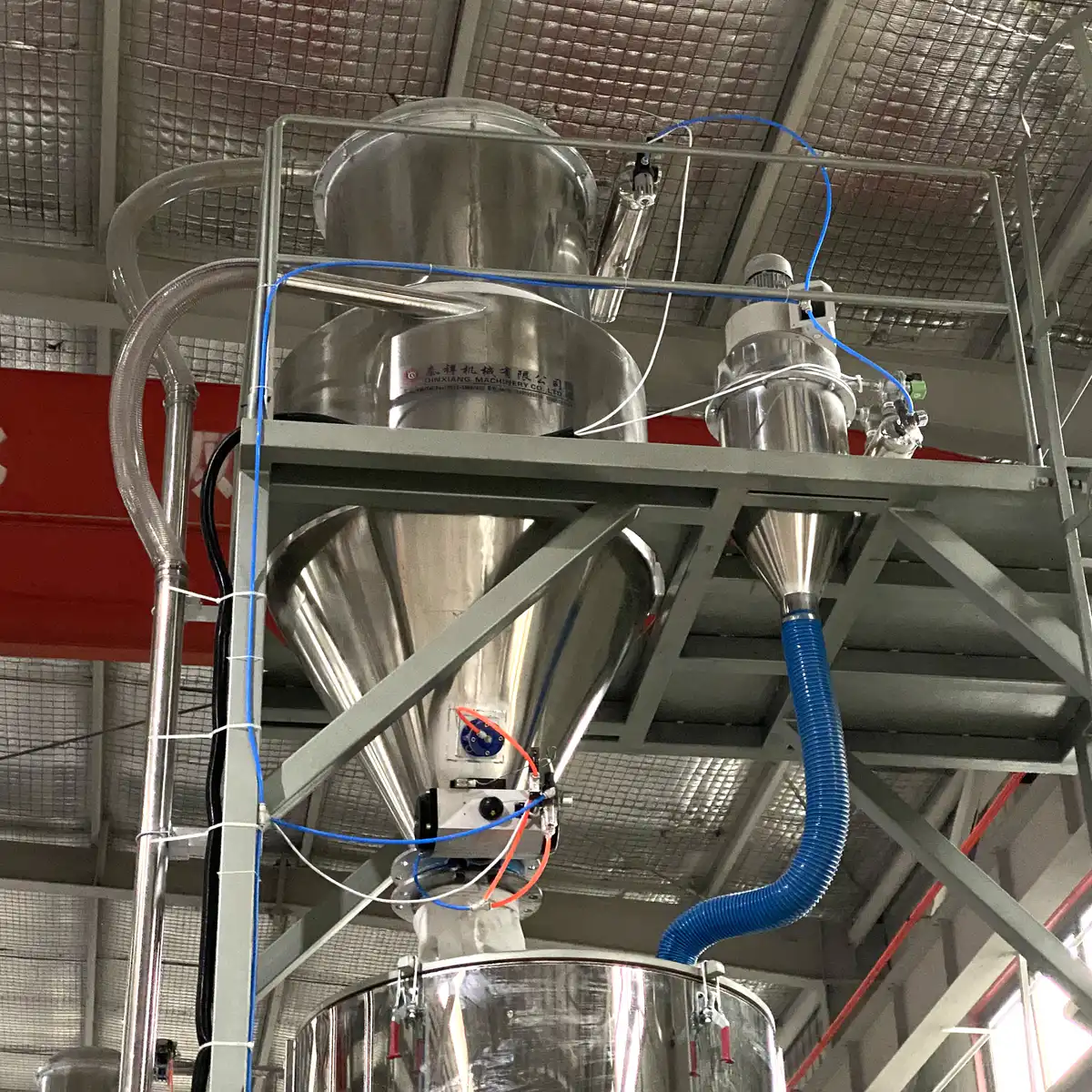
Judge Mixing Quality By The Finished Blend
A bigger motor or a higher blade speed does not automatically give you a better blend. What matters is the condition of the material leaving the mixer, and whether the next batch leaves in the same condition.
Five things to check before you sign off on a mixer, or on a supplier.
What Affects The Mixing Result?
These eight factors work together. Mixer RPM or motor power on its own cannot tell you what the finished blend will look like, so when you compare mixers, compare the whole picture.
- Blade Design
- Vessel Geometry
- Mixer Speed
- Fill Level
- Mixing Time
- Temperature
- Material Sequence
- Formula
Change one and the others shift with it. That is why we ask for the formula and the batch process before quoting a mixer size.
What Is Going Wrong In Your Mixing Process?
If your formula has not changed but material preparation is getting less stable, the cause is usually somewhere in dosing, mixing, cooling or transfer. Start from the symptom you see and work through the conditions that can produce it.
Formula Is Correct, But Results Still Vary
Same recipe, yet batches differ and the extruder needs adjusting more often than it used to.
Check
Additives Or Fillers Form Lumps
Powders enter the mixer correctly but do not disperse through the batch, leaving clumps in the blend.
Check
Hot Blend Agglomerates After Discharge
The dry blend leaves the mixer too warm and cakes during transfer or in the silo.
Check
Material Builds Up Inside The Mixer
Residue on the wall, around the discharge or in low-flow zones carries into the next batch and adds cleaning time.
Check
Dust Escapes During Mixing
Powder leaks at charging, venting or discharge points. You lose material and the area around the mixer needs constant cleaning.
Check
Batch Time Keeps Increasing
The same formula gradually takes longer to prepare. The mixer volume is rarely the reason.
Check
Check The Complete Process
A mixing problem should not be diagnosed from one machine parameter. The five stages influence each other, and the symptom often shows up two stages away from the cause.
When we review an existing system, we look at your formula, batch data, temperatures, cycle time and downstream production condition together before we recommend any equipment change.
Dosing
Right weight, every batch
Mixing
Dispersion and endpoint
Cooling
Heat out before transfer
Transfer
Conveying and storage
Extrusion
Where the symptom shows
Can The Mixer Keep Your Extruder Supplied?
Vessel volume does not tell you how many kilograms you can prepare per hour. Capacity comes from the usable batch weight, the real cycle time and what your extrusion line actually consumes. Put your numbers in and see where you land.
Step 1. Actual Mixing Throughput
Material per batch, not vessel volume.
Batches Per Hour
4.0
Actual Mixing Throughput
800
kg/hSame vessel, different formula or cooling cycle, different number.
Step 2. Match It To Extruder Demand
Mixing Throughput
800
kg/hFrom step 1 above.
Your line output, or the extruder rating.
Operating Margin
Comfortable+60
%Enough headroom for cycle variation and a slower cooling cycle in summer.
If your extruder needs 500 kg/h, a mixing system rated at exactly 500 kg/h leaves no room once charging, cooling, transfer and normal production variation are counted. We size for margin, then check that the cooling side can hold it.
What Affects Actual Capacity?
Six things move the kg/h figure, and only one of them is the size of the vessel.
Batch Weight
The usable material weight per batch, not the total vessel volume. Fill level and bulk density decide the difference.
Mixing Cycle
The time to charge, mix and reach the process endpoint. Charging by hand adds minutes you will not see on the mixer datasheet.
Cooling Capacity
Slow cooling becomes the limiting stage even when the hot mixer has plenty of capacity. Water temperature in summer counts here too.
Material Transfer
Discharge, hot-to-cold transfer, silo loading and downstream feeding all sit inside the cycle. Any one of them can hold the next batch.
Formula
Filler level, additives and material characteristics change the practical batch condition and the cycle time. High CaCO3 blends heat and cool differently.
Production Margin
Reserve capacity absorbs normal swings in cycle time and downstream demand. Without it, every slow batch shows up at the extruder.
Hot And Cold Mixers Must Be Matched Together
In a heating and cooling system the hot mixer and the cooling mixer usually work on different batches at the same time. Your hourly capacity is therefore set by the slowest stage of the complete cycle, not by the biggest vessel.
A larger hot mixer will not raise your output if the cooling mixer, the transfer system or the downstream feeding cannot keep pace with it.
Select the mixing system by kg per batch, cycle time and required kg/h, not by vessel volume alone.
Two Mixers, Overlapping Batches
The hot mixer finishes batch 3 while the cooling mixer is still on batch 2. From here on, the cooling side sets how much blend reaches the extruder per hour.
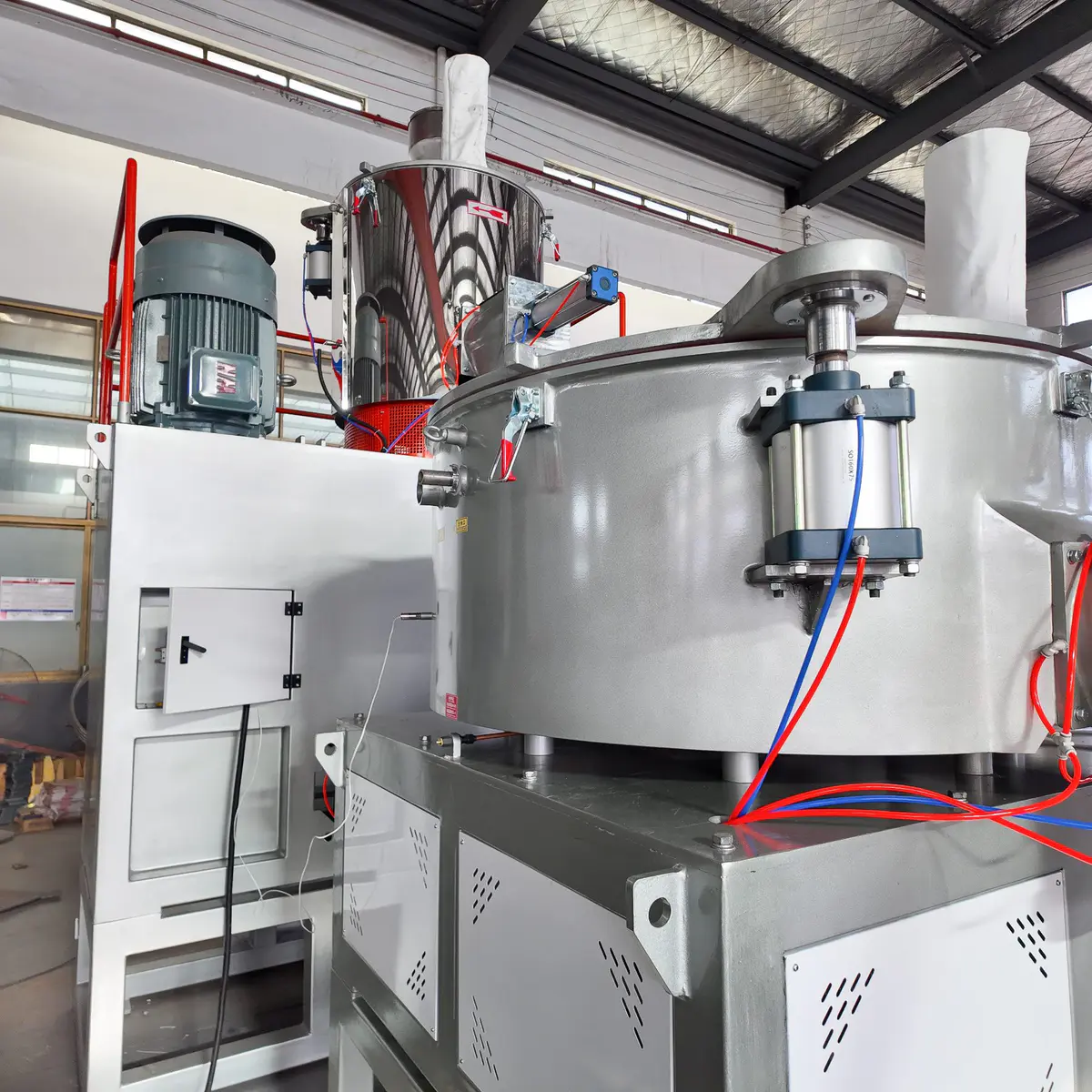
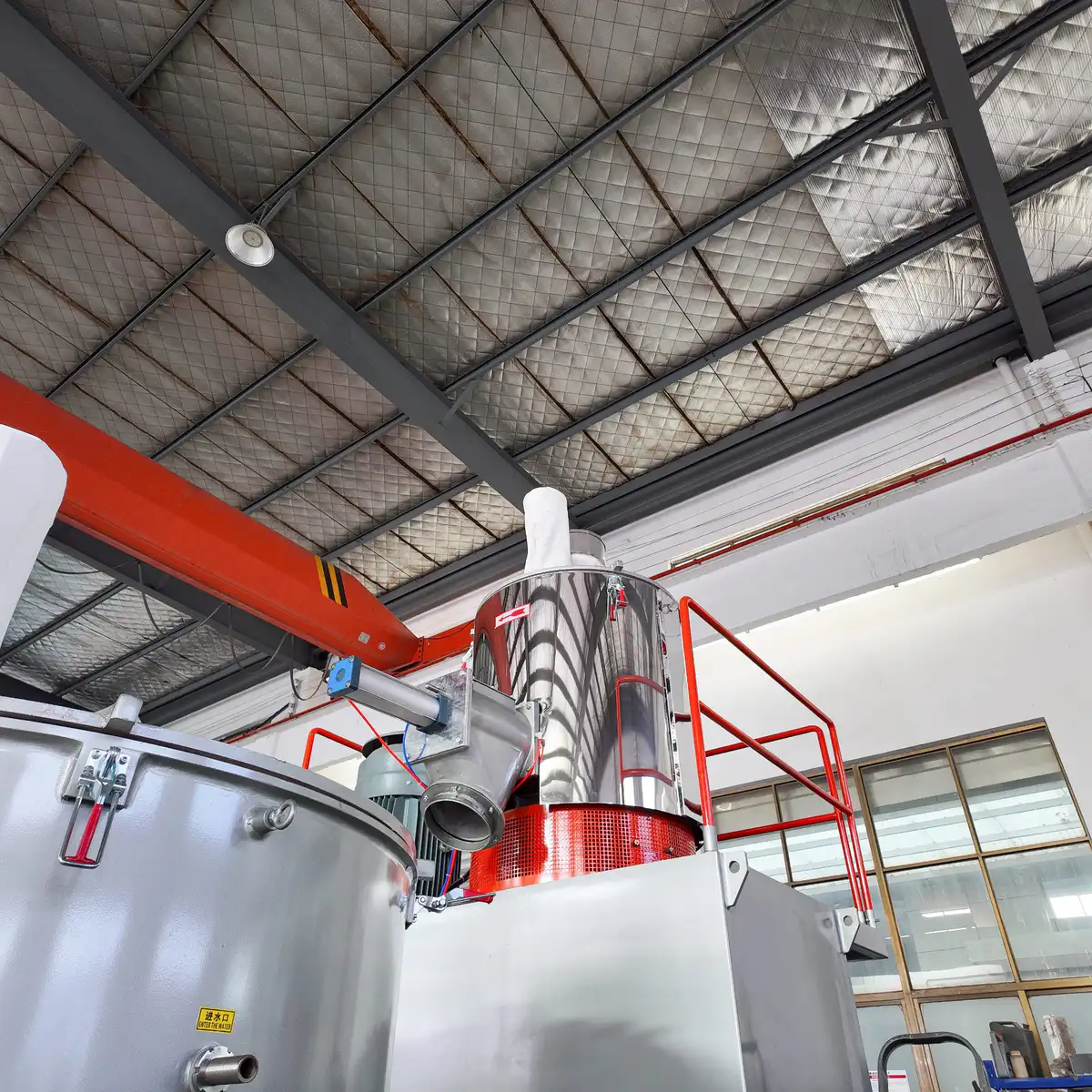
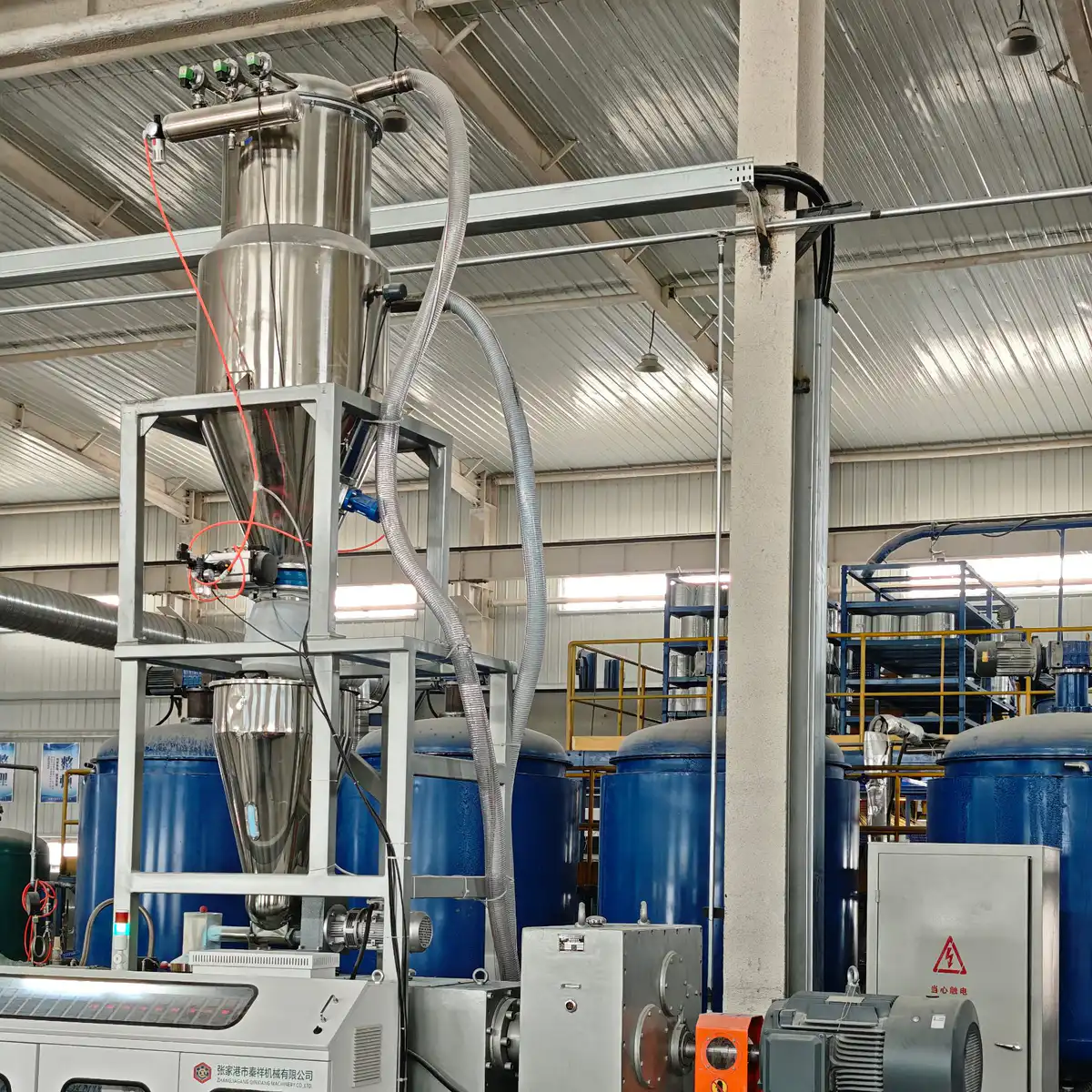
Control Cooling, Dust And Material Flow
The mixer does not work on its own. Cooling water, air handling and material transfer decide how smoothly each batch moves from mixing to storage or the extruder, and any of the three can quietly become your bottleneck.
Keep The Whole Material Path Balanced
A faster mixer does nothing for your output if cooling or transfer becomes the next bottleneck. We match these stages as one material-preparation system, so the number on the quote is the number you get on the floor.
Change Formula Without Carrying The Last Batch Forward
Whatever stays in the mixer ends up in your next batch. That is a small problem when the recipe is the same and a real one when you switch color, filler level or formula. So we treat cleaning as part of the mixing process, not as something the maintenance team deals with on Saturday.
You Should Be Able To See And Reach Every Surface Powder Touches
Cleaning takes as long as the hardest place to reach. If the operator needs a torch, a mirror or a spanner to check the shaft seal, that check gets skipped on a busy shift.
Powder collects in the same places on every mixer: the vessel wall above the fill line, the underside of the blades, around the shaft, the discharge opening, and in the filter. Each of those should open or come off without tools.
Check
The First Batch After A Changeover Tells You How Clean The Mixer Was
If discharge and cleaning were incomplete, the leftover material shows up in the next recipe. Three changeovers catch people out most often:
Your changeover procedure should follow the mixer, not a generic checklist: how much residue is typically left, where it collects, and which parts have to be cleaned before the next recipe starts. How often you change over decides how much of this is worth automating.
Check
The Best Cleaning Job Is The One The Mixer Does Not Need
Easy access helps, but a mixer that holds less material back between batches helps more. The difference is made in the design, not in the cleaning routine.
A polished vessel wall with no steps or welds for powder to sit on. A bottom blade that sweeps the floor of the vessel instead of leaving a ring around the edge. A discharge valve that opens fully, so the batch drops in one go rather than draining through a gap.
Get those three right and a color change becomes a quick wipe and a purge batch, instead of an hour with the lid open and the line waiting.
Running several colors or formulas on one mixer? Tell us how often you change over and we configure the vessel, blades and discharge for it.
Upgrade Your Mixing System Around The Existing Line
When material preparation becomes the bottleneck, the extruder behind it is usually fine. You do not need a new line. You need to find where the capacity is leaking and change that one part.
If your current mixer cannot keep up any more, we start with the batch data, not with a quote. Pick the symptom on the left and see which upgrade normally fixes it.
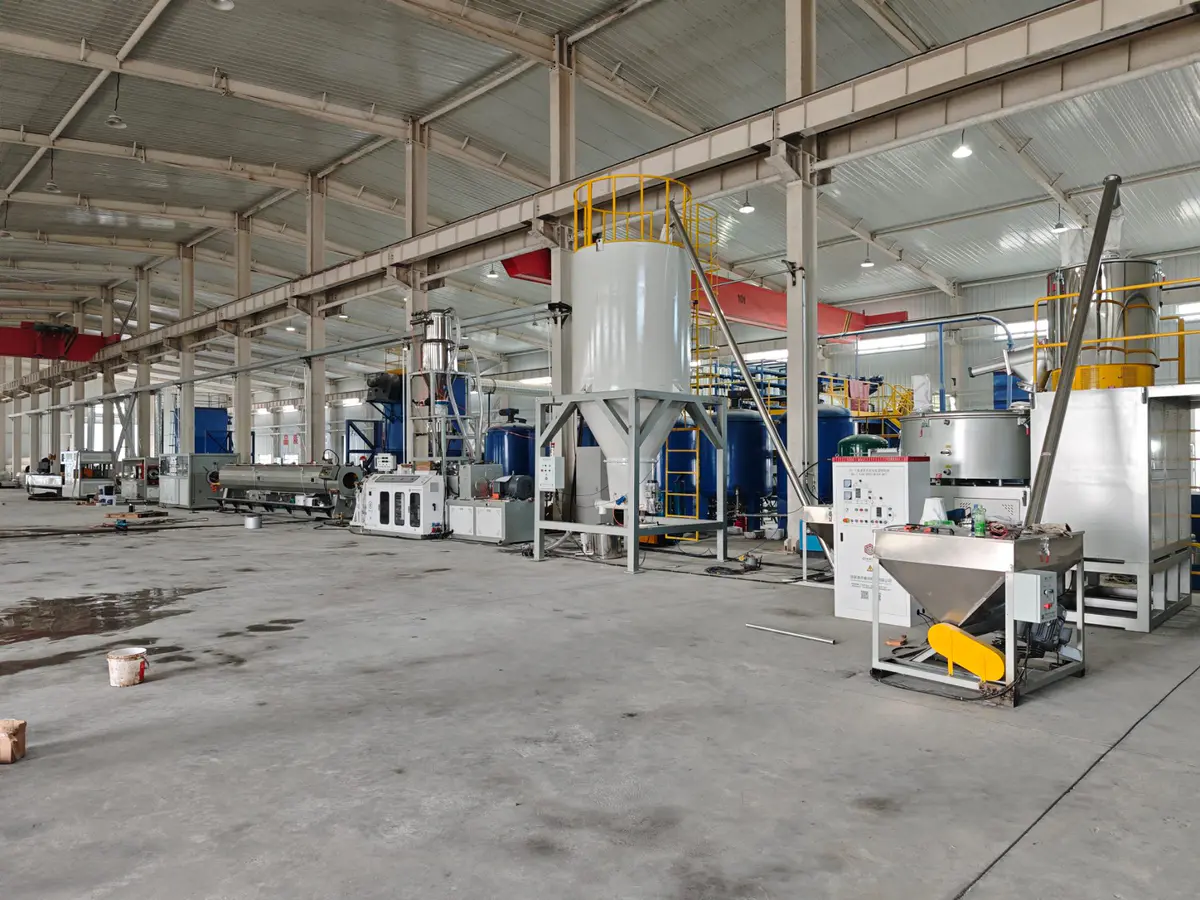
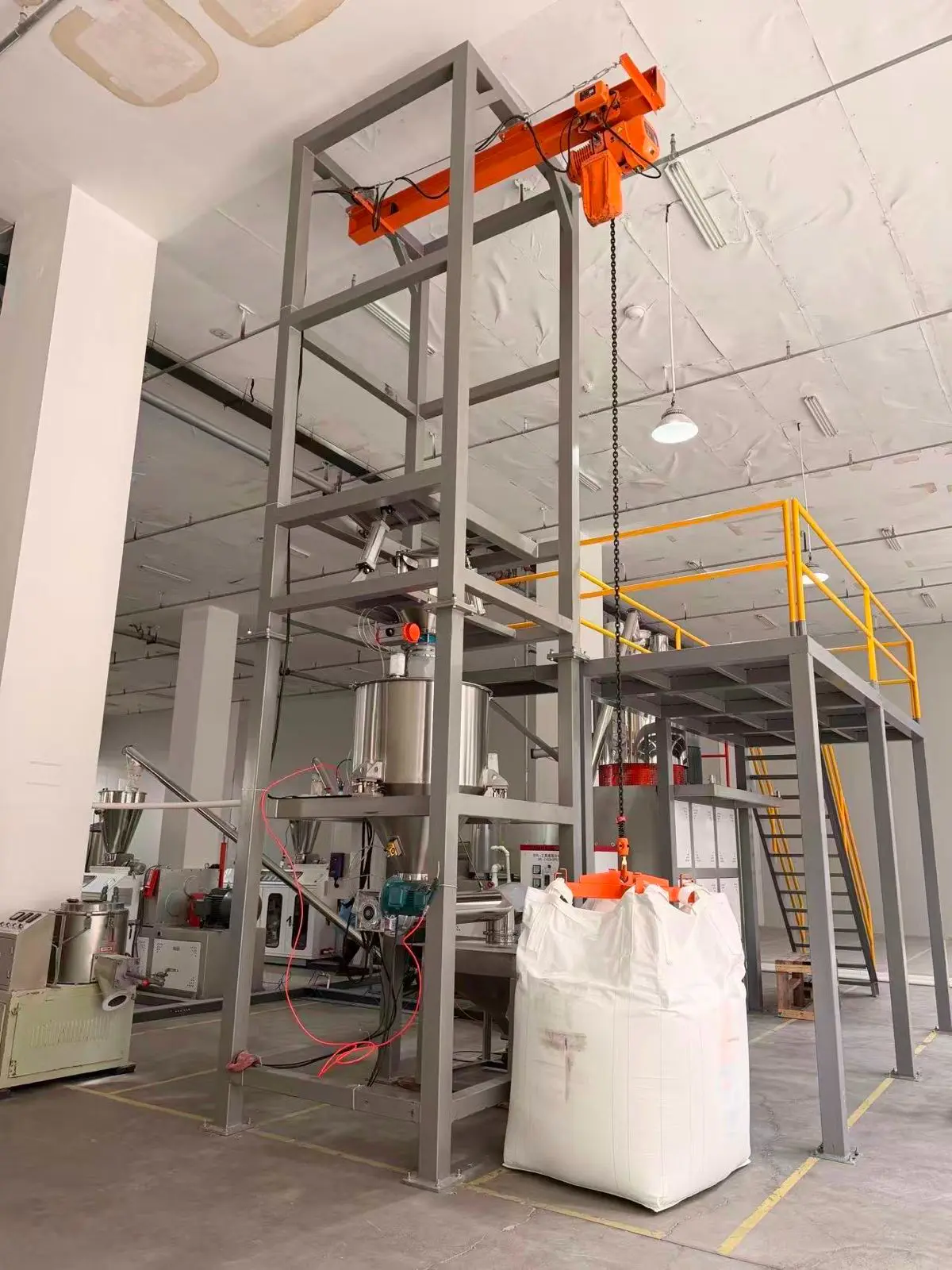
Existing hot mixer kept, cooling mixer and loading added. The most common upgrade we ship.
Where Is The Bottleneck?
What Can Be Upgraded?
Send us your current mixer model, batch weight and extruder output. We tell you which of these five you need, and which you do not.
See How Your Mixing Equipment Is Built
Vessel fabrication, cooling-jacket welding, blade and shaft machining, assembly and electrical integration all happen in our own workshop. The attention goes to the parts that decide how your material circulates, how cleanly it discharges, how fast it cools, and how many years the machine runs. You can come and watch, or we send you the photos and the test video of your machine.
Zhangjiagang City, Jiangsu, China
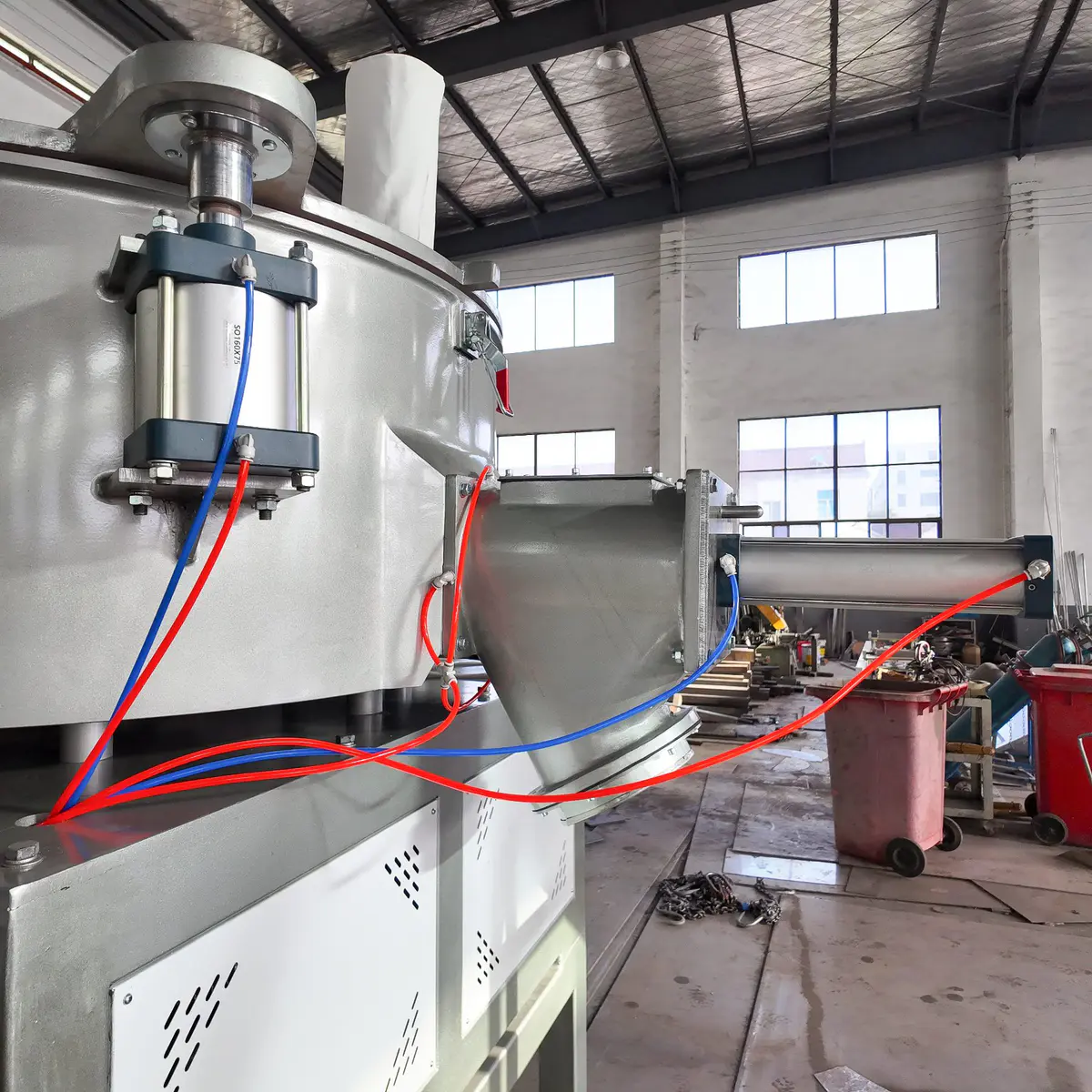
Tested With Your Formula, Not An Empty Vessel
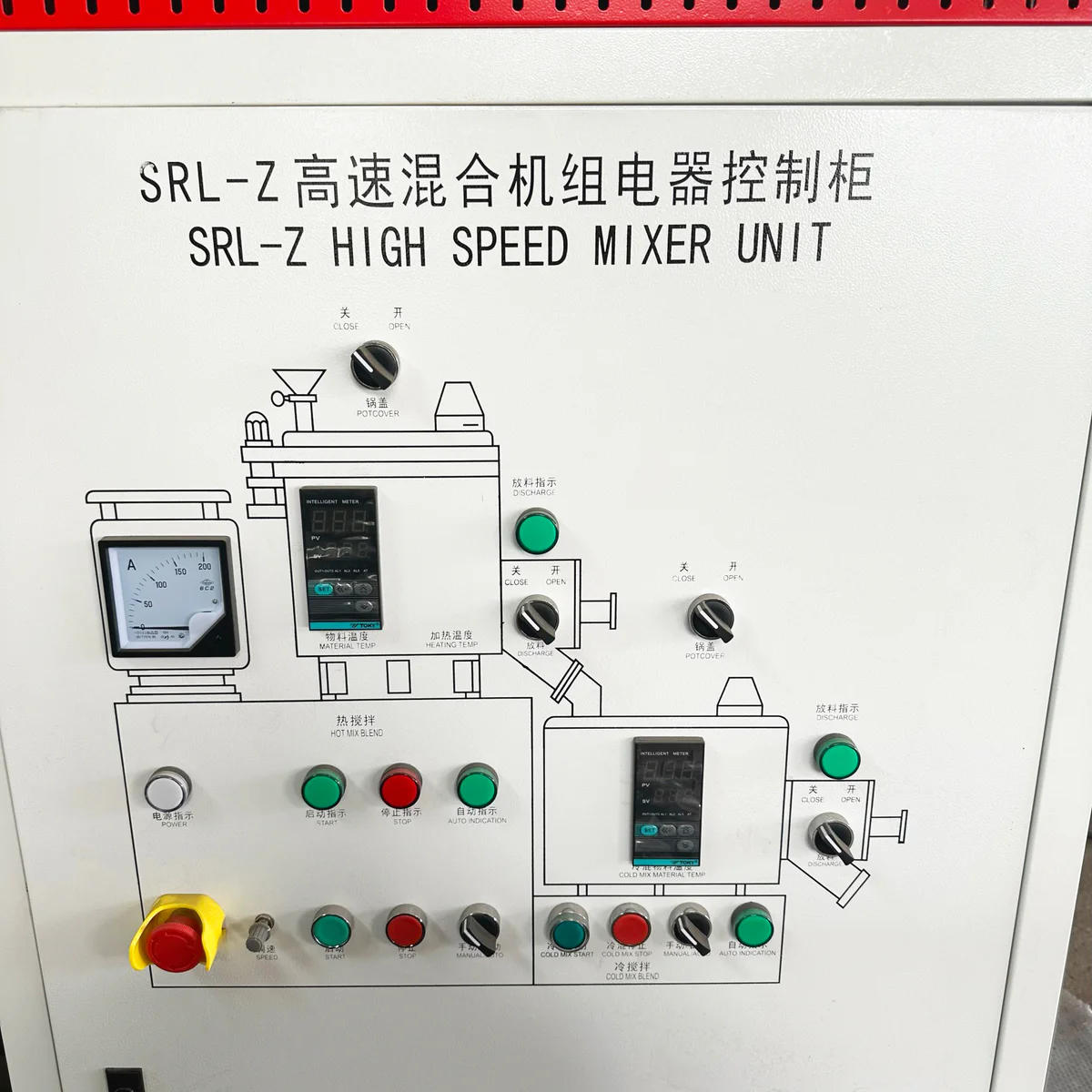
Every unit runs a full batch cycle here before crating. If you send a bag of your material, we run that. You get the photos, the batch record and a video of the test before you pay the balance.
Vessel And Contact Surfaces
Weld seams ground, inner wall polished, no steps or pockets where powder can sit.
Blade Balance And Clearance
Blades balanced, bottom clearance set, no vibration at full speed with a loaded vessel.
Shaft Seal And Discharge Valve
No powder past the seal, valve opens fully and closes tight after the batch drops.
Cooling Jacket Pressure Test
Jacket pressure tested for leaks, water in and out checked for flow.
Temperature And Sequence Control
Sensors calibrated, discharge at setpoint, hot to cold sequence runs unattended.
Voltage And Standard For Your Market
Motors, cabinet and safety devices built to your local voltage, frequency and standard.
What We Check Before The Mixer Leaves The Factory
Confirming that the motor starts is not an inspection. Before shipment the mixer is checked as a complete working system: the rotating assembly, temperature control, discharge, cooling circuit, sealing and the automatic sequence. Eight steps, each one signed off before the next.
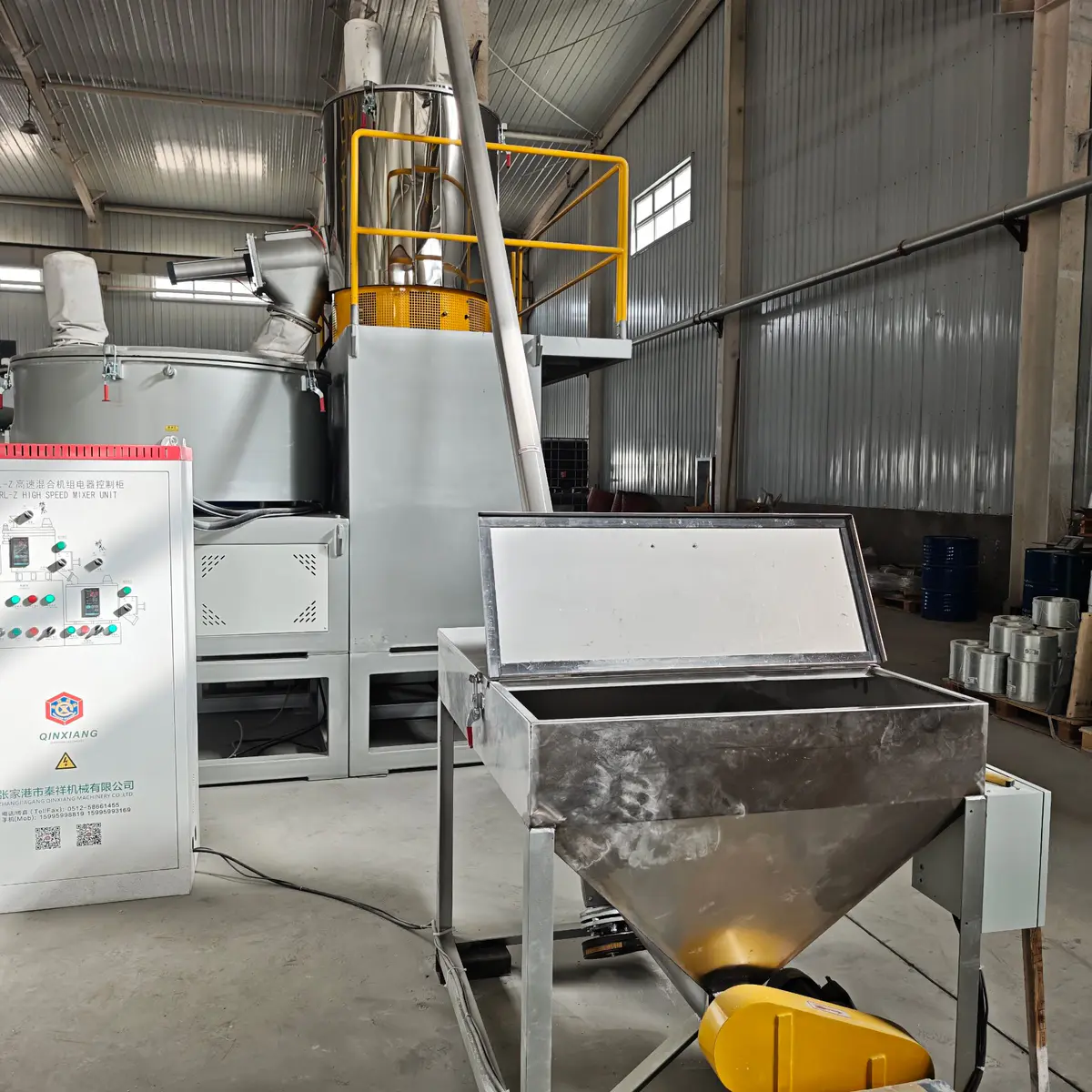
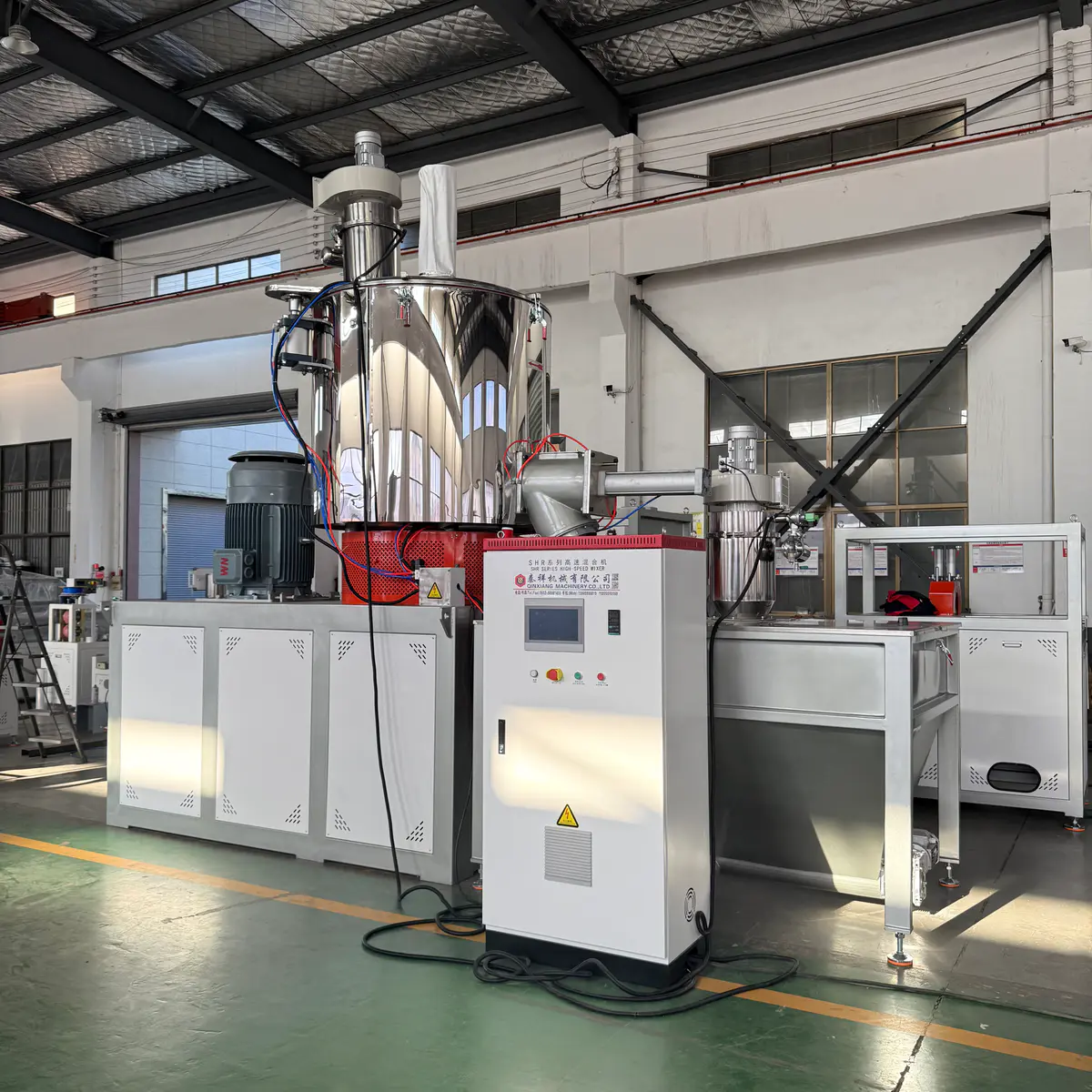
Blade & Shaft Assembly
01 / 08
Blade & Shaft Assembly
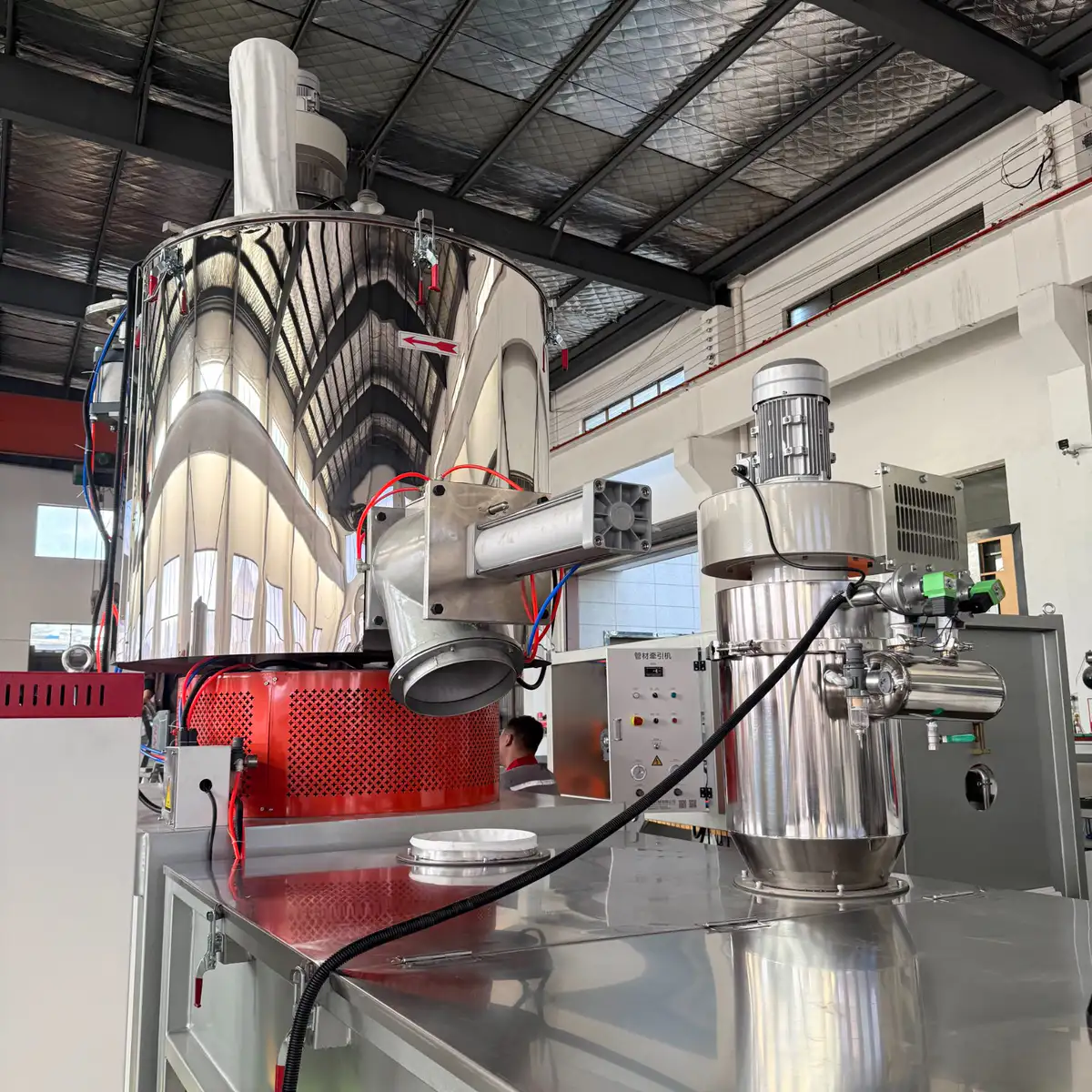
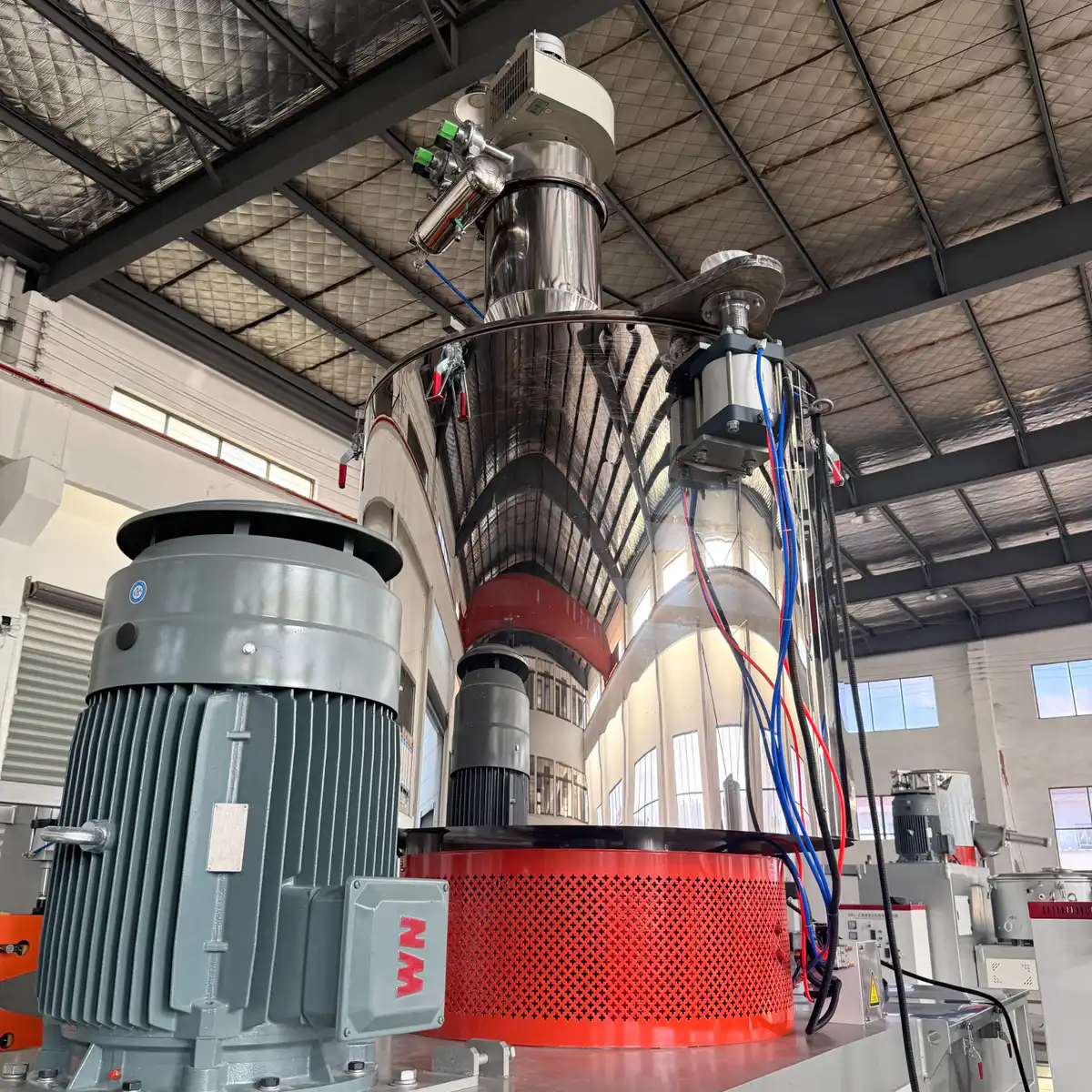
Blade installation, shaft alignment, fastening and free rotation are checked by hand before the drive is ever switched on. A blade that is a few millimeters off shows up later as vibration, wear and uneven mixing.
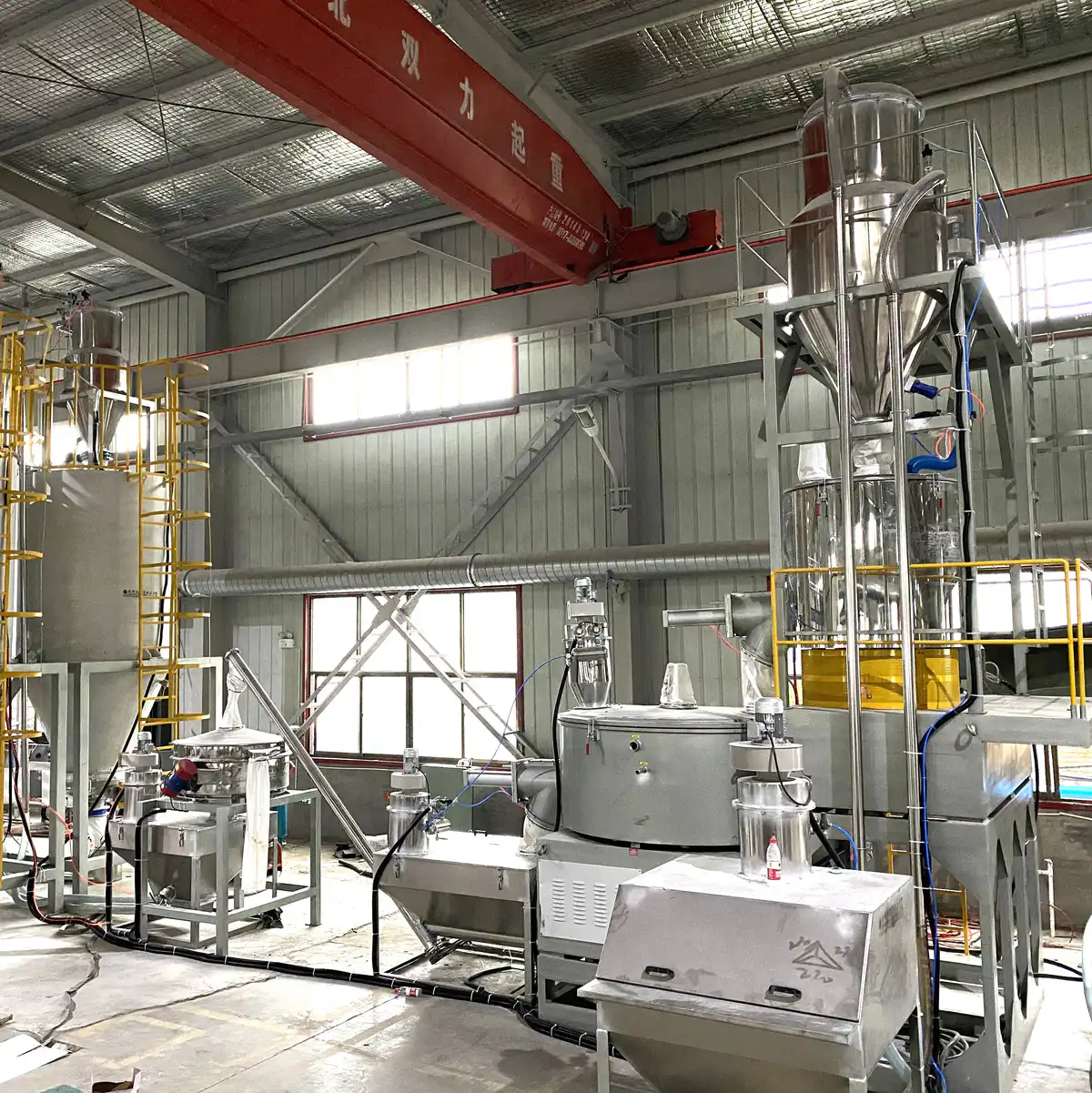
No-Load Running Test
The mixer runs empty at operating speed while we watch the drive. Vibration, noise, motor current, bearing temperature and rotation direction are all recorded before any material goes in.
Temperature Control
The sensor, the display and the setpoint response are checked together, then the discharge signal is triggered from temperature to confirm the batch will leave when it should, not when a timer says so.
Discharge System
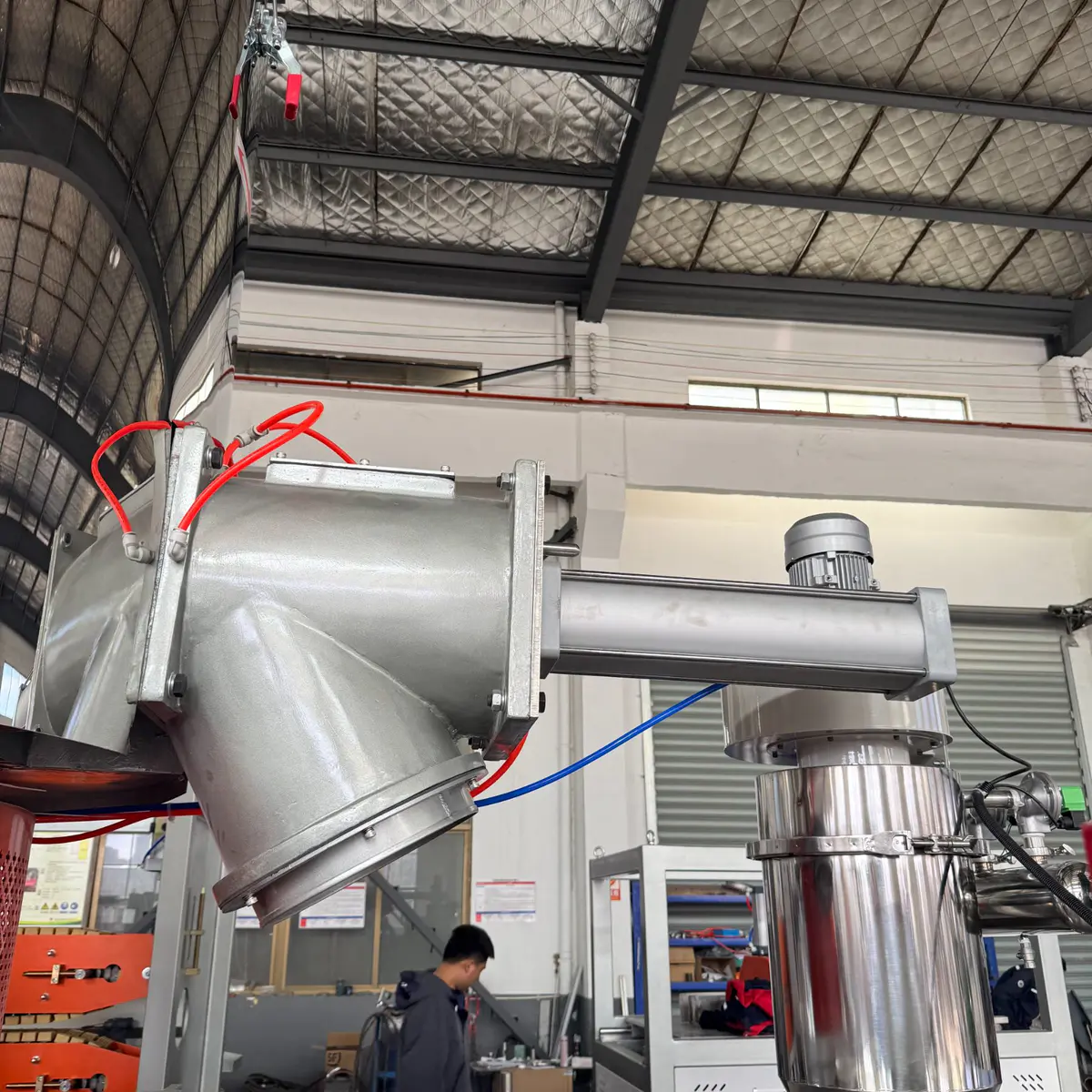
The discharge valve is cycled again and again. We confirm it opens fully, returns to the closed position every time, and that the interlock stops the mixer from running with the valve open.
Cooling Circuit
Water goes through the jacket before the machine is crated. Inlet and outlet, jacket, joints and circulation are checked for flow and for leaks, so the first thing you see on site is not a puddle.
Sealing & Dust Control
Every place powder can get out is inspected: the shaft seal, the vessel and lid seal, the filter and aspiration connections, and the discharge seal. Dust on the floor around a new mixer is a sealing fault, not a fact of life.
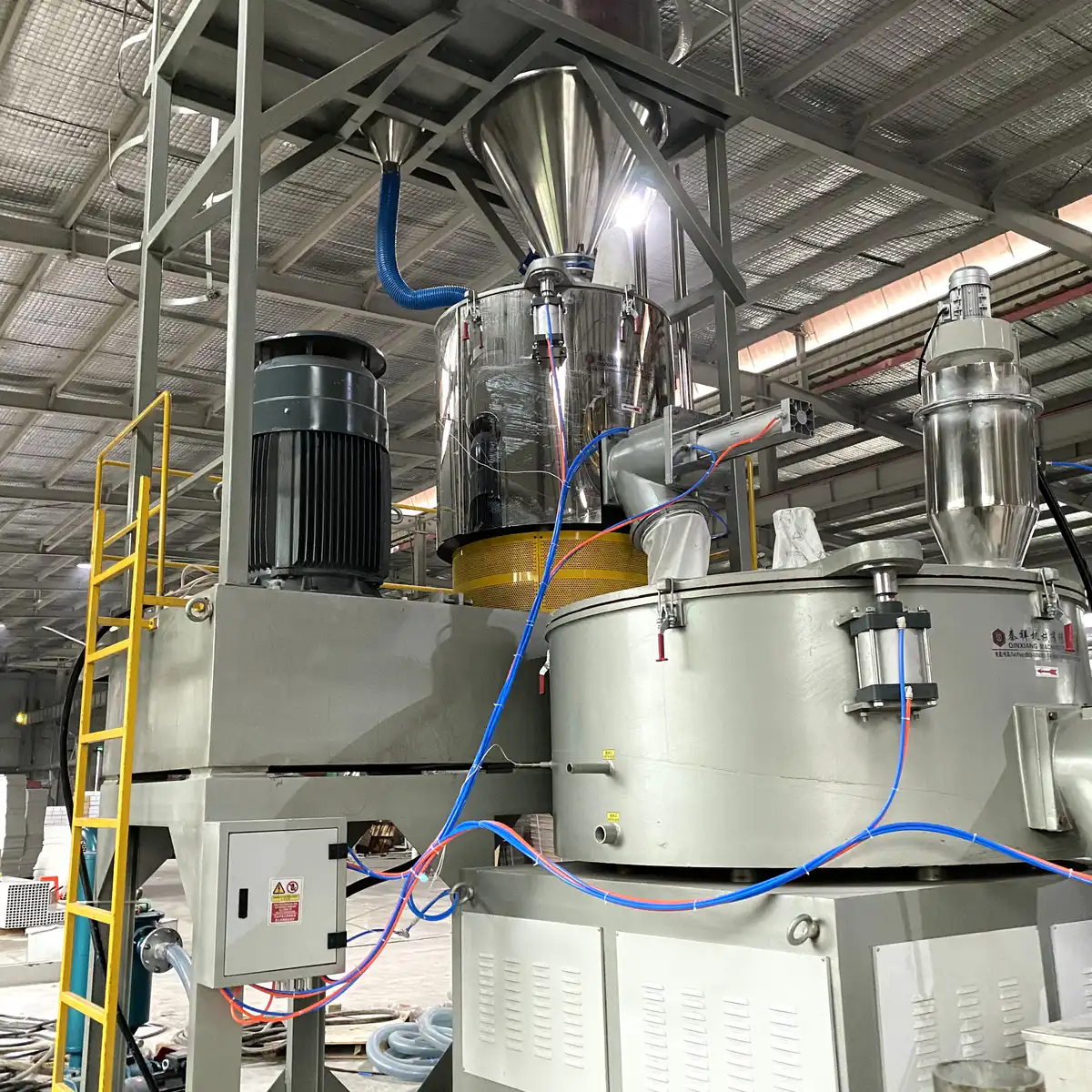
Electrical & Safety Functions
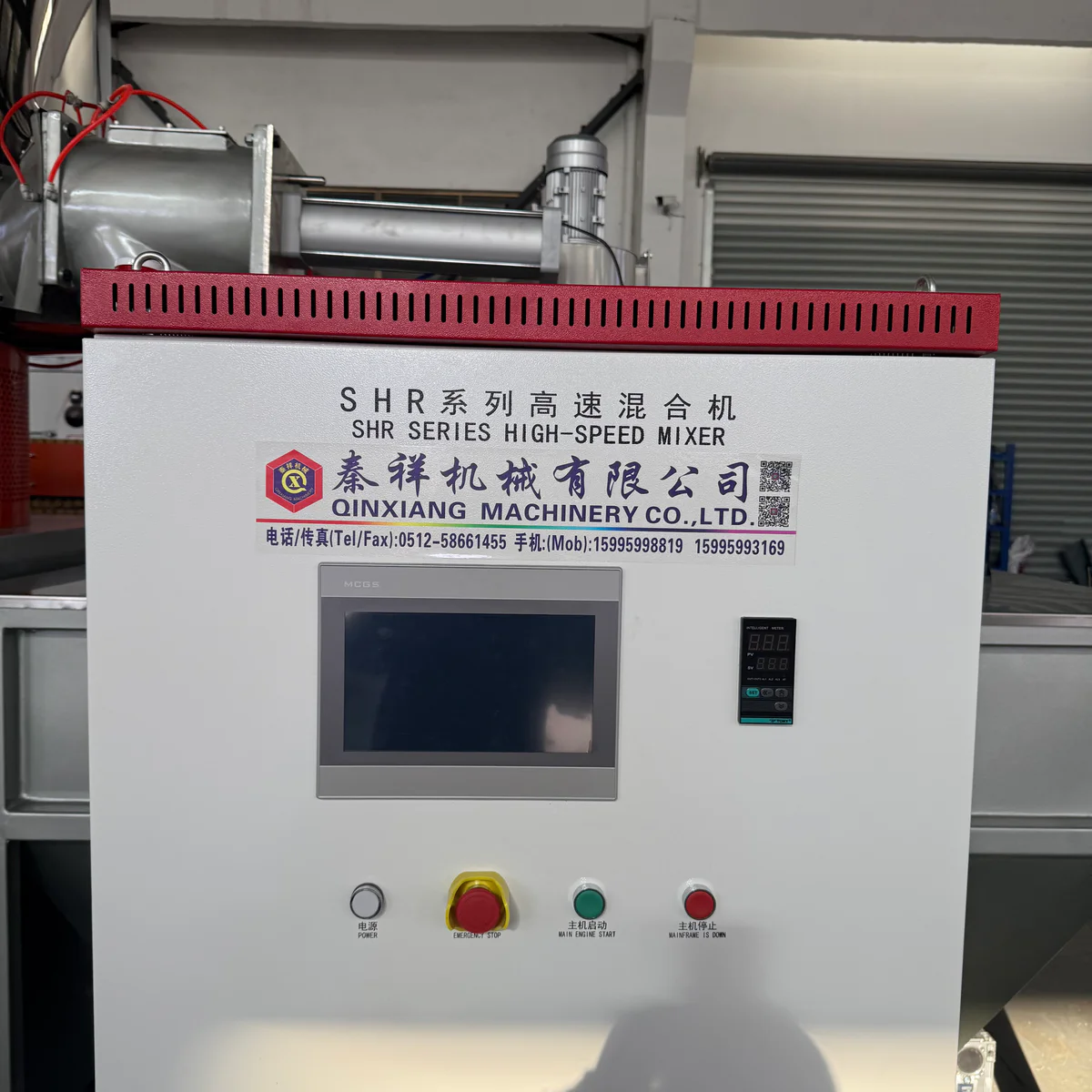
The cabinet is tested as your operators will use it. Motor control, every sensor, every interlock, the emergency stop and the alarms are triggered one by one, then the operating sequence is run through from the panel.
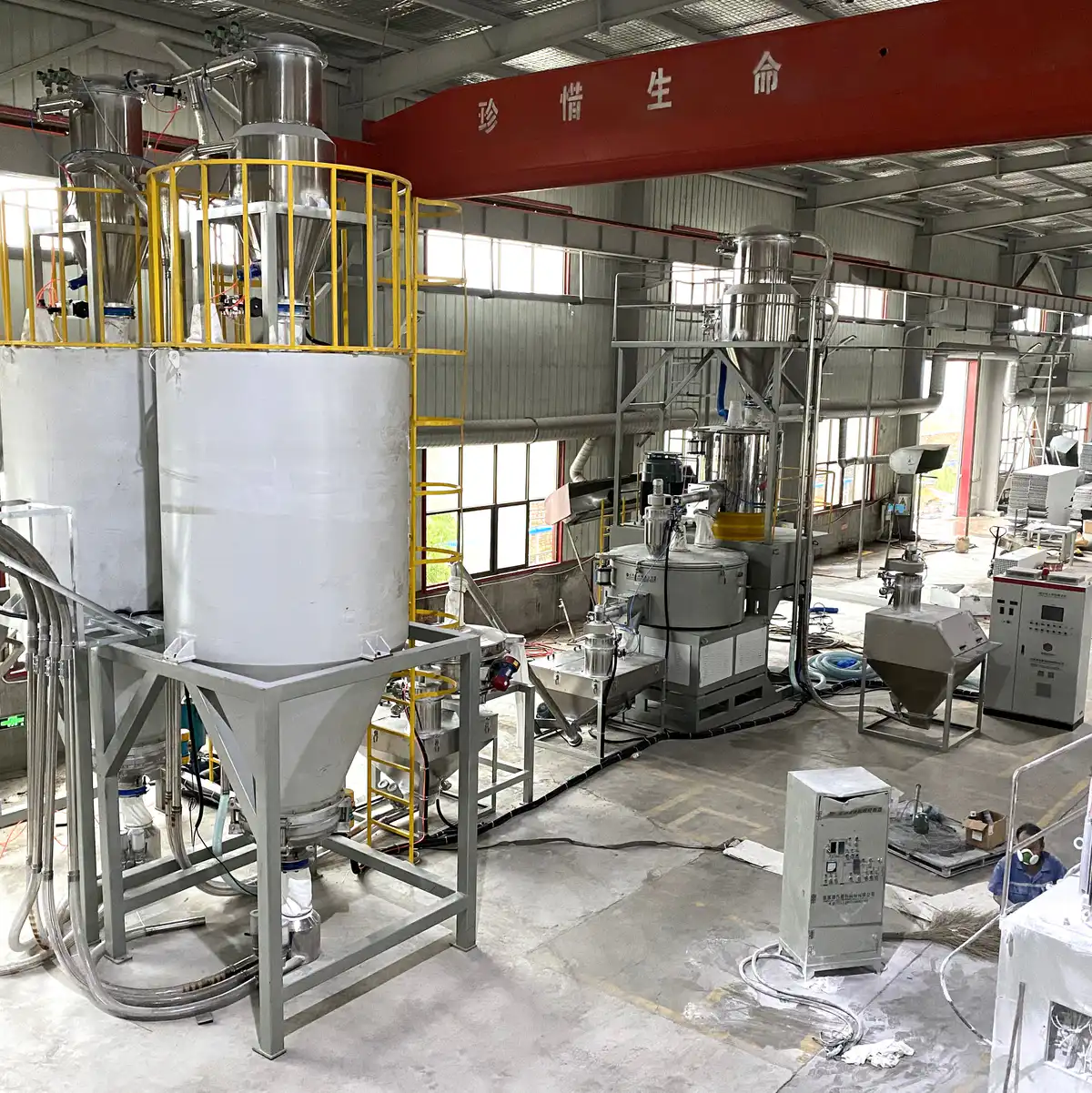
Complete Sequence Test
Finally the whole thing runs on its own: start, charging, mixing to setpoint, automatic discharge, cooling and stop, with the alarms armed. If charging, mixing, discharge and cooling talk to each other here, they will on your floor.
You get the inspection record, photos and the sequence test video before the balance payment. Come and watch in person if you prefer.
Frequently Asked Questions
The questions buyers ask us most before they order a mixing system. If yours is not here, send it to Maggie and you get a real answer, not a catalogue.
01
How Do I Choose The Right Material Mixing Machine For My Extrusion Line?
Start with the formulation, usable batch weight, required kg/h and your downstream extruder capacity. Vessel volume comes last, not first.
For PVC dry blend you also need to look at the hot mixing cycle, the discharge condition your formula needs, cooling time and how the material gets moved. The complete system has to deliver enough practical throughput to keep the extruder supplied without turning cooling or transfer into the next bottleneck.
02
Is Mixer Volume The Same As Actual Production Capacity?
No. Vessel volume only tells you how big the mixer is.
Real capacity comes from usable batch weight and how many batches the complete system prepares per hour. Charging time, mixing cycle, cooling, discharge and material transfer all sit inside that number.
Two mixers with the same vessel can produce very different kg/h once the formula and the process conditions are different.
03
Why Does PVC Dry Blend Normally Need Both Hot Mixing And Cooling?
High-speed mixing distributes resin, fillers and additives while putting into the batch the energy the PVC dry blend process needs.
When hot mixing finishes, the material is still carrying that heat. Cooling brings the temperature down before storage, conveying or extrusion, and keeps the blend from agglomerating on the way.
So the hot mixer and the cooling mixer are selected as one process, not as two machines that happen to sit next to each other.
04
How Does High CaCO3 Filler Content Affect Mixer Selection?
More filler changes the material load, and that changes circulation, dispersion, batch weight and how the batch behaves as it heats.
The answer is not automatically a bigger motor or a bigger vessel. We look at the formula together with your intended batch weight, fill level, mixing process and required output.
Send the approximate PVC to filler ratio and the configuration gets evaluated around your actual formula instead of a generic one.
05
Do I Need A Horizontal Or A Vertical Cooling Mixer?
It comes down to cooling demand, required throughput, the space you have and how you want to clean it.
Horizontal cooling mixers suit larger batches and higher cooling capacity. Vertical ones suit compact layouts where floor space and easy access matter more.
Either way, the cooling mixer is matched to the output and cycle of the hot mixer, not chosen by physical size on its own.
06
What Causes Inconsistent Results Between Mixing Batches?
Batch variation can come from anywhere in material preparation, which is why chasing it at the extruder rarely works.
The usual suspects: dosing accuracy, charging sequence, fill level, mixing time, temperature endpoint, blade condition, cooling performance and residue left from the previous batch.
If the formula has not changed but your extrusion settings need adjusting again and again, review the mixing process together with upstream dosing and downstream extrusion conditions.
07
What Causes Powder Buildup Or Residue Inside The Mixer?
Material collects because of internal dead zones, a process temperature that does not suit the formula, incomplete discharge, the material itself, or surfaces powder likes to stick to.
Residue around the vessel wall, blades, shaft or discharge area adds cleaning time and can contaminate your next batch.
When you evaluate a mixer, look at internal geometry, discharge design, access, and exactly what has to be cleaned during a formula or color change.
08
How Should The Mixer Be Configured If We Change Colors Or Formulas Often?
Frequent changeover moves residual material and cleaning access to the top of the list.
You want practical access to the vessel, the blades, the discharge area and the filtration parts. Low retention and complete discharge mean less material to remove before the next formula starts.
Tell us how often you change recipes and whether you switch between colors or filler levels, and we build that into the configuration rather than leaving it to your operators.
09
Can An Existing Mixing System Be Upgraded Without Replacing The Whole Line?
Usually yes. The first job is finding the real bottleneck.
It is normally one of these: not enough cooling capacity, a batch size that is too small, manual dosing, slow material transfer, poor dust control, or recipe operation that varies by operator.
From there the upgrade can be a larger cooling mixer, automatic dosing, vacuum transfer, a buffer silo or PLC recipe control, while you keep whatever still does its job.
10
What Information Should I Send Before You Recommend A System?
The more of this you have, the faster the answer comes back:
- Main material and formula
- Approximate filler content
- Powder, pellet or liquid additions
- Required batch weight
- Required capacity in kg/h
- Extruder capacity in kg/h
- Hot mixer, hot and cold unit, or complete system
- Current mixing equipment, if upgrading
- Existing cycle time and the problem you have now
- Layout or available installation space
With that, the system gets evaluated from your material process and required throughput, instead of being recommended by model number or vessel volume.
Question not covered here? Send it with your formula and batch weight, and Maggie comes back within 24 hours.
Send Your Formula To Maggie
Base material, rough filler percentage, batch weight and your required kg/h. That is enough for a real mixing configuration and a quote back within 24 hours.

Maggie
Sales, QTech Machinery
Replies within 24 hoursEvery message from this page reaches me directly. Tell me what you are mixing and how much your line consumes, and I come back with a mixing configuration, drawings and a real quote, not a catalogue.
If a single high-speed mixer covers your output, I will say so. If your cooling side is what needs to grow, I will say that too, before you order.
Maggie
Sales, Zhangjiagang Qinxiang Machinery Co., Ltd.
- Mixer sized from your formula and kg/h, not by vessel volume
- Hot and cooling mixer matched as one cycle, with margin
- Voltage, control standard and panel language set for your market
- Full batch test before shipment, record and video sent to you
- Your formula stays private, no sales spam
Get Your Mixing Configuration
Fields marked are required.