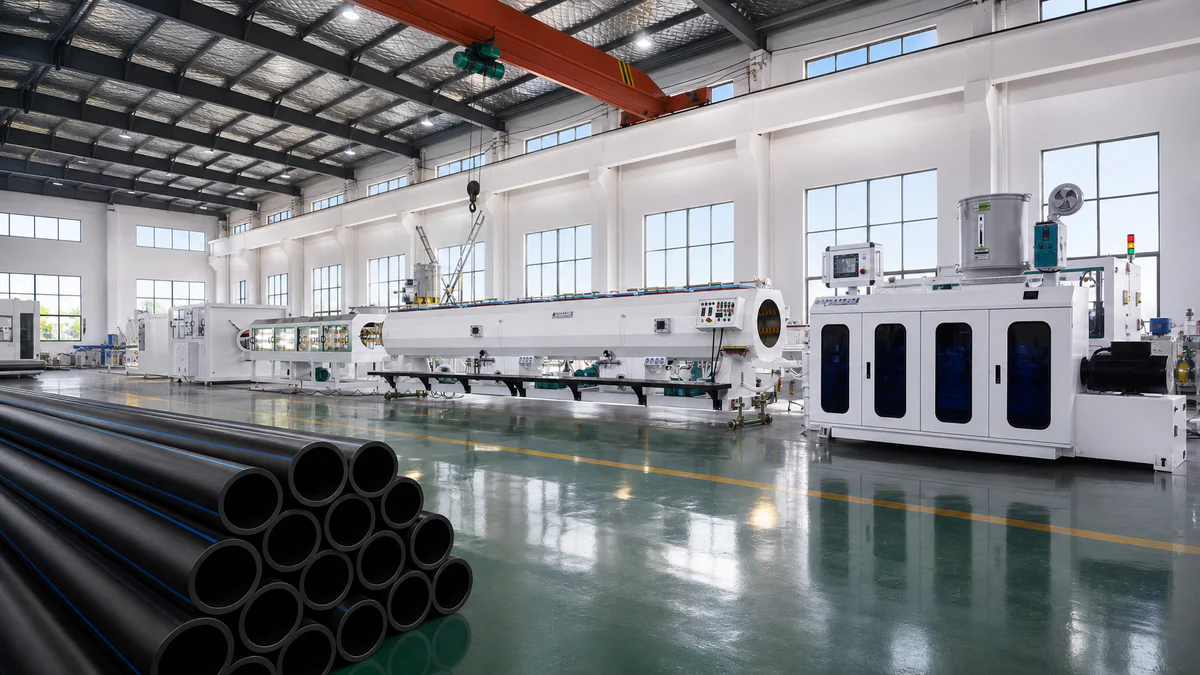
China HDPE Pipe Extrusion Line Factory
An HDPE line begins at a single screw extruder with grooved feed and ends at a coiler or a stacker. We build that whole sequence for pipe from 20mm to 1200mm, size each machine to your PE grade, SDR and kg/h, and run the line on your pipe spec before it leaves our workshop.
- PE80 and PE100 pipe lines
- Color stripe and multilayer co-extrusion
- Coilers for small sizes, stackers for large
- Trial run on your approved pipe spec
20mm To 1200mm
Outside diameter range, planned in bands so each line is sized for the pipes it will actually run.
Single Screw, Grooved Feed
The main extruder for PE pellets, with a small co-extruder added for stripes or a second layer.
Water, Gas, Irrigation, Duct
Plus PE pressure pipe. End use and SDR decide the cooling length, the haul-off and the cutter.
Your HDPE Line, Stage By Stage
Start with the pipe, then follow it down the line: extruder, die, tanks, haul-off, cutter and the coil or stack at the end. Each card jumps to one decision you will have to make.
Line Flow
Nine stages, one sequence
Pipe Spec
PE grade, SDR, end use
Diameter Bands
20mm to 1200mm in three bands
Feeding And Extrusion
Grooved feed, dosed by weight
Die Head And Stripes
Spiral die, one to four stripes
Sizing And Cooling
Tank length set by the wall
Haul-Off And Cutting
Grip, pull, knife or saw
Coil Or Straight
Winder or stacker
Quality Checks
What buyers measure
Project Case
A Φ20 to Φ110mm HDPE line
Project Steps
Spec review to start-up
What To Send
Details for a first layout
FAQ
Short answers before you order
Configuration Request
Send your HDPE pipe spec
Comparing HDPE with PVC, PPR or tube lines? See every line family on our pipe extrusion lines page.
How An HDPE Line Runs, From Pellet To Finished Pipe
An HDPE line works as a chain, and its weakest stage sets your real output. This is the order the pipe travels in, what each stage does to it, and the machine page behind every step.
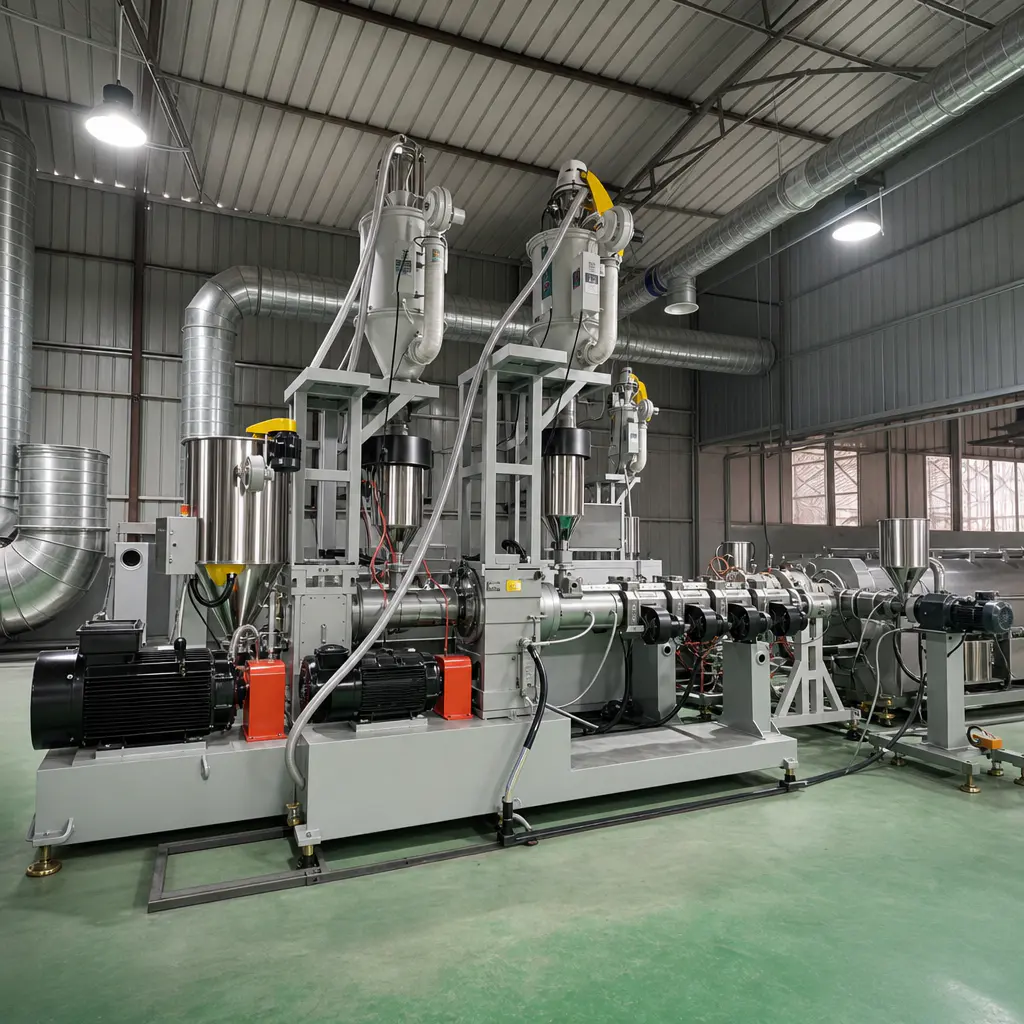
Added when your spec calls for it
-
Feeding And Dosing
A vacuum loader, a hopper dryer and a weigh feeder keep resin, masterbatch and regrind arriving at the ratio and rate the screw expects.
-
Single Screw Extruder
The grooved feed main extruder melts and homogenizes the PE, then pushes it into the die at a steady pressure.
-
Stripe Or Layer Co-Extruder Optional
A small second extruder feeds identification stripes, or an extra layer, into the same die head.
-
Pipe Die Head
A spiral die spreads the melt evenly around the mandrel, so the wall leaves the die with the same thickness all the way round.
-
Vacuum Calibration Tank
Vacuum holds the soft pipe against the sizing sleeve. The outside diameter and roundness are fixed here while the first cooling begins.
-
Spray Cooling Tanks
One or more spray stages draw out the remaining heat, so the pipe keeps its size after it leaves the water.
-
Haul-Off
Servo driven caterpillars pull the pipe at a speed tied to extruder output. That ratio is what keeps the wall on spec.
-
Pipe Cutter
Chipless or planetary cutting to length. The cutting unit travels with the moving pipe, so each cut lands where the length counter says.
-
Winder Or Stacker
Small diameters are wound into coils. Larger pipe is received, tilted and collected on a stacker, then sent on to a bundling station if you ship in bundles.
None of these machines can be sized until the pipe is pinned down, so the next step is your PE grade, your SDR and where the pipe will be laid.
PE80, PE100 And SDR Shape The Line Before Any Machine Is Chosen
Two lines that make the same outside diameter can be very different machines. The grade, the wall your SDR calls for and the end use decide how much melt the line moves, how much heat it has to remove and how hard the haul-off pulls.
PE80 Or PE100, And What Else Goes In
Send the grade printed on the bag, plus the material data sheet if you have one. List any masterbatch, additives and regrind share as well, because the screw setup, the temperature profile and the dosing plan all start from that list.
SDR Tells Us The Real Wall
Diameter alone hides the load. A heavy wall 110mm pipe carries far more material and heat than a thin wall pipe of the same size, so your SDR or wall range is what sizes the extruder, the tank length and the pull force.
Where The Pipe Will Be Laid
Water supply, gas, irrigation, cable duct and pressure pipe each put the weight on a different check. The standard you sell against also fixes the stripe colour, the pressure rating and the length you cut or coil.
Put A Condition On Every kg/h
A quotation that only says maximum 500 kg/h cannot be checked. Write the target the way it will be tested:
Send every supplier the same four lines and the output, motor size and energy per kilogram on their quotes become comparable.
Swipe the table sideways for all three columns.
| End Use | What Buyers Watch | Where The Line Responds |
|---|---|---|
| Water supply | Accurate wall, steady OD, stable running over long shifts, a blue stripe where the standard asks for one | Die distribution, cooling length, stripe co-extruder |
| Gas | Yellow stripe marking, wall held to the SDR or pressure rating | Stripe feeds in the die, dosing by weight |
| Irrigation | Stable output, cost per meter, coils that unwind cleanly in the field | Extruder sizing, winder tension and traverse |
| Cable duct | OD and length to the buyer's spec, coiled on the smaller sizes | Cutter or winder chosen by size |
| PE pressure pipe | A wall that stays on target hour after hour, without overfilling | Gravimetric meter weight control, haul-off synchronization |
With the pipe defined, the next question is how many of your sizes one line should carry before a second line becomes the better buy.
20mm To 1200mm, Planned In Three Diameter Bands
A line covers a size range, not every size. Inside a band you swap die tooling, sleeves and downstream settings. Across a very wide spread, the cooling, pull force and cutting needs drift so far apart that a separate line plan usually pays off.
20 To 110mm
Fast lines and light pipe, much of it coiled. Winder choice and tension matter as much as the extruder.
110 To 315mm
More throughput and thicker walls. Long vacuum and spray sections, a four-track haul-off and chipless cutting in our reference line.
315 To 1200mm
Heavy straight pipe. Melt sag in the die, cooling load and pull force lead the design from the first drawing.
What Changes From Band To Band
Swipe the table sideways to compare all three bands.
| Stage | Small Bore, 20 To 110mm | Medium Bore, 110 To 315mm | Large Bore, 315 To 1200mm |
|---|---|---|---|
| Reference | Φ20 to Φ110mm project, PE100 water supply pipe | 110 to 315mm project delivered in 2023 | Configured per project from your size list and SDR |
| Main extruder | SJ75/33 single screw, 200 to 250 kg/h designed output | SJ75/38 single screw, 300 to 600 kg/h, 160 kW, L/D 38:1 | Single screw sized to the kg/h of your heaviest SDR |
| Co-extruder | SJ25/25 for four color stripes | SJ50/33, 30 to 80 kg/h, for a stripe or second layer | Stripe or layer extruder to suit the pipe structure |
| Feeding and dosing | Vacuum loader, hopper dryer, double-layer gravimetric metering | QX-900 vacuum feeding rated 900 kg/h, QX-150 hopper dryer, dual-layer weight control | Loading and dosing rated to the extruder output |
| Die head | Spiral die for Φ20 to Φ110mm in 40Cr forged steel, copper sizing sleeves | Die body and sleeve set planned for the 110 to 315mm size list | Spiral distribution and land length set against sag and weld lines |
| Vacuum tank | 9 m, SUS304 stainless steel | 9 m with elliptical calibrator | Length and vacuum capacity worked out from wall, SDR and line speed |
| Spray cooling | Two 6 m spray tanks | Two 8 m spray tanks, stainless spray pipes, nylon nozzles | Large-diameter spray stages that also support the soft pipe |
| Haul-off | Three-caterpillar servo, 10,000 N maximum pull, pneumatic clamping | Four-track servo, pneumatic clamping | Six or eight caterpillars, or a multi-caterpillar frame |
| Cutting | Combined fly-knife and ring chipless cutting | Chipless cutter, hydraulic feed, 2.2 kW | Planetary saw with an enclosed cutting area and extraction |
| Pipe handling | Double-station winder for Φ20 to Φ63mm, single-station winder for larger coils, 5 m discharge stacker | Straight lengths leaving the chipless cutter | Heavy-duty stacker with a slower, controlled tilt |
| Controls | Siemens PLC, MCGS touchscreen, ABB inverter | Delta PLC, 7-inch touchscreen, ABB and Yaskawa inverters | PLC and component brands agreed with you for local spares |
The small and medium bore columns record what went into two delivered lines. They show how a band was configured, not a fixed model list. Large bore lines are configured per project, so send your sizes and SDR to get real figures.
Every band starts at the same point: resin that arrives at the right ratio and an extruder that melts it evenly at the output you named.
Single Screw With Grooved Feed, Fed By Weight
For HDPE and PE pipe the single screw extruder is the standard choice; twin screw machines belong to PVC dry blend. What we size is the flow you need at a steady melt temperature and pressure, not the highest screw speed on a datasheet.
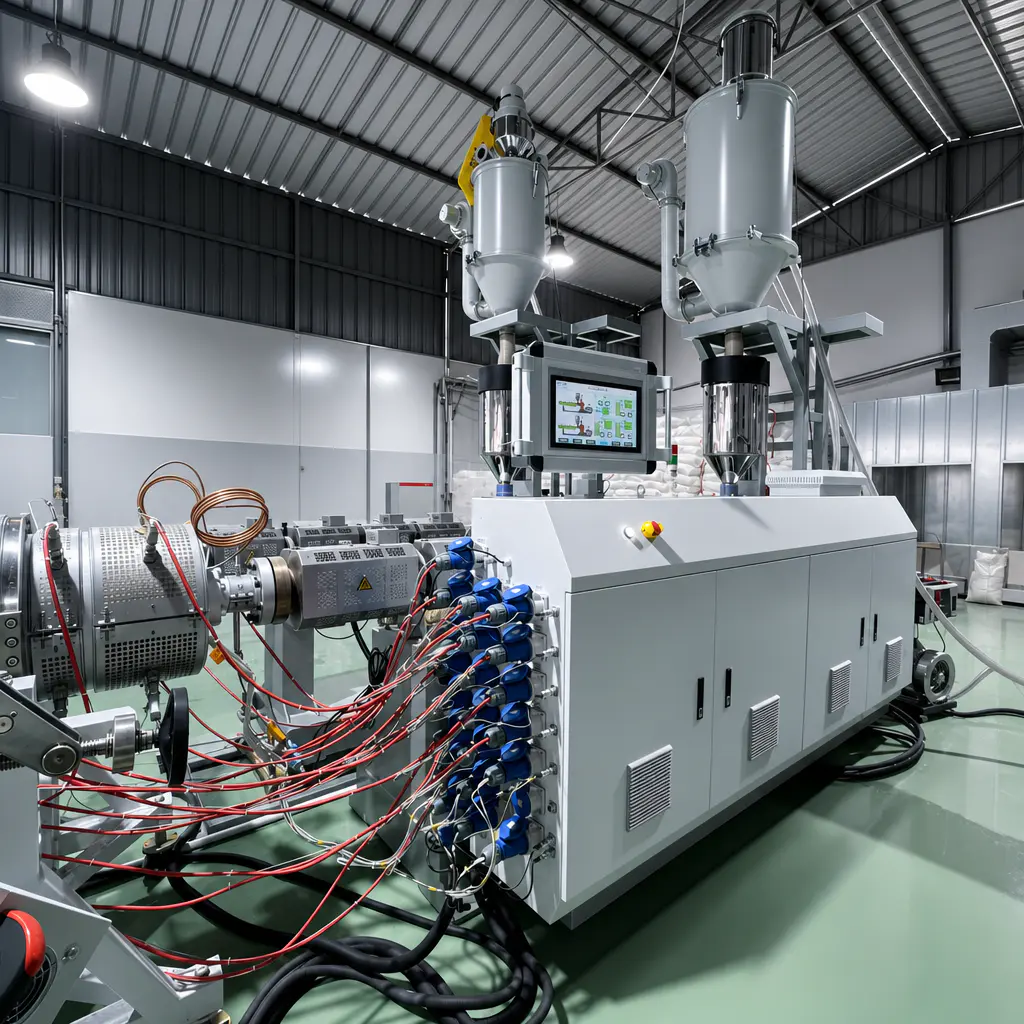
What We Settle Before The Screw Is Machined
The grooved feed section, screw geometry and L/D are chosen together for the grade and throughput you run. Our single screw extruders span screw diameters from 45mm to 120mm, and the motor, gearbox and heating zones are rated for your production load rather than a catalogue maximum.
Replacing an extruder on a running line? Send the current machine data, the die connection and the downstream you keep, and the new unit is matched to them.
See Our ExtrudersVacuum Loading
Pellets travel from storage to the dryer or hopper on their own, so the screw is never starved and output does not dip between bag changes.
Hopper Drying
HDPE absorbs little moisture, yet damp storage, a high regrind share or a humid plant can still mark the pipe surface. A hopper dryer ahead of the feed throat takes that risk out.
Gravimetric Dosing
Resin, black or color masterbatch and regrind are dosed by weight, so the ratio holds when bulk density shifts. Some lines feed the bulk resin by volume and keep only the critical additive on weight.
Meter Weight Control On Pressure Pipe
The weigh feeder can be tied to the haul-off. It reads how many grams of PE go into each meter of pipe and trims extruder or line speed to suit, which keeps the wall on target without giving resin away.
Once the melt is steady, the die decides whether it reaches the tank as an even wall or a lopsided one.
Spiral Die Heads And Color Stripe Co-Extrusion
PE comes out of the die hot and sets slowly. On larger sizes it wants to sag toward the bottom of the pipe and can show weld lines, so the spiral distribution and land length are worked out for your OD and SDR range.
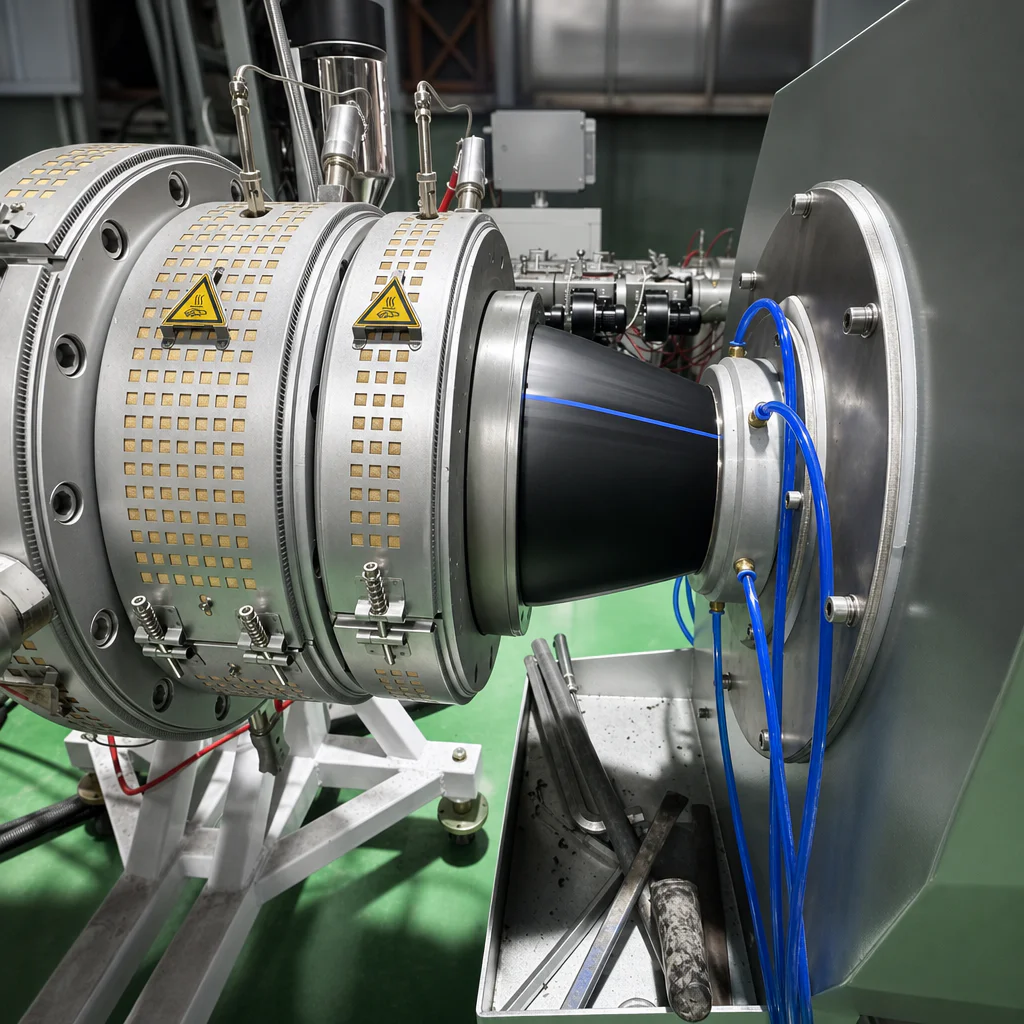
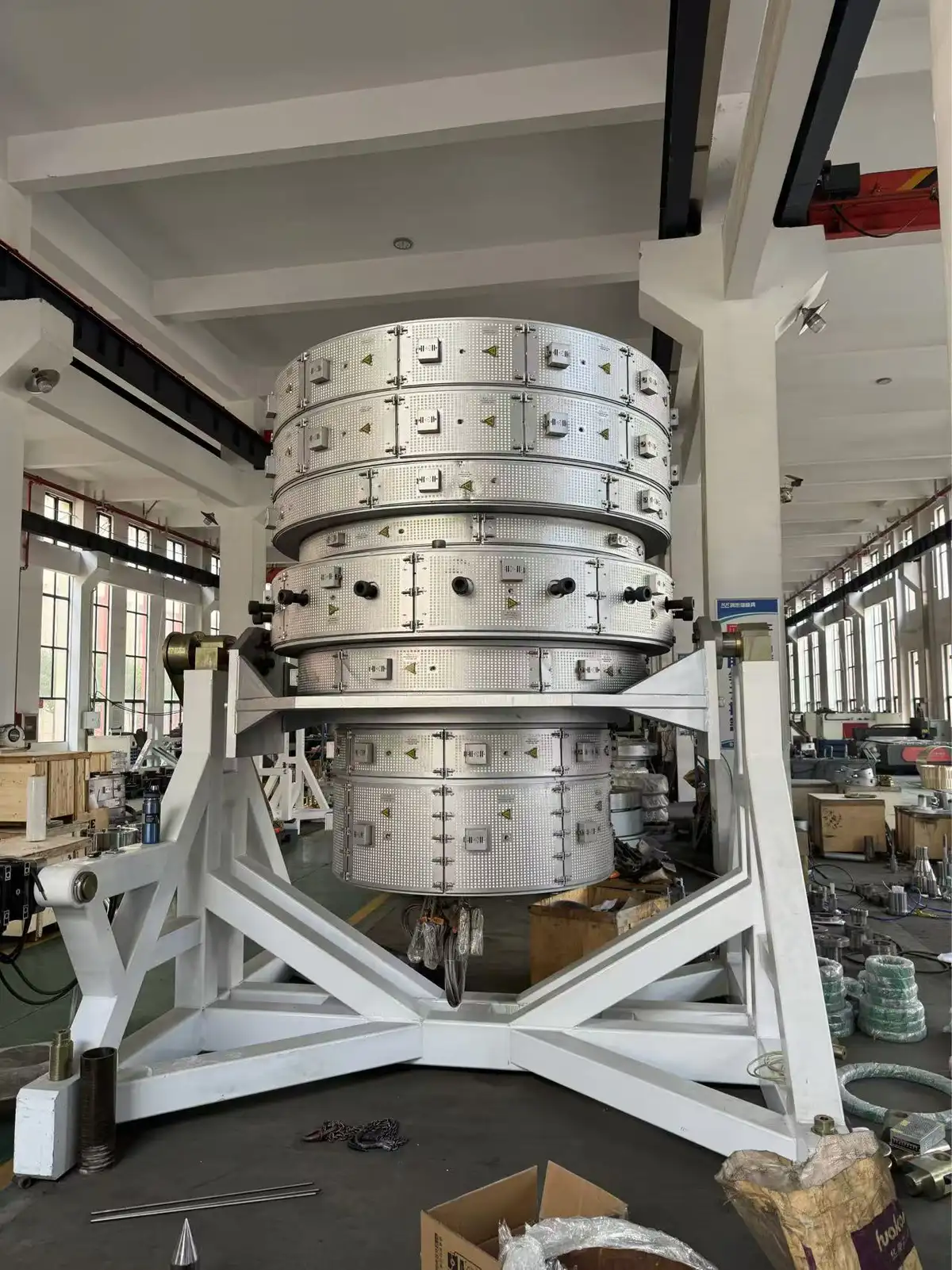
An Even Wall All The Way Round
Any imbalance around the circumference shows up twice: a thin side that fails the spec and a thick side that gives resin away. On thick wall and large bore pipe, throughput, distribution and wall adjustment are solved as one problem, without pushing head pressure or melt temperature higher than they need to be.
One Die Body, Several Sizes
List every diameter you plan to make, next year's included. One die body can often carry a group of sizes with only the forming tooling and sleeves changed, which saves you buying a second head later.
Two Or Three Layers
With two or three layers, each layer's material, thickness and share of the output shapes the melt channels, so the co-extruder data belongs on the first drawing.
Color Stripes Are Built Into The Die
Each stripe has its own feed through the head from a small co-extruder, so the count and position matter more than the colour. Tell us the layout early: drawing the feeds in costs far less than adding them to a finished head.
1 Stripe
The usual identification line, from one feed.
2 Stripes
One on each side, visible after the pipe is laid.
4 Stripes
Readable at any rotation, from four balanced feeds.
Custom
Spacing, width or position taken from your drawing.
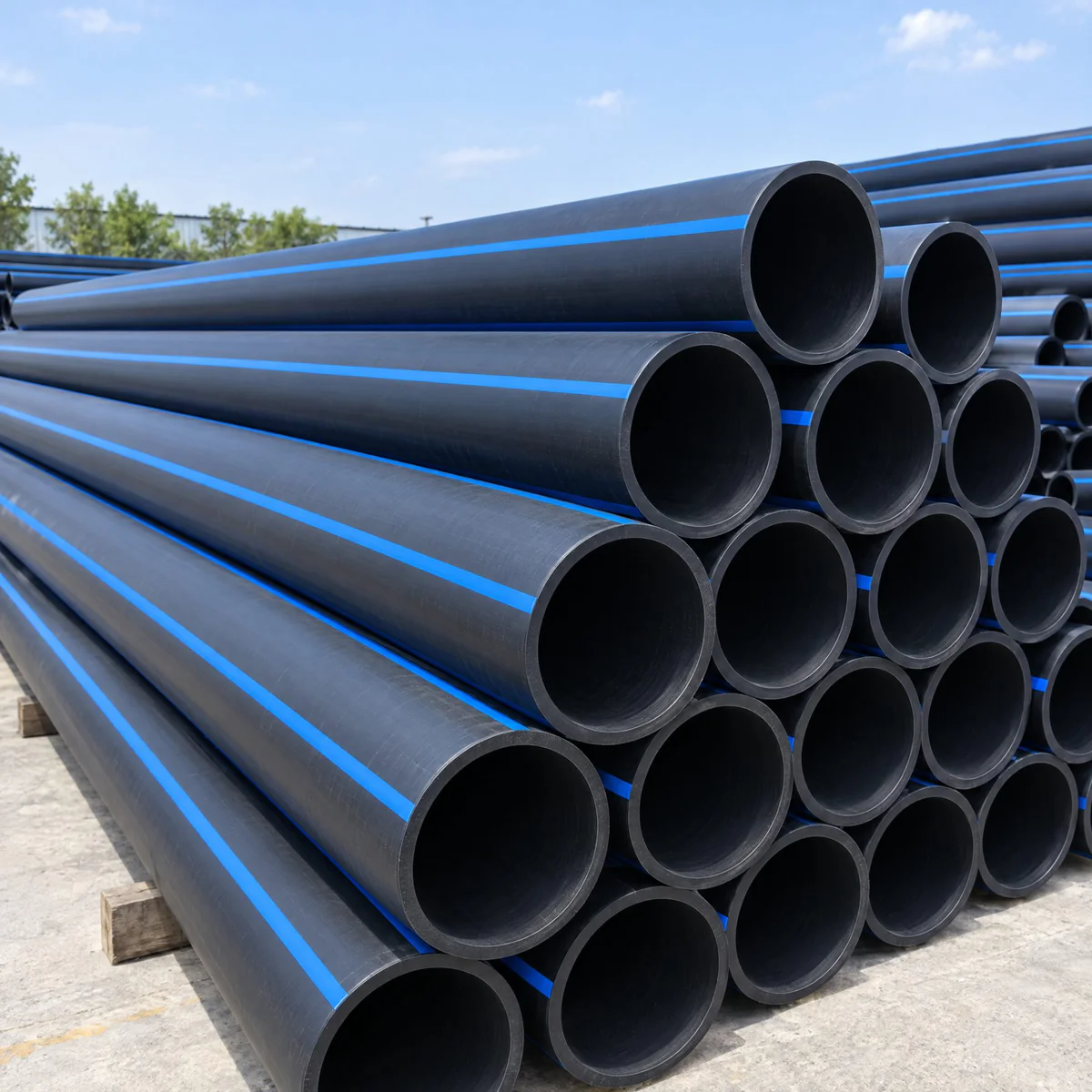
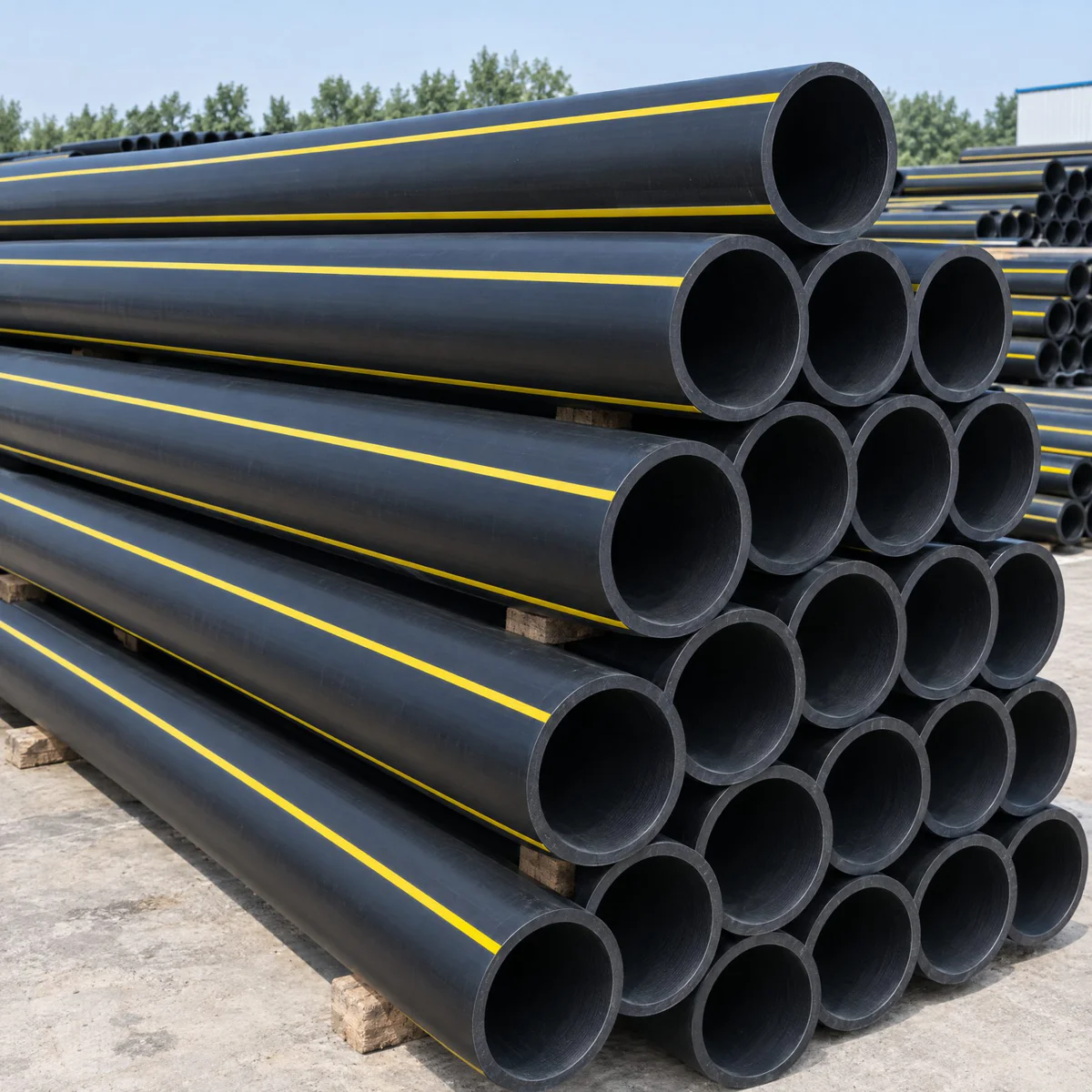
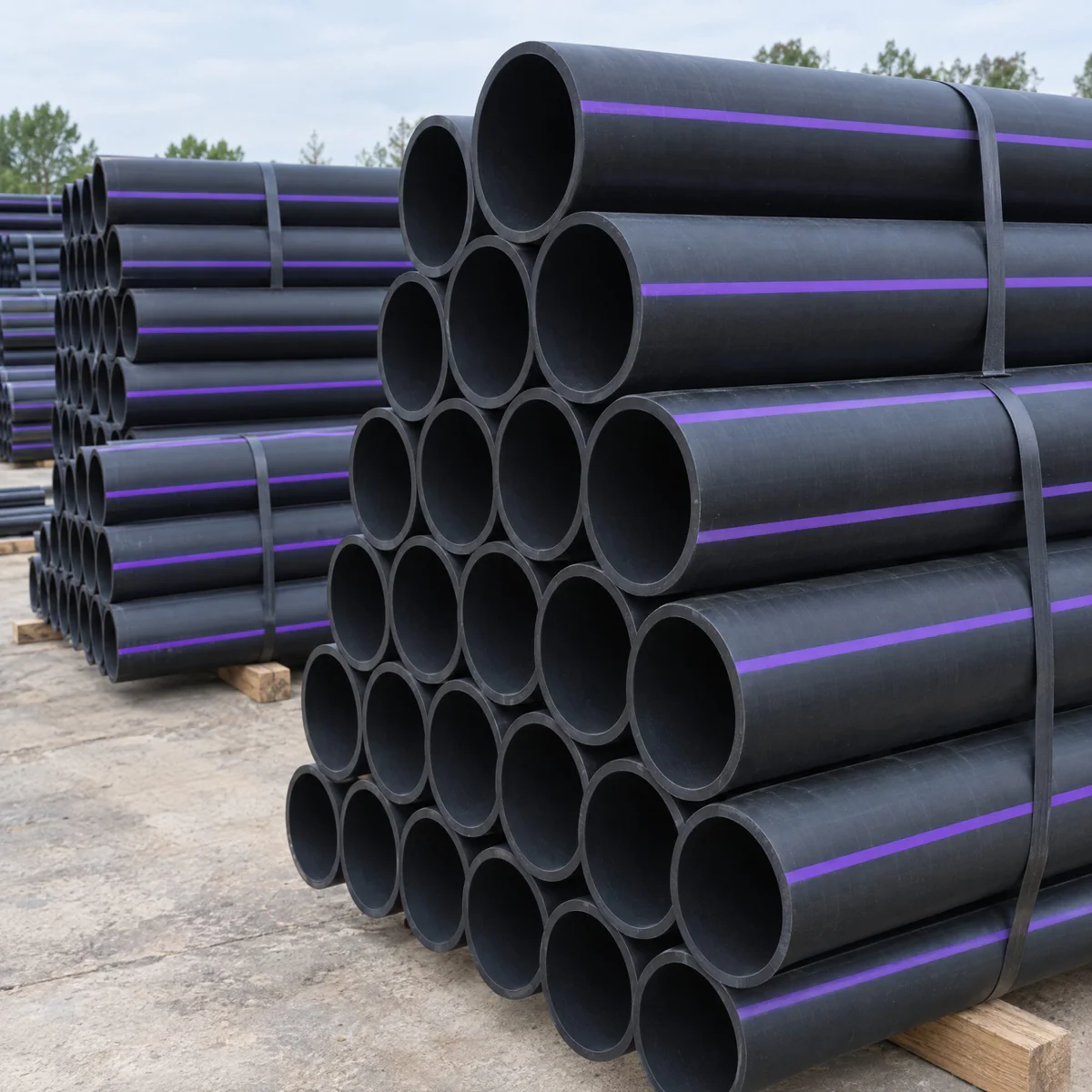
The final colour follows your standard, your masterbatch reference or an approved sample, never a screen image.
Past the die lip the pipe is still soft, and the next stretch of vacuum and water fixes its size and roundness for good.
Vacuum Sizing, Then Enough Spray Cooling For Your Wall
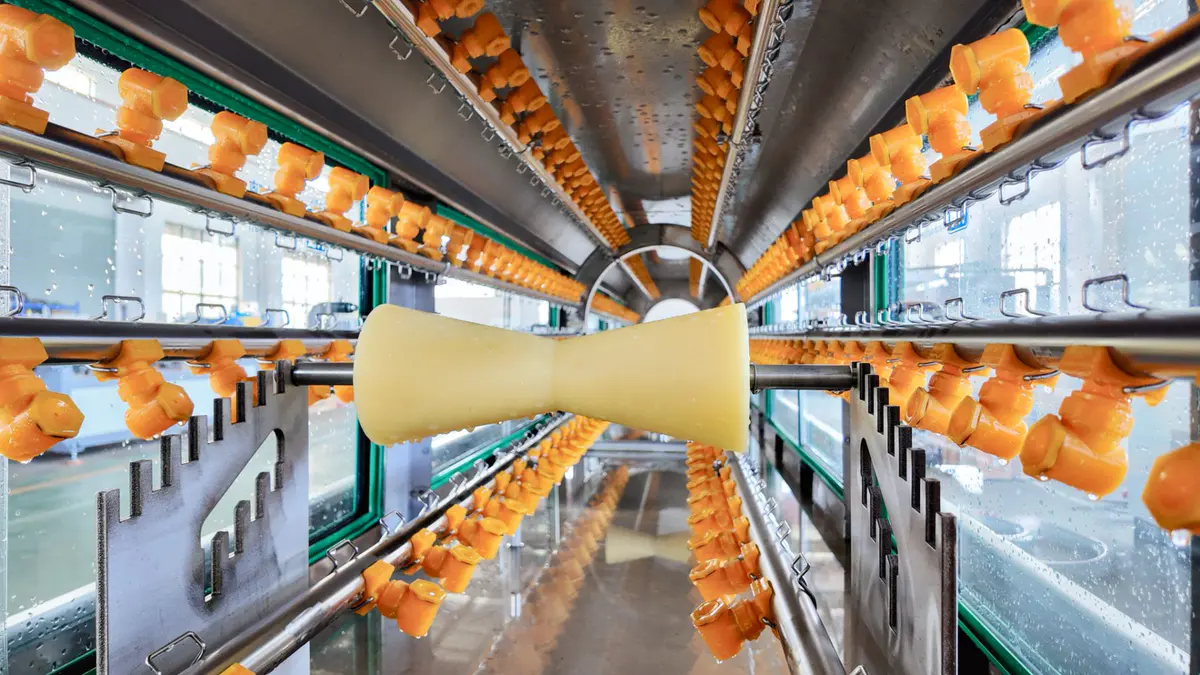
The vacuum tank draws the hot pipe against the sizing sleeve and fixes its OD and roundness. The spray tanks then keep pulling heat out until the wall is firm enough for the haul-off pads and the cutter.

What Decides The Tank Length
Diameter on its own is a poor guide. A heavier wall holds more heat, so two lines on the same OD can need different tank lengths and vacuum capacity. Sometimes the limit is not the meters of tank at all but the water flow or the spray layout, and fixing that costs less than adding a tank.
If the OD drifts during a run, look at vacuum level, sleeve match, cooling and line speed together before blaming the pump.
9 m vacuum tank
followed by two 6 m spray cooling tanks
9 m tank, elliptical calibrator
followed by two 8 m spray cooling tanks
When Cooling Runs Short
A round, cooled pipe still needs a pull that never slips and a cut that lands on length.
Haul-Off Grip And Cutting Matched To Pipe Size And Weight
The haul-off sets line speed, and together with extruder output it sets the wall. The cutter follows the same speed signal, so a pull that wavers shows up first as wall variation and then as wrong lengths.


How Many Caterpillars Your Pipe Needs
Swipe the table sideways to read each row in full.
| Haul-Off Type | Where It Fits On An HDPE Line |
|---|---|
| Belt | Small diameters at high line speed, where continuous belt contact keeps the pull smooth |
| 2 caterpillars | Standard small and medium pipe with ordinary pull demand |
| 3 or 4 caterpillars | More contact and support around the pipe, so clamping pressure can stay lower |
| 6 or 8 caterpillars | Large diameter and heavier pipe, held evenly from several sides |
| Multi-caterpillar | Large or special pipe that needs high traction with independently controlled contact points |
Grip comes from contact area, pad design and clamping pressure in balance. Turning the pressure up to stop slip marks the surface or flattens a thin wall, and on a multi-caterpillar frame every track also has to run at the same effective speed. Servo drives hold the set speed while pipe weight and line resistance change underneath them.
Haul-Off MachinesThree Ways To Cut HDPE Pipe
Chipless Knife Cutting
Often picked for suitable PE and HDPE sizes because it leaves almost no swarf and a clean end. Wall thickness, diameter and the cycle time you need still decide whether it fits.
Planetary Knife Cutting
The tool travels around the circumference while it moves with the pipe, giving controlled penetration through the wall.
Planetary Saw Cutting
For larger diameters and thick walls, where material has to be removed. An enclosed cutting area and extraction deal with the chips.
When the cut length wanders, look upstream before you blame the blade: haul-off speed changes, slip, the length encoder and carriage synchronization all move the cut point.
Pipe Cutting Machines
After the cutter the line splits two ways: small sizes head for a winder, larger pipe for a stacker.
Coil The Small Diameters, Stack The Large Ones
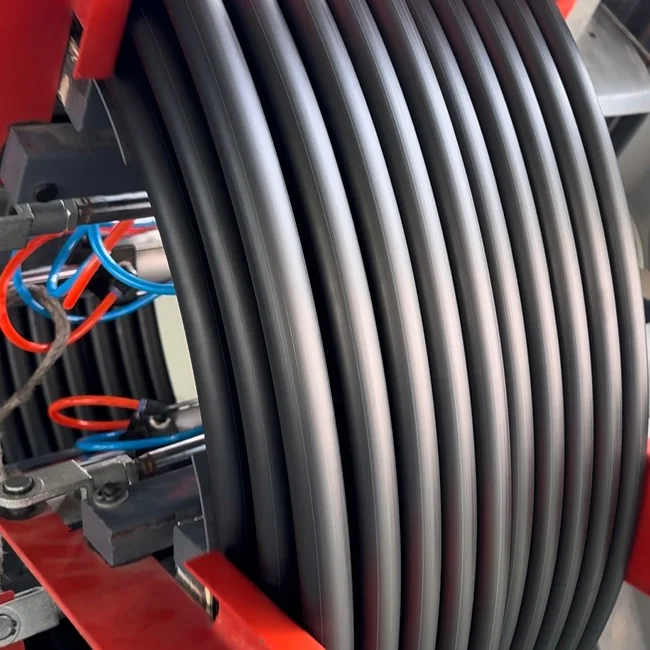
Flexible small pipe is wound into coils; stiffer, larger pipe is cut to length and stacked. Plenty of HDPE lines need both, so the switch between winding and stacking is planned at the start rather than bolted on later.
Winding Small Sizes Into Clean Coils
- On our Φ20 to Φ110mm reference line, a double-station winder takes Φ20 to Φ63mm and a single-station winder takes the larger coiled sizes.
- With two stations, one drum keeps receiving while the full coil is strapped and lifted off, so the extruder does not slow at each change.
- Tension follows OD, wall and material. Too tight and thin wall PE goes oval or stretches; too loose and the coil springs open on the pallet.
- Send coil length, inner and outer coil diameter, width and weight. The coiler is built around what your pallets and containers take.
Cutting And Stacking Larger Sizes
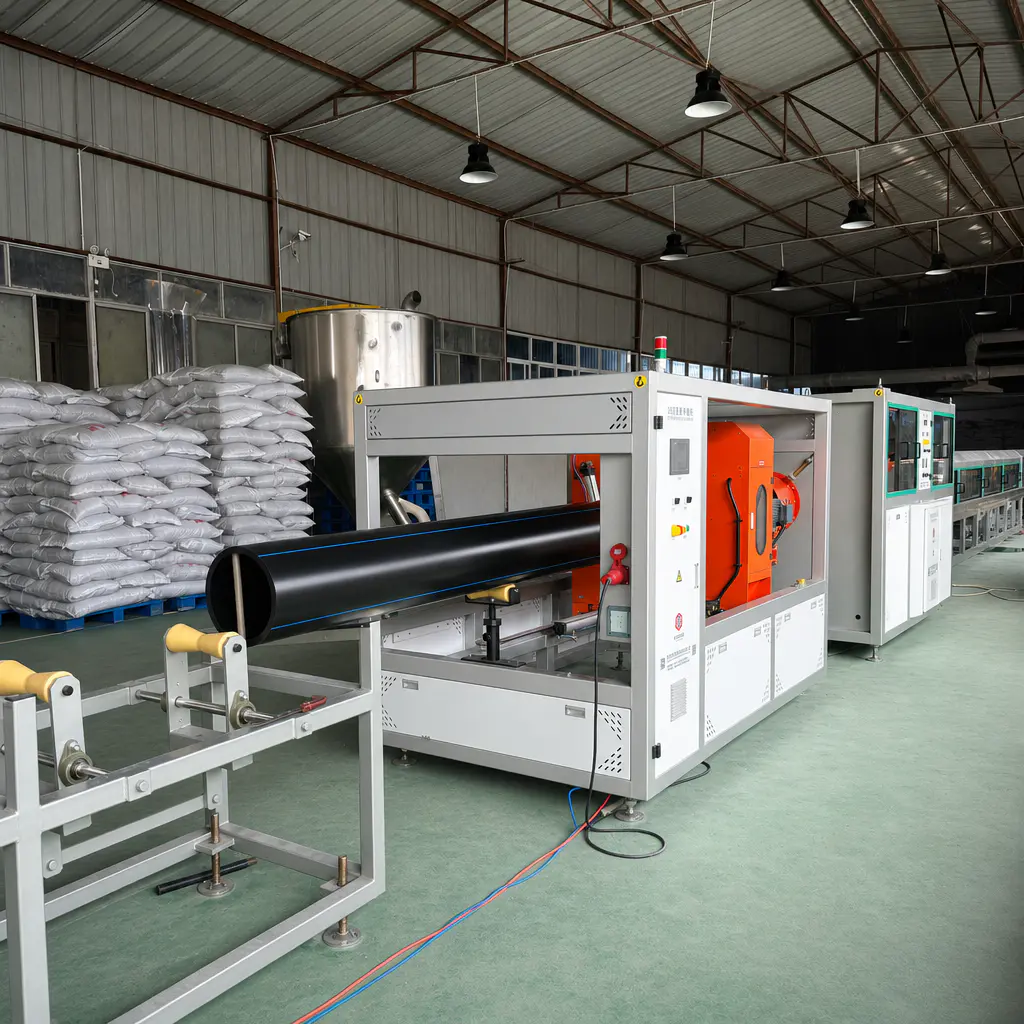
- The stacker receives each cut length, tilts it across and clears the table before the next pipe arrives from the cutter.
- Support positions follow your pipe length, whether that is 3 m, 6 m, 12 m or something else.
- Long, heavy and large bore pipe moves to a heavy-duty stacker with a slower, controlled tilt, so nothing drops onto the rack.
- Straight lengths can continue to a bundling station for strapping, film or bags before they are loaded.
Coiled or straight, the pipe is judged on the same handful of measurements, and each one traces back to a stage of the line.
What HDPE Pipe Buyers Measure, And Where The Line Holds It
Your customers inspect the pipe, not the machines. We trace each check they make back to the stage that controls it, and set that stage up for your spec.
| Buyer Check | Held Mainly By | What We Confirm |
|---|---|---|
| 01OD steady along the run | Vacuum tank, sizing sleeve, haul-off speed | Vacuum level, sleeve size per diameter, line synchronization |
| 02Even wall thickness | Die distribution, gravimetric metering, haul-off sync | Die design, melt pressure, meter weight, line speed |
| 03Ovality under control | Vacuum and spray cooling length, haul-off clamping | Cooling time against wall and speed, pipe support, pad pressure |
| 04Smooth outer surface | Material drying, die and sizing sleeves | Moisture risk, melt temperature, sleeve condition |
| 05Stripe in the right place | Stripe co-extruder and the feeds in the die | Stripe count, position and width |
| 06Accurate cut length | Cutter synchronized with the haul-off | Encoder signal, pipe slip, carriage travel |
| 07Clean coils on small pipe | Winder tension and traverse | Traverse pitch per OD, tension per wall |
| 08Quality held over a long run | The full line at the agreed output | Trial run readings recorded over time |
Wall Varies Around The Pipe
Usually die imbalance, unsteady melt pressure or a haul-off out of step with the extruder. It wastes resin and throws the meter weight off, so we check die, sleeve, tank, haul-off and speed as one set, and add online wall control when the spec is tight.
Pipe Goes Oval After The Tank
The pipe leaves the water still too soft, or the pads squeeze it. On medium and large PE we review size, wall, cooling time and your floor space before the tanks and haul-off are fixed.
Trial Run On Your Spec
The line runs on the pipe spec you approve. You receive sample pipe, a running video or the inspection points your project calls for. Ask for readings that show the target was held, not just touched:
Here is how those choices came together on one delivered Φ20 to Φ110mm HDPE water pipe line.
Case: Φ20 To Φ110mm HDPE Water Supply Pipe Line
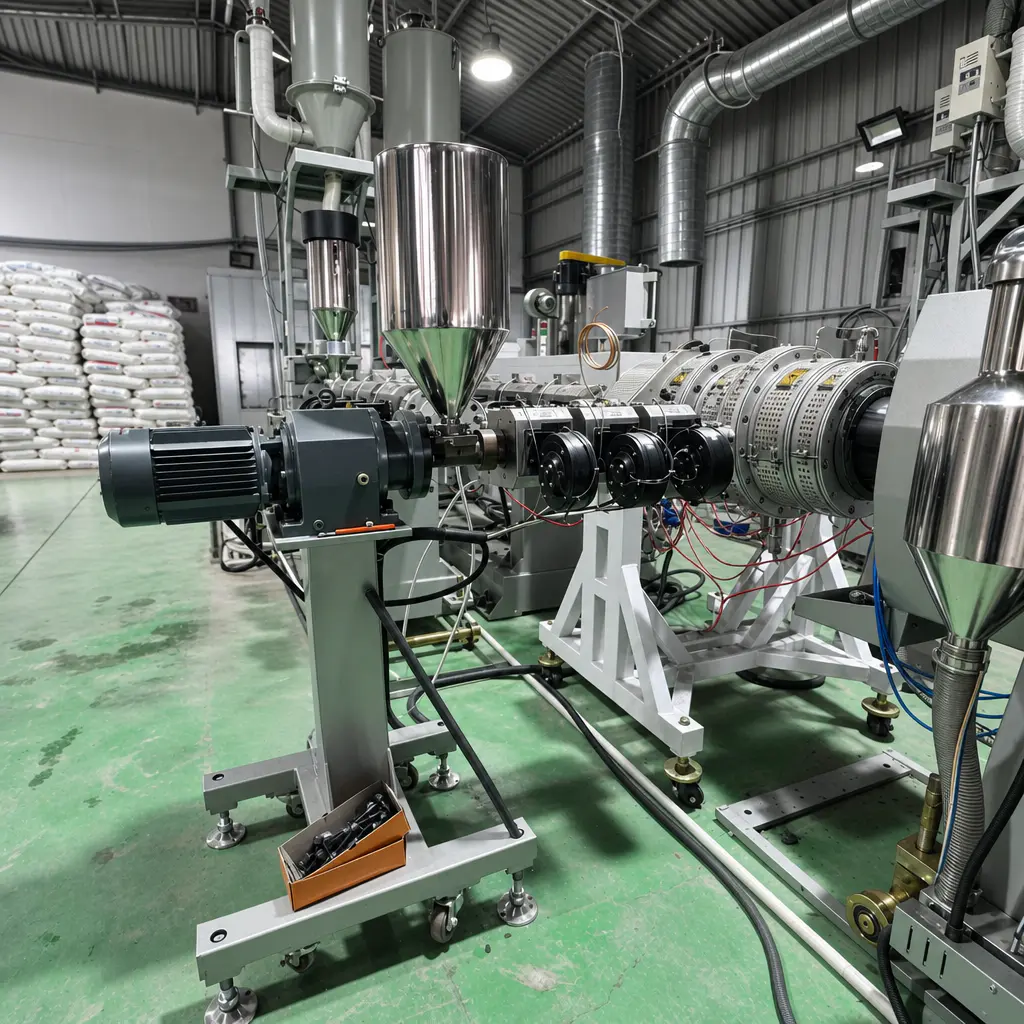
A producer of PE water supply pipe wanted black PE100 pipe with four identification stripes, both coiled and straight output, and less hand work at feeding and in production. QTech supplied the complete line, from vacuum loading to the discharge stacker, with a spare parts and technical support package.
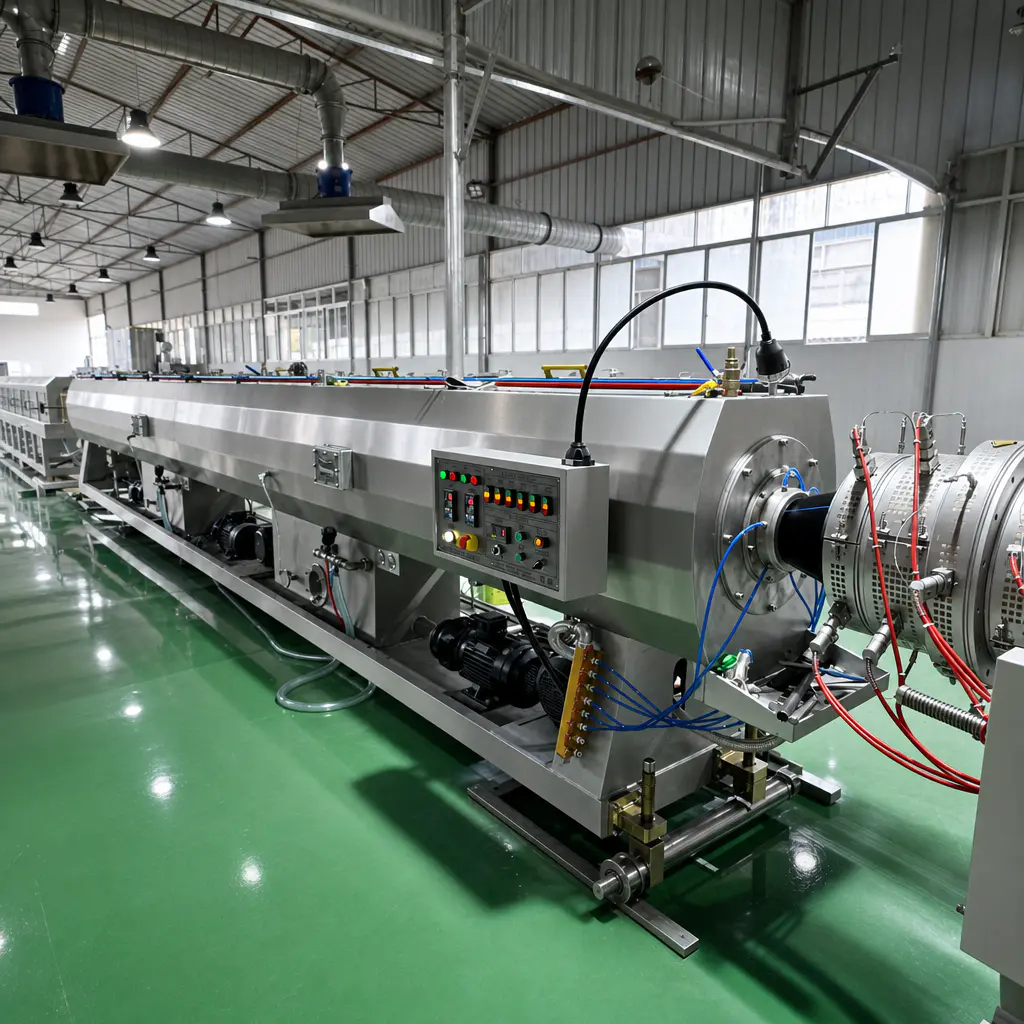

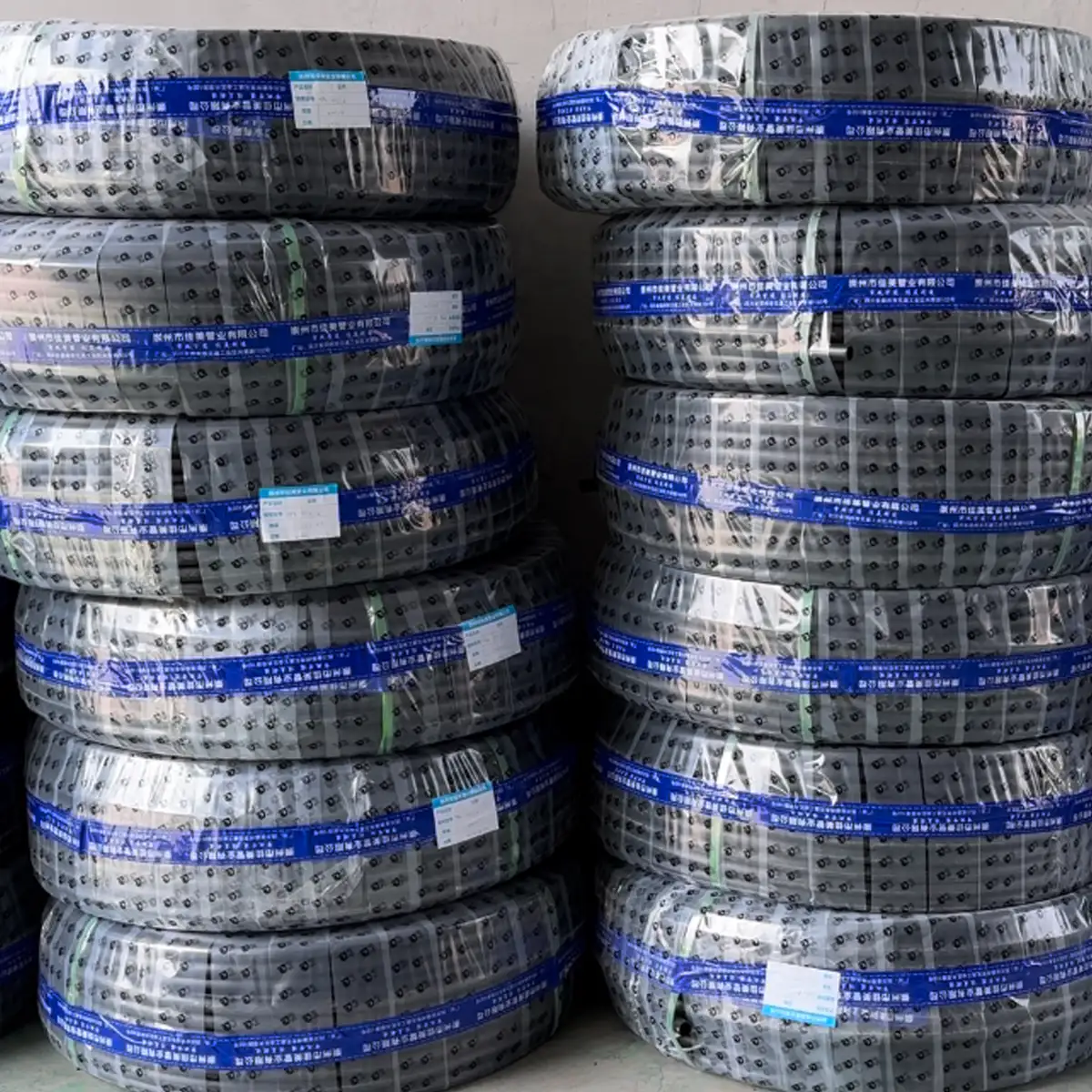
- Pipe range
- Φ20 to Φ110mm
- Material
- PE100 HDPE, black with four color stripes
- Designed output
- 200 to 250 kg/h
- Line speed
- 1 to 25 m/min, by diameter and wall
- Main extruder
- SJ75/33, 75mm screw, L/D 33:1, 110 kW motor
- Stripe extruder
- SJ25/25
- Dosing
- Double-layer gravimetric metering
- Sizing and cooling
- 9 m vacuum tank, two 6 m spray tanks
- Haul-off
- Three-caterpillar servo, 10,000 N
- Cutting
- Fly-knife and ring chipless
- Handling
- Double and single-station winders, 5 m stacker
- Control
- Siemens PLC, MCGS touchscreen, ABB inverter
110 To 315mm HDPE Line, Delivered 2023
For larger sizes the brief was 350 to 650 kg/h on a three-phase 380V/50Hz supply, met with an SJ75/38 main extruder rated 300 to 600 kg/h and an SJ50/33 co-extruder. The full stage list sits in the medium bore column of the diameter band table.
A line like this goes from your first message to production start-up in eight steps, each ending with something you can check.
Pipe Spec To Start-Up In Eight Steps
Each step ends with something you can hold us to, so nothing is missing when the containers reach your plant.
-
01
Spec Review
You send the PE grade, size list, SDR, kg/h, end use, voltage and workshop size. We point out any gaps before anything is drawn.
-
02
Line Configuration
Extruder, die, tanks, haul-off, cutter, winder or stacker and auxiliaries are sized together, against the same pipe.
-
03
Technical Proposal
You receive the machine list and its main parameters, a layout reference, the power you need, the options, what the test covers, a delivery plan and the warranty.
-
04
Build And Assembly
Machining, assembly, cabinet wiring and downstream matching are done in our Zhangjiagang workshop.
-
05
Trial Run
The line runs to your approved spec. Sample pipe photos, a running video or FAT records are prepared as your project needs.
-
06
Packing And Loading
Machines, spares and documents are packed for export, with loading photos, a packing list and the manual.
-
07
Installation And Training
Layout and wiring guidance, commissioning support on site or remotely, and training for your operators.
-
08
After Sales
Troubleshooting, spare parts, maintenance advice and help setting up new pipe sizes once you are in production.
If you already have some of these details to hand, the checklist below shows which ones get a first layout moving.
What To Send For A First HDPE Line Layout
Five details are enough for a first configuration. Missing one is fine; we tell you which gap still matters.
A full technical file can come later. A pipe drawing, a photo of the pipe you sell or a short video of your current line often answers half the questions at once.
Send These First
- 1PE grade, PE80 or PE100, and any regrind share
- 2Smallest and largest outside diameter you plan to run
- 3SDR, wall thickness or pressure rating for each size
- 4Target output in kg/h, per size if it varies
- 5End use and the pipe standard you sell to
Helpful If You Have It
- Coil or straight, with coil length or pipe length
- Stripe count, colour and position
- Single layer or multilayer structure
- Voltage, frequency and phase at your plant
- Workshop length and a rough floor layout
- Preferred electrical brands for local spares
HDPE Pipe Line Questions
Short answers to what pipe producers ask most before they order. Anything else, ask Maggie directly.
PE pellets feed, melt and homogenize well on a single screw, so it is the normal choice for HDPE and PE pipe. Our HDPE lines run a single screw with grooved feed, sized to your grade and kg/h. Twin screw extruders are kept for PVC dry blend.
Not on one line. A line covers a band of sizes, with die tooling, sleeves and downstream settings changed inside it. Across a very wide spread the cooling, pull force and cutting needs drift too far apart, so small, medium and large bore lines are planned separately.
Both run on the same type of line: dosing, extruder, die, tanks, haul-off and cutter. What we check is the processing setup, so send the grade and its data sheet. Screw configuration and temperature settings are reviewed against it, and output is quoted on the resin you will actually run.
No length follows from diameter alone; wall thickness, line speed, output and cooling water temperature decide it. As references, our Φ20 to Φ110mm line used a 9 m vacuum tank and two 6 m spray tanks, and a 110 to 315mm line used a 9 m vacuum tank and two 8 m spray tanks.
Chipless knife cutting suits many PE and HDPE sizes and leaves almost no swarf. As diameter and wall grow, planetary cutting takes over, with a saw for the largest and thickest pipe. We confirm the method against your wall, size and cycle time.
Yes. Our Φ20 to Φ110mm reference line has a combined cutter, double and single-station winders and a discharge stacker, so production switches between coiling and stacking by size and order.
One, two or four stripes are common, and custom layouts are drawn from your pipe drawing. Each stripe needs its own feed through the die from a small co-extruder, so tell us the count and position before the head is designed.
The line runs on your approved pipe spec in our workshop. Ask for the actual kg/h together with screw speed, motor load, melt temperature, melt pressure and running time, so you can see the target held rather than touched.
Yes. Whether it is a new extruder, a stripe co-extruder, a longer tank or a stronger haul-off, we check the connection points, centre height and controls against your existing line before manufacturing starts.
Voltage, frequency and safety standard are set for your market before shipment, for example 380V 50Hz or 440V 60Hz. Tell us your plant supply and any preferred electrical brands with the inquiry.
Send Your Pipe Spec To Maggie
New line, more capacity or a second diameter band: send what you know about the pipe. Maggie answers personally within 24 hours with a configuration and the next step.

Maggie
HDPE Pipe Line Sales, QTech Machinery
Replies within 24 hoursYour message comes straight to me. Give me the PE grade, sizes, SDR and output, and I come back with a line layout and a real quote.
A pipe drawing or a photo of the pipe you sell is enough to start. We ship extrusion lines to factories and importers in 60+ countries.
Maggie
Sales, Zhangjiagang Qinxiang Machinery Co., Ltd.
Tell Us About Your HDPE Pipe
Fields marked are required.