Conical twin-screw arrangement
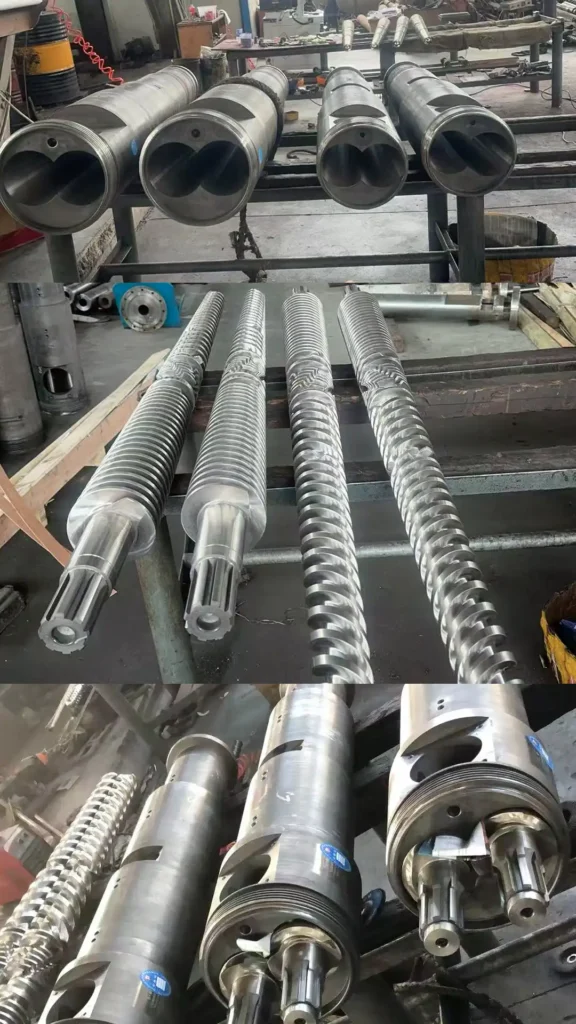
Two conical screws process the compound and deliver material to the die. Screw geometry must suit the formulation, including filler content, additives and the planned material preparation route.
Configure the extrusion unit around your PVC formulation and finished product.
Review SJSZ conical twin-screw extruders for PVC pipe and profile production. Compare the screw pair, drive and downstream connection for your formulation.
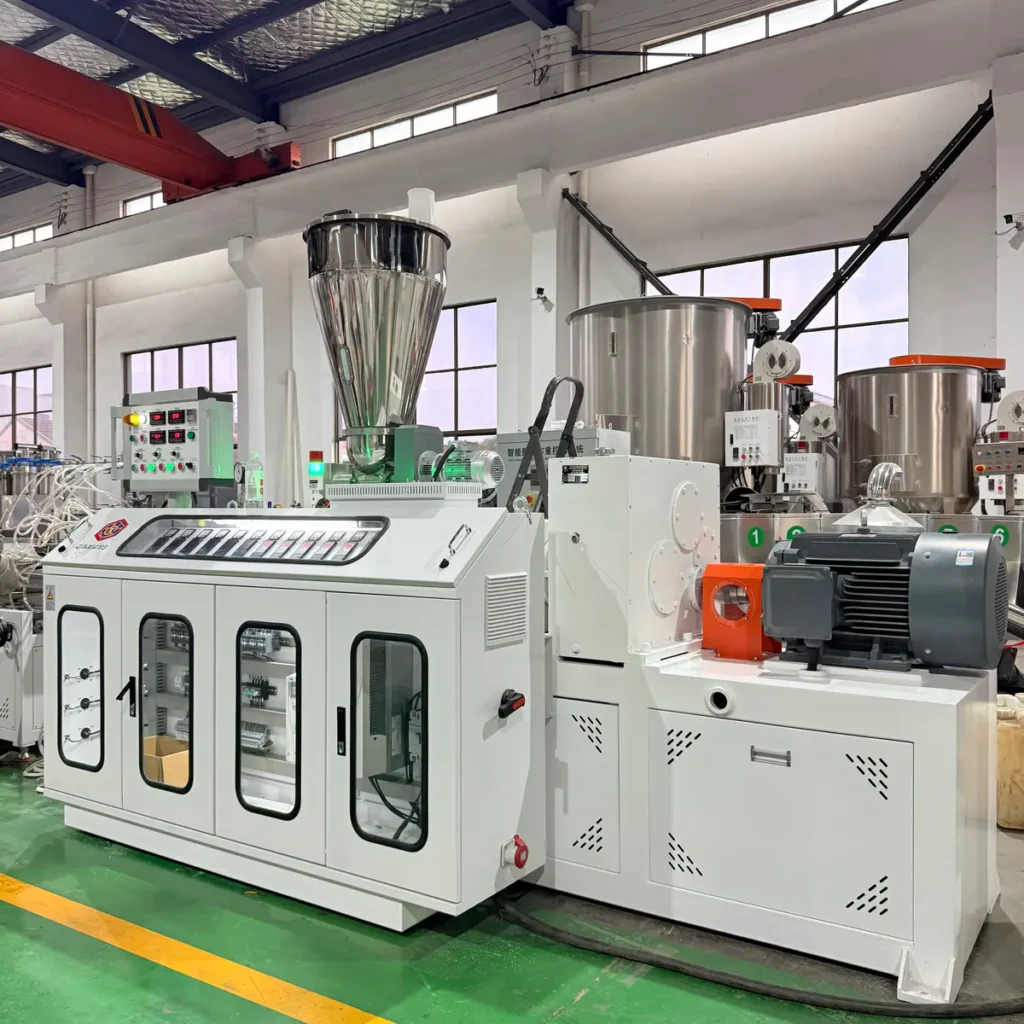 SJSZ Series
Series
SJSZ
Models in comparison
6
Machine Type
Extruders
Materials
PVC
The SJSZ series is a conical twin-screw extrusion platform for processing PVC compounds. Your formulation, product section and required output determine the appropriate screw pair and drive configuration. Select the extrusion unit together with the die and downstream equipment so that material preparation, melt delivery and line speed work as one process.
For a replacement project, start with the existing machine nameplate, screw information and die connection. For a new line, start with the material formulation and the finished product drawing. Both routes require a clear production target before a model is selected.
Compare the listed models against your material, product dimensions and operating requirements.
| Parameter | SJSZ-45/90 | SJSZ-51/105 | SJSZ-55/113 | SJSZ-65/132 | SJSZ-80/156 | SJSZ-92/188 |
|---|---|---|---|---|---|---|
| Screw diameter mm | 45/90 | 51/105 | 55/113 | 65/132 | 80/156 | 92/188 |
| Screw speed rpm | 1–45 | 1–45 | – | 1–35 | 1–37 | 1–33 |
| Effective screw length mm | 985 | 1070 | 1200 | 1440 | 1800 | 2500 |
| Extruder motor power (catalog configuration/range) kW | 15 | 18.5 | – | 37 | 55 | 90 |
| Barrel heating power (catalog) kW | 12 | 18 | 18 | 24 | 36 | 86.8 |
| Output (catalog figure/range) kg/h | 120 | 80–150 | 150–180 | 250–300 | 320–400 | 600–800 |
| Center height (catalog) mm | 1000±50 | 1000±50 | 1000±50 | 1000±50 | 1000±50 | 1200±50 |
| Net weight (catalog) kg | 2800 | 3200 | 3500 | 4000 | 5000 | 8000 |
| Overall dimensions (L × W × H) mm | 3300×1200×2100 | 3600×1100×2100 | 3600×1100×2100 | 4235×1520×2450 | 4750×1550×2460 | 6725×1550×2841 |
Catalog figures are for model comparison. The supplied configuration and production target must be confirmed for your formulation, tooling and operating conditions.
A dash means no value is listed for that model. Confirm the final specification with the selected configuration.
Two conical screws process the compound and deliver material to the die. Screw geometry must suit the formulation, including filler content, additives and the planned material preparation route.
Compare the models in the specification table before narrowing the selection. Screw diameter and motor power describe the machine; achievable output also depends on the compound, die resistance and product.
Define feeding, temperature control, venting and downstream coordination as part of the configuration. These details matter when an extruder is added to an existing line.
Send your material, product size and output target. We shortlist the model and the options with you before quotation.
Match the extruder to the pipe formulation, diameter range, wall thickness and die arrangement. Include the calibration, haul-off and cutting requirements in the same review.
Use the profile drawing or board section to establish material demand and tooling requirements. A shared material name does not make every screw and die combination interchangeable.
Settle these points first and the quotation you receive can be compared line by line.
Provide the resin, filler proportion, additives and recycled-content plan. Identify changes that must be covered by one machine rather than quoting only a nominal PVC grade.
State the required output for a named product and formulation. Record the quality checks and run conditions used to evaluate that target.
These machines show the position in a typical line, not a confirmed match. Interfaces are checked for each configuration.
Complete Lines Using This Machine
Points worth writing into the order, so the run test before shipment proves what matters for your product.
Review stable feeding, temperature behavior and product appearance using the agreed formulation and tooling.
Record output, screw speed and relevant drive readings alongside the product dimensions. Compare results under the same test conditions.
Machine Videos
 0:55
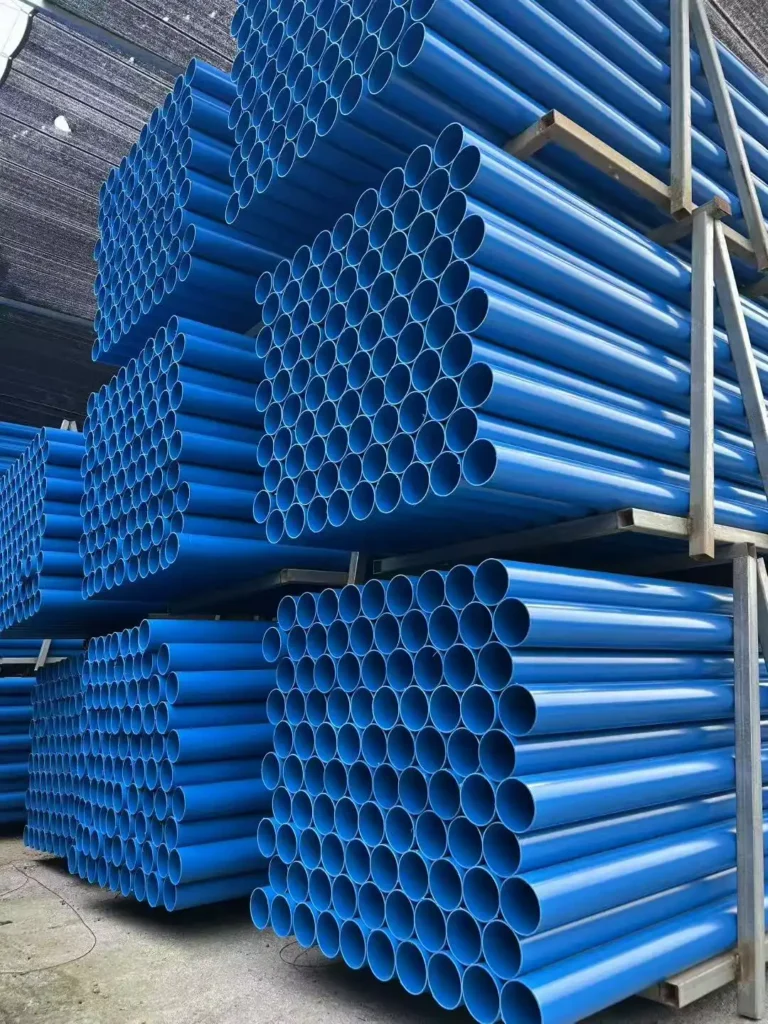
Machine Testing · The main machine or system featured in this video is the QTech-Machinery PVC Pipe Extrusion Line.
Discover how QTech-Machinery's cutting-edge PVC pipe extrusion line enhances production efficiency and quality. Designed for water supply pipes ranging from Φ110mm to Φ315mm, this advanced solution offers superior performance, energy savings, and compliance with international standards. Watch to learn how we can transform your manufacturing capabilities.
Watch VideoNeed an answer for your own material or product? Ask Maggie directly.
Use the formulation, product dimensions and required output to narrow the range, then check drive requirements and die compatibility. Screw size alone is not a complete selection method.
A replacement needs a connection review covering the die flange, center height, footprint, feeding equipment, utilities and controls. Send the current nameplate and installation photographs.
No. Formulation, tooling and operating conditions affect output. The production target and acceptance method should refer to the material and product you intend to manufacture.
Tell us what you need to produce, the required output and whether this is a new installation or a replacement. Share the information you already have so we can review the next configuration details with you.
Have These Ready