What machines are included in a complete HDPE pipe extrusion line?
A complete HDPE pipe extrusion line is not just one extruder. It is a coordinated production system that includes material feeding, drying, extrusion, co-extrusion, die tooling, vacuum calibration, cooling, haul-off, cutting, winding or stacking, electrical control, spare parts, and technical documents. For manufacturers planning to produce PE100 water supply pipes, irrigation pipes, cable protection pipes, drainage pipes, or industrial HDPE pipes, choosing a complete and well-matched line is essential for stable production and long-term profitability.
Based on QTech-Machinery’s Φ20–Φ110 mm HDPE pipe extrusion line project, a practical medium-capacity line can be configured with an SJ75/33 single-screw main extruder, automatic feeding system, gravimetric dosing, four-stripe co-extrusion, 9 m vacuum calibration tank, 12 m spray cooling tank, servo haul-off, fly-knife or chipless cutter, and winding or stacking system.
1. What material feeding machines are needed before HDPE pipe extrusion?
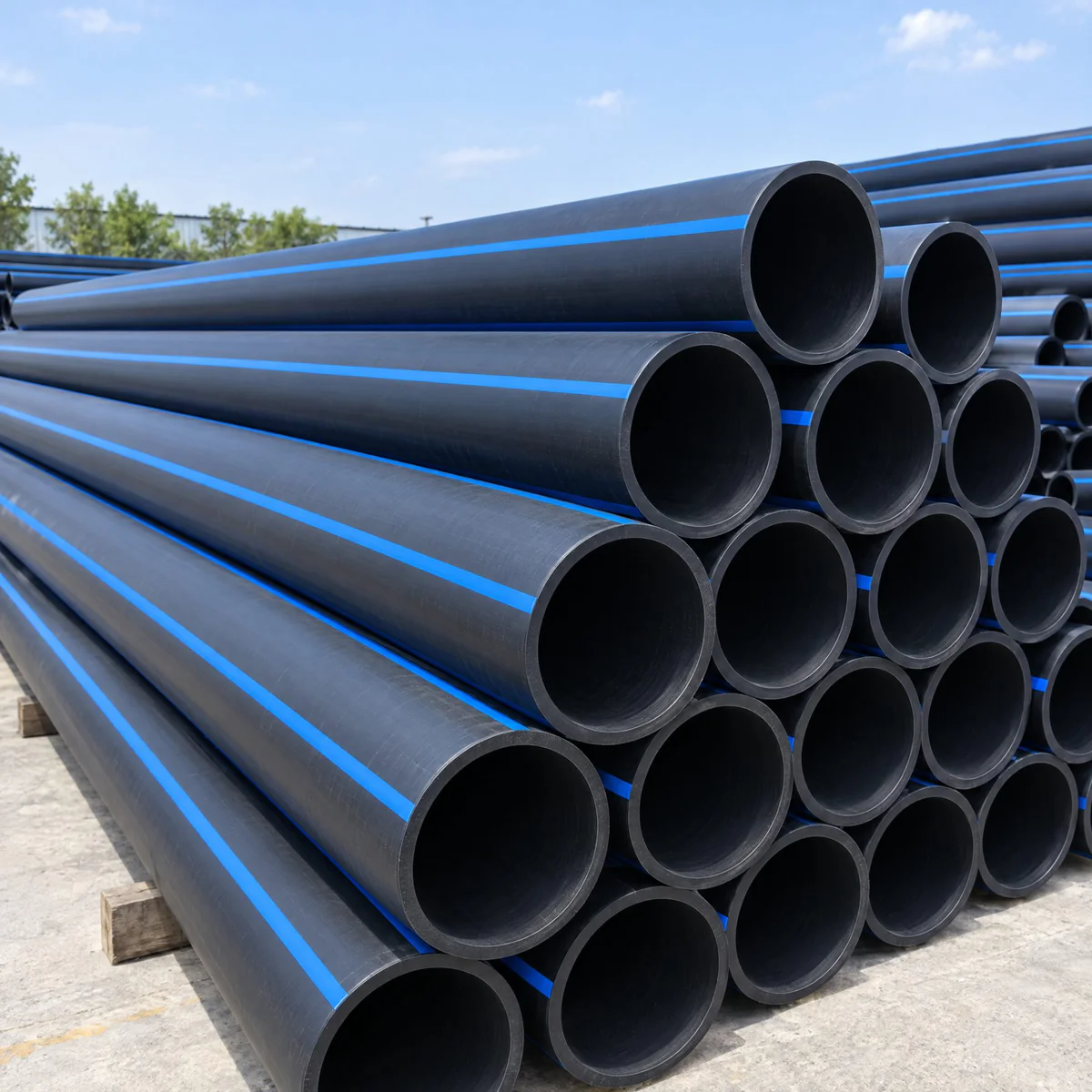
A complete HDPE pipe extrusion line usually starts with an automatic vacuum loader, hopper dryer, and material dosing system to ensure stable and clean raw material supply.
The feeding system is the first step of stable HDPE pipe production. In a modern PE100 pipe extrusion line, raw material is usually conveyed automatically from material bags, silos, or storage containers to the hopper dryer or directly to the extruder hopper. This reduces manual labor, improves production cleanliness, and helps maintain continuous operation.
In the QTech-Machinery Φ20–Φ110 mm HDPE pipe extrusion line project, the line includes an automatic vacuum loading system and hopper dryer. The vacuum loader supports continuous HDPE granule supply, while the hopper dryer helps reduce possible moisture-related defects when required by production conditions.
For customers in Africa, the Middle East, Central Asia, and other emerging markets, automatic feeding is especially valuable because it reduces operator workload and improves production consistency during long working shifts.
Typical feeding section includes:
| Machine | Function | Benefit |
|---|---|---|
| Automatic vacuum loader | Transfers HDPE granules to dryer or hopper | Reduces manual feeding |
| Hopper dryer | Removes moisture when needed | Improves pipe surface quality |
| Gravimetric dosing system | Controls material input accurately | Supports stable wall thickness |
| Color masterbatch feeder | Adds color stripe material | Enables pipe identification |
Internal link suggestion: QTech-Machinery Home
2. Why is the SJ75/33 single-screw extruder important in a Φ20–Φ110 mm HDPE pipe line?
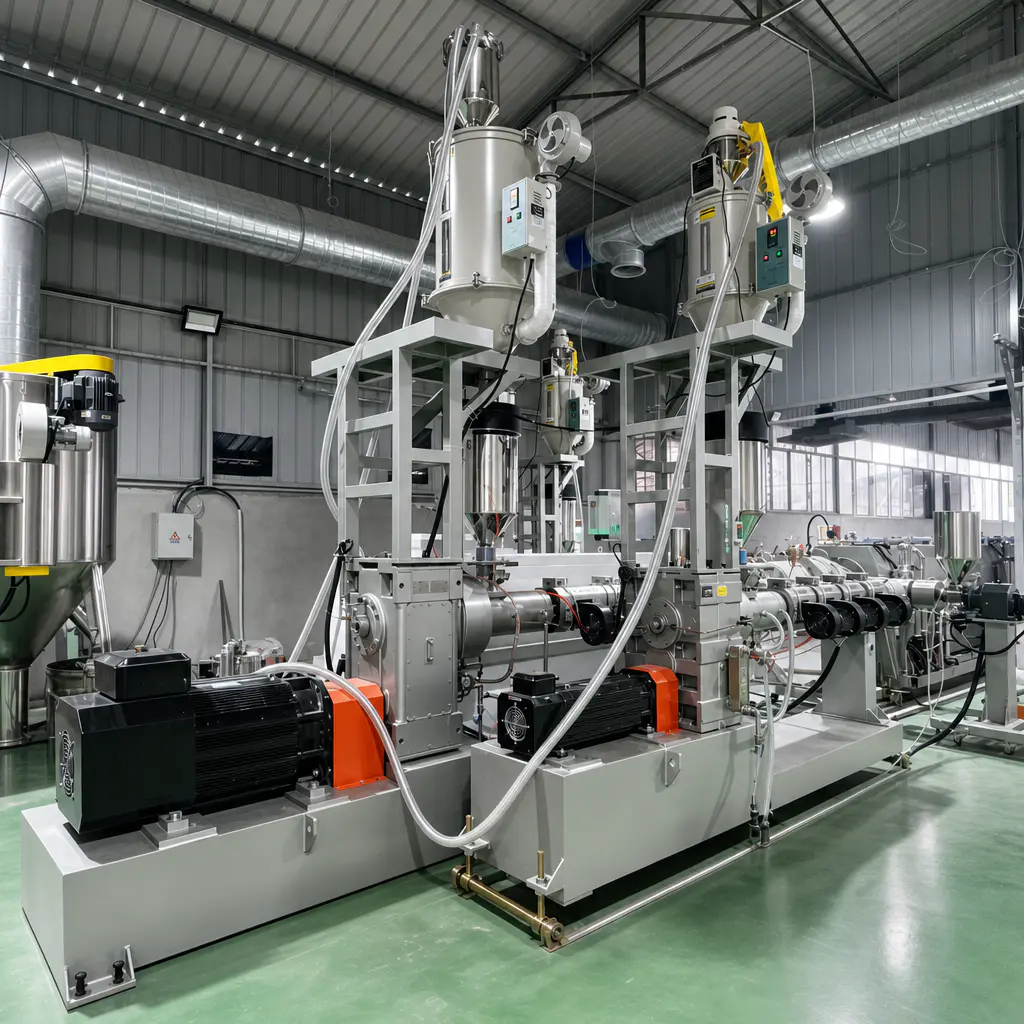
The SJ75/33 single-screw extruder is the core machine that melts, plasticizes, and pushes HDPE material into the pipe die with stable output.
The main extruder determines the production capacity, melt quality, energy consumption, and stability of the whole pipe line. For PE100 HDPE pipe production, the extruder must provide enough plasticizing capacity while maintaining stable melt pressure and temperature.
In QTech-Machinery’s Φ20–Φ110 mm HDPE pipe extrusion line, the main machine is an SJ75/33 single-screw extruder. This configuration is suitable for medium-capacity HDPE pipe production with an output of approximately 200–250 kg/h, depending on pipe diameter, SDR, formulation, and operating conditions.
The 33:1 L/D ratio supports better plasticizing and stable material flow. With reliable motor, inverter, gearbox, and temperature control, the extruder helps manufacturers produce stable PE100 water pipes with consistent appearance and performance.
Industry discussions about HDPE pipe extrusion often emphasize that wall thickness and pipe stability are influenced by output, haul-off speed, die geometry, vacuum sizing, and cooling balance. Therefore, the extruder should not be selected alone; it must be matched with the complete downstream system. [0] [1]
QTech-Machinery advantage:
- Practical SJ75/33 configuration for Φ20–Φ110 mm HDPE pipes
- Designed output around 200–250 kg/h
- Suitable for PE100 water supply pipe production
- Complete line matching instead of separate machine selling
- Custom design according to pipe size, SDR, layout, and capacity
3. What is the role of co-extrusion in HDPE pipe production?
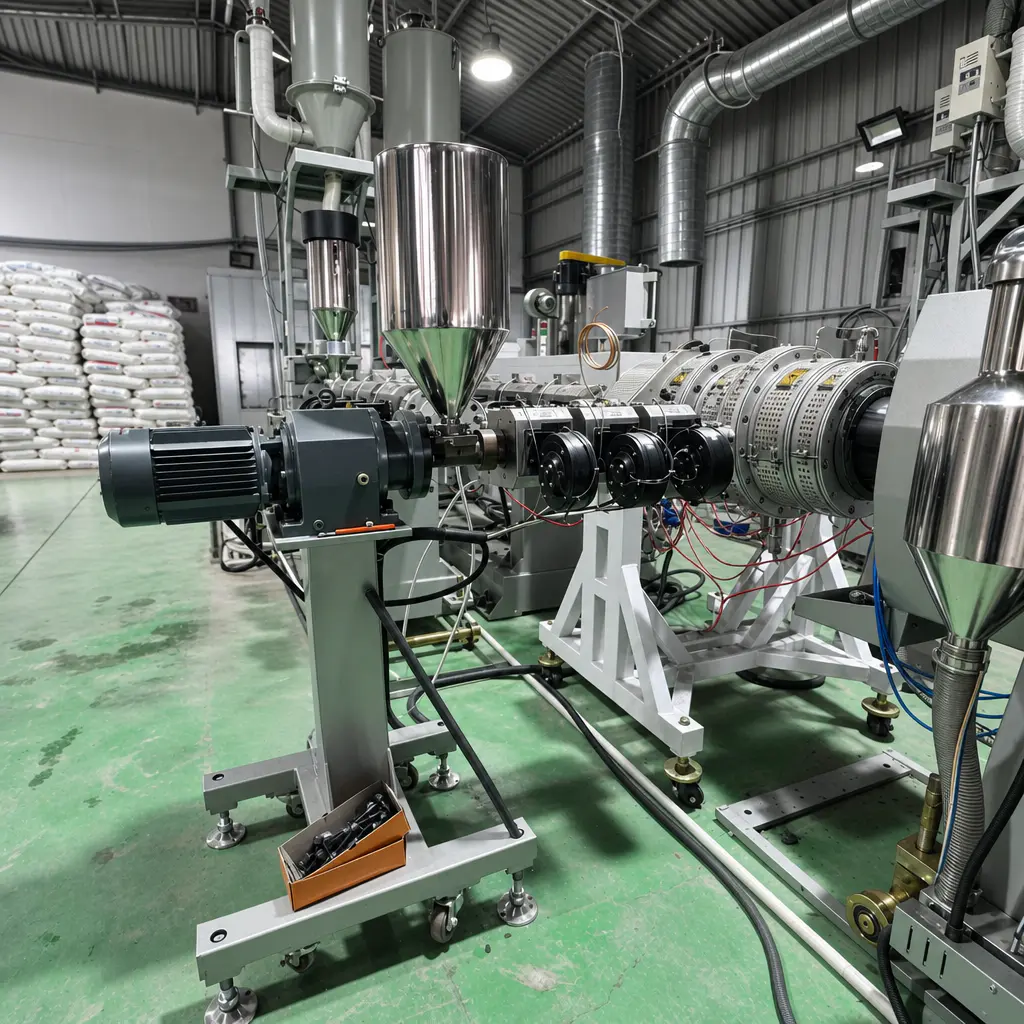
Co-extrusion is used to add color marking stripes on HDPE pipes for identification, application classification, and market compliance.
Many HDPE pipes require color stripes. For example, blue stripes are commonly used for water supply pipes, yellow stripes for gas pipes, and other colors for cable protection or special industrial applications. The stripe does not replace the main pipe material, but it helps customers quickly identify pipe usage.
The QTech-Machinery line includes a four-stripe co-extrusion system, which allows the customer to produce black HDPE pipes with color identification stripes. This is useful for PE100 water supply pipes and other pressure pipe applications.
A complete stripe co-extrusion system normally includes:
| Component | Function |
|---|---|
| Small co-extruder | Melts color masterbatch and PE material |
| Stripe die connection | Guides stripe material into pipe die |
| Color feeder | Controls color material input |
| Control system | Synchronizes stripe output with main line |
This system gives pipe manufacturers more product flexibility. Instead of producing only plain black pipes, they can meet different market requirements with stripe-marked pipes.
Internal link suggestion: Φ20–Φ110 mm HDPE Pipe Extrusion Line Case
4. What pipe die head and calibration equipment are included in a complete line?
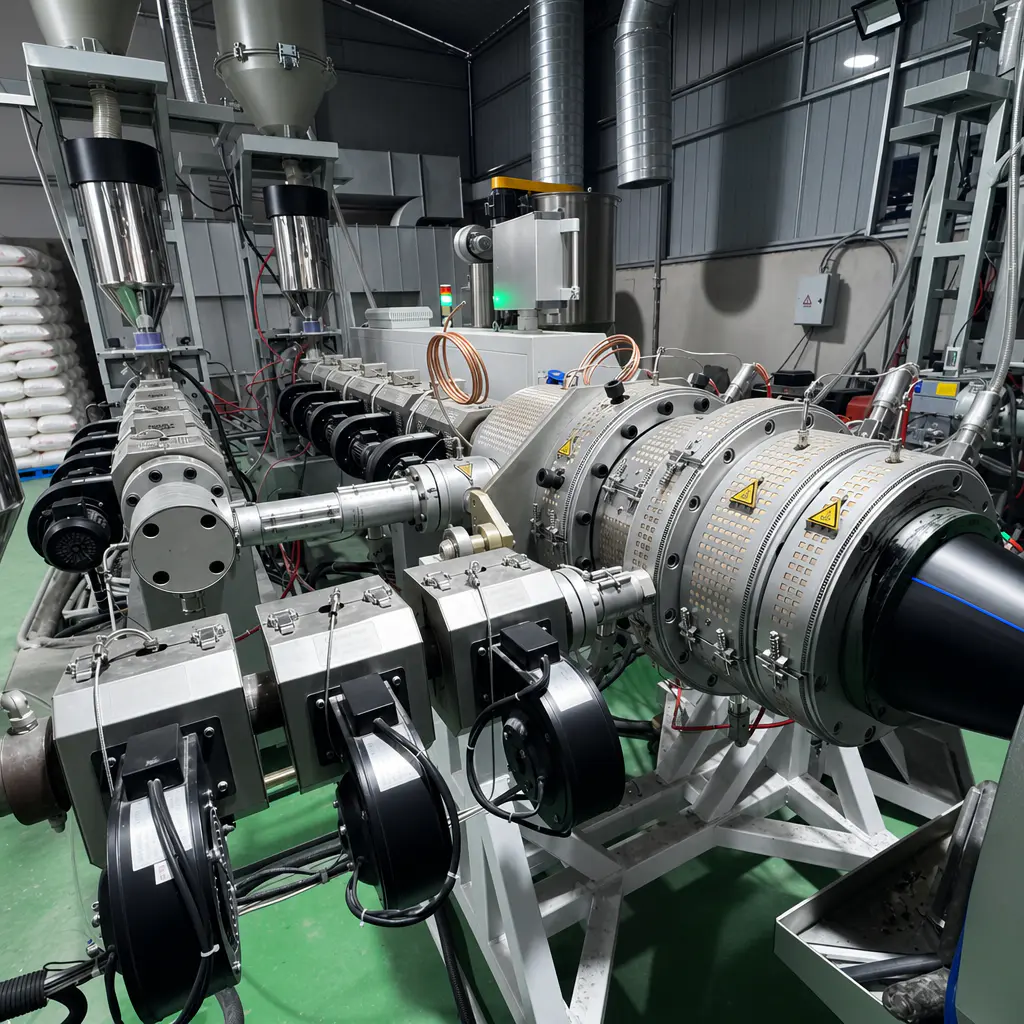
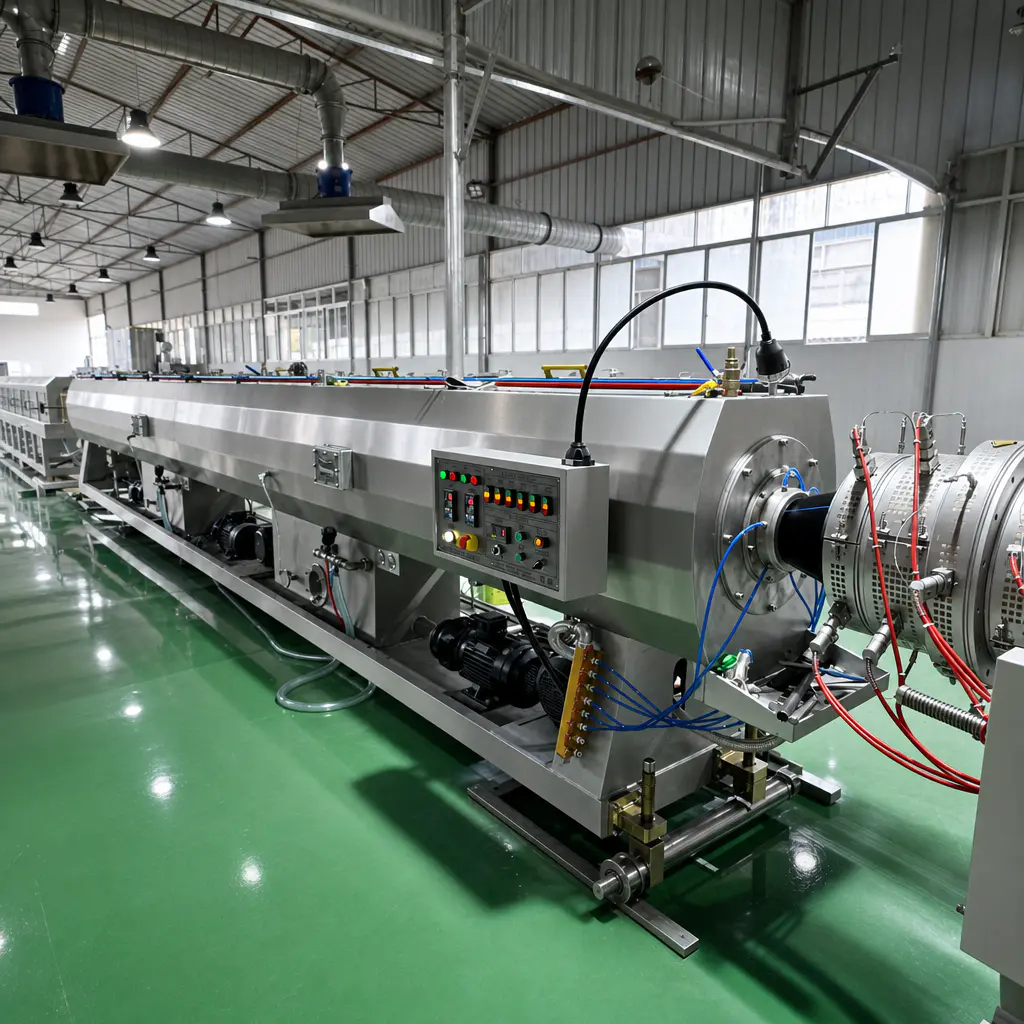
A complete line includes pipe die tooling, sizing sleeves, and a vacuum calibration tank to form the pipe and control outer diameter accuracy.
After HDPE material is melted and pushed by the extruder, it enters the pipe die head. The die head forms the molten material into a pipe shape. Then the pipe enters the vacuum calibration tank, where vacuum pressure and cooling water help fix the pipe diameter and roundness.
In the QTech-Machinery Φ20–Φ110 mm project, the line uses pipe extrusion die tooling and a 9 m vacuum calibration tank. This length is practical for medium-diameter PE pipe production and helps the pipe maintain stable size during continuous extrusion.
Vacuum calibration is one of the most important steps in HDPE pipe production because it affects:
- Outer diameter control
- Pipe roundness
- Surface finish
- Initial cooling effect
- Dimensional stability
- Production speed
If vacuum sizing is unstable, the pipe may become oval, oversized, undersized, or show surface defects. That is why QTech-Machinery designs the calibration section according to the pipe diameter range and required speed.
Industry articles on HDPE pipe extrusion also point out that the cooling and sizing section helps solidify the pipe structure and maintain pipe shape after extrusion. [2]
5. Why does an HDPE pipe line need spray cooling tanks?
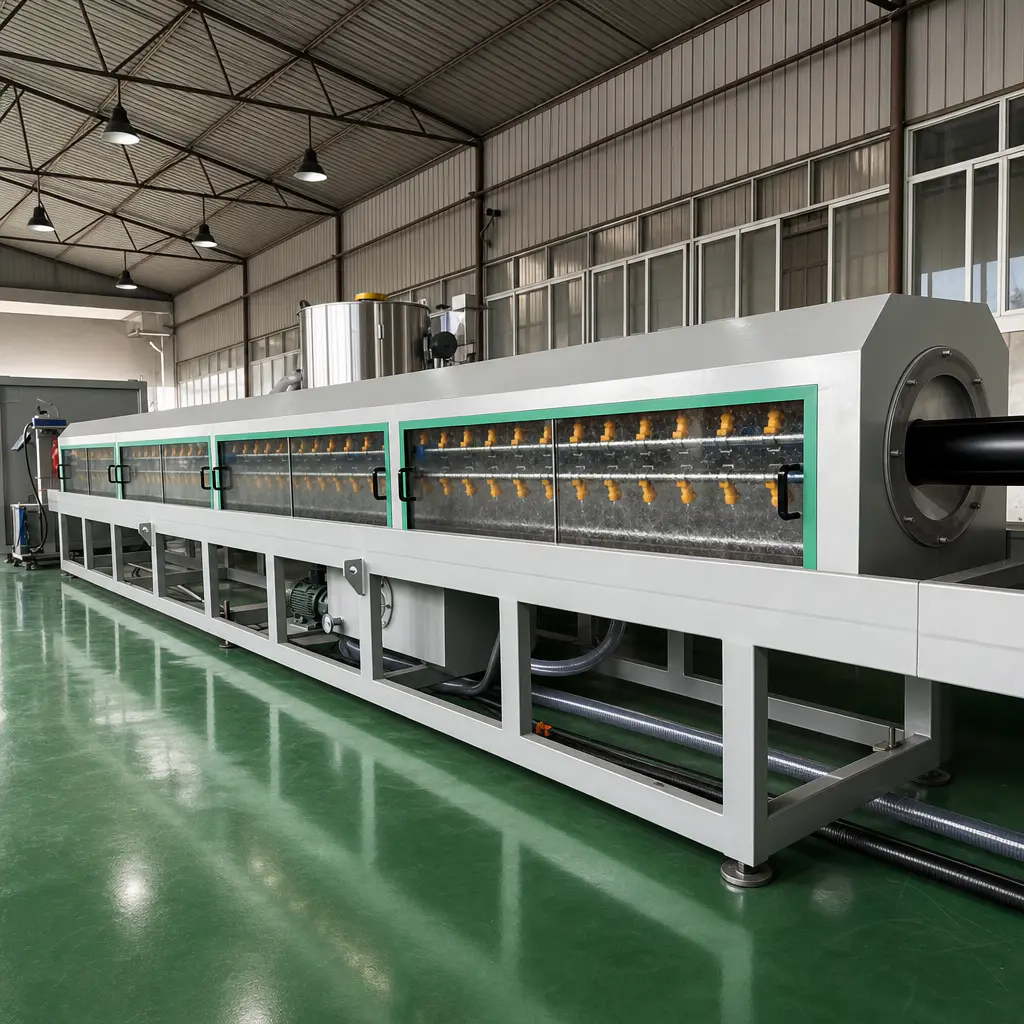
Spray cooling tanks continue cooling the pipe after vacuum calibration so that the pipe becomes dimensionally stable before haul-off and cutting.
HDPE material needs enough cooling time before cutting, winding, or stacking. If the pipe is not cooled properly, it may deform, shrink unevenly, or become difficult to cut cleanly. The cooling system must be matched with the pipe size, wall thickness, output, and line speed.
The QTech-Machinery Φ20–Φ110 mm HDPE pipe extrusion line includes a 12 m spray cooling tank after the 9 m vacuum calibration tank. This combination supports stable cooling for medium-capacity production at approximately 200–250 kg/h.
A typical cooling section may include:
| Cooling equipment | Purpose |
|---|---|
| Vacuum calibration tank | Initial sizing and cooling |
| Spray cooling tank | Further cooling and stabilization |
| Water circulation system | Maintains cooling water supply |
| Temperature and water-level control | Supports stable operation |
Effective cooling is frequently discussed in extrusion production because cooling length, water flow, pipe wall thickness, material type, and output all affect final pipe quality. [3]
6. What does the haul-off machine do in HDPE pipe extrusion?
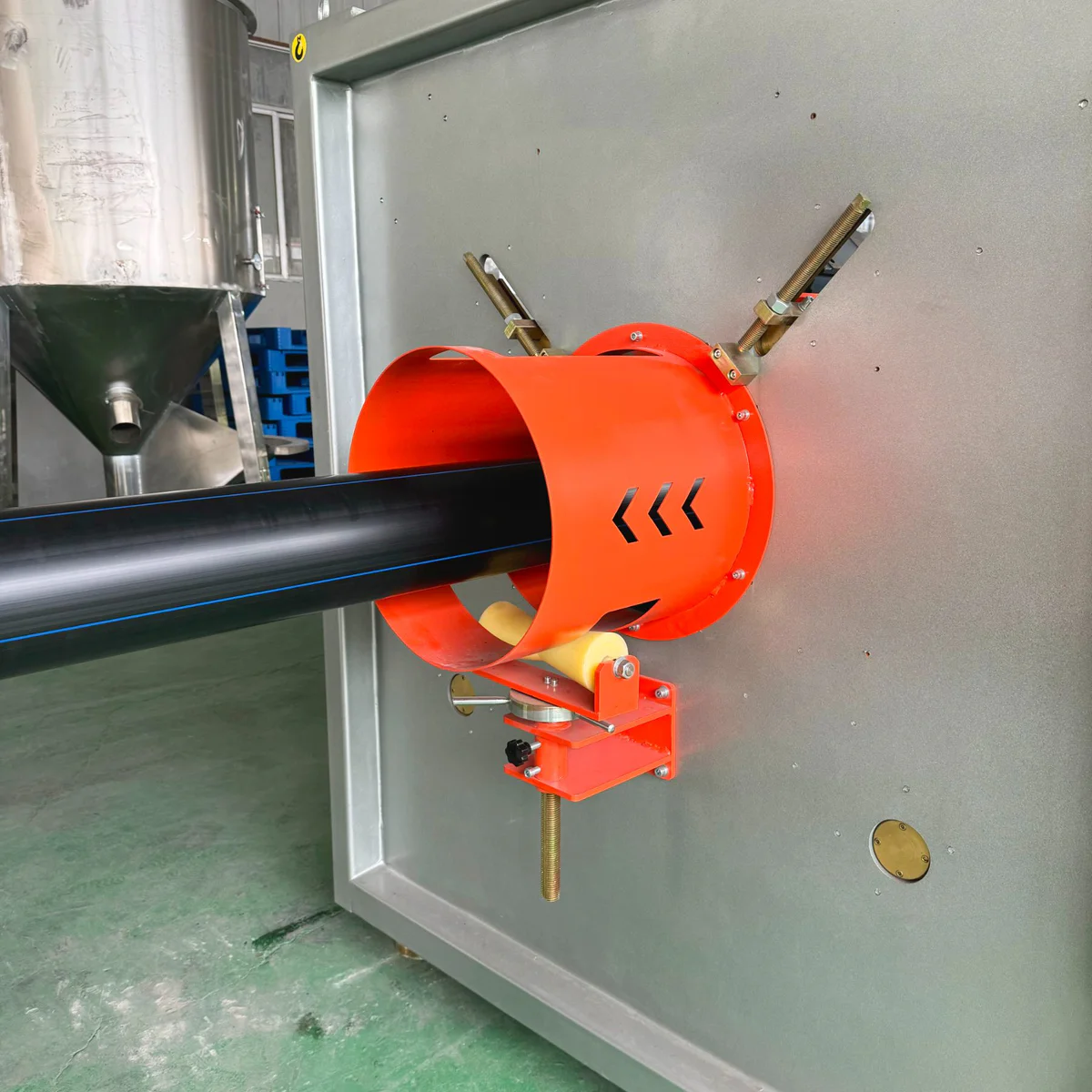
The haul-off machine pulls the pipe at a controlled speed and directly affects pipe wall thickness and production stability.
The haul-off machine, also called a caterpillar haul-off or tractor, pulls the pipe through the line after calibration and cooling. Its speed must be synchronized with extrusion output. If the haul-off speed is too fast, the pipe wall may become too thin. If the speed is too slow, the wall may become too thick.
In the QTech-Machinery project, the line uses a servo-controlled haul-off unit. Compared with a basic haul-off system, servo control provides more accurate speed regulation and better synchronization with the extrusion process.
This is especially important for PE100 water pipe production, where wall thickness consistency is closely related to pipe pressure performance and material cost control.
Benefits of servo haul-off:
- More accurate traction speed
- Stable wall thickness control
- Better synchronization with cutter
- Lower pipe deformation risk
- Easier operation for workers
- Suitable for different pipe diameters and SDRs
Industry extrusion resources also explain that haul-off speed and extruder output together influence pipe wall thickness, making haul-off control a key part of the whole process. [0] [1]
7. What cutting and collection machines are used after HDPE pipe cooling?
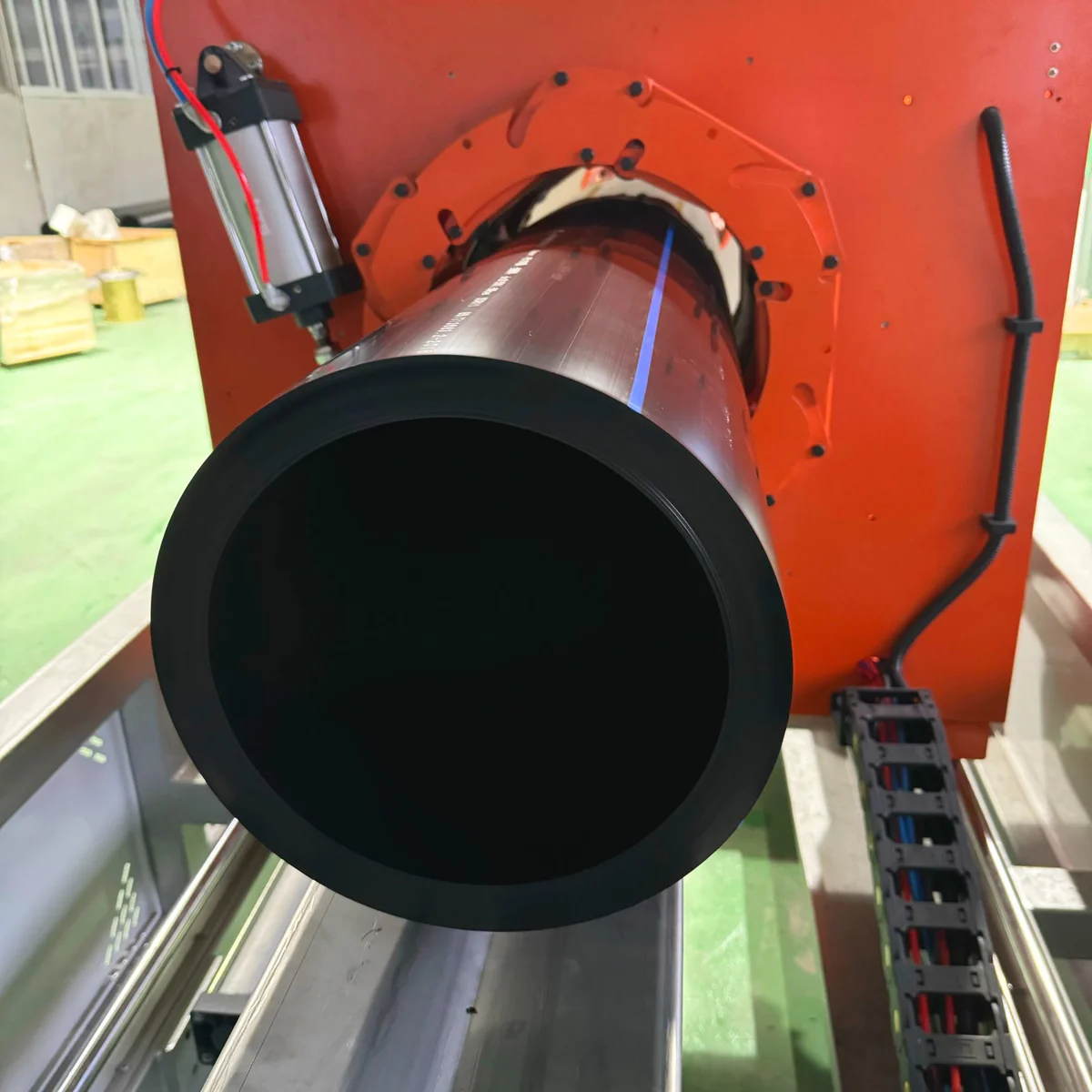
A complete HDPE pipe line usually includes fly-knife or chipless cutting, plus winding or stacking equipment according to pipe diameter and final packaging method.
After the pipe is cooled and pulled forward, it must be cut or collected. Small-diameter pipes can often be wound into coils, while larger-diameter pipes are usually cut into straight lengths and stacked.
The QTech-Machinery Φ20–Φ110 mm line supports both fly-knife cutting and chipless cutting options. This gives customers flexibility according to pipe size, wall thickness, production speed, and market requirements.
Finished pipe handling can include:
| Pipe size/application | Recommended collection method |
|---|---|
| Small diameter flexible pipe | Winding machine |
| Medium diameter pipe | Cutting and stacking |
| Water supply pipe | Straight pipe or coil, depending on diameter |
| Irrigation pipe | Coil collection often preferred |
| Cable protection pipe | Coil or straight length |
QTech-Machinery provides both winding and stacking solutions, helping customers produce different pipe specifications with one flexible line.
Internal link suggestion: QTech-Machinery Cases
8. What control system, documents, and support should a complete HDPE pipe line supplier provide?
A reliable supplier should provide the electrical control system, layout design, technical documents, spare parts list, installation guidance, and after-sales support.
A complete HDPE pipe extrusion line is not only a set of machines. It also requires engineering support, process knowledge, electrical integration, documentation, and service. For overseas customers, this is especially important because installation and operation must be clear and practical.
In the Φ20–Φ110 mm HDPE pipe extrusion line project, QTech-Machinery supplied a turnkey solution based on the customer’s pipe diameter range, PE100 material, output target, product application, and factory operation needs. The line was designed for stable medium-capacity production, precise pipe dimension control, and flexible finished pipe handling.
Documents usually provided by QTech-Machinery:
| Document | Purpose |
|---|---|
| Technical proposal | Confirms line configuration and specifications |
| Quotation sheet | Shows price and commercial terms |
| Factory layout drawing | Helps customer plan workshop space |
| Electrical diagram | Supports installation and maintenance |
| Operation manual | Guides daily operation |
| Maintenance manual | Helps long-term machine care |
| Spare parts list | Supports future replacement planning |
| Packing list | Confirms shipment details |
| Installation guide | Supports on-site setup |
| Testing video or report | Shows line performance before shipment |
Internal link suggestion: Contact QTech-Machinery
Key machine configuration table for a Φ20–Φ110 mm HDPE pipe extrusion line
| Section | Machine / System | Example configuration from QTech-Machinery | Main purpose |
|---|---|---|---|
| Material handling | Automatic vacuum loader | QX-900 type or customized | Automatic raw material feeding |
| Drying | Hopper dryer | Matched with output | Moisture control when needed |
| Main extrusion | Single-screw extruder | SJ75/33 | Melting and plasticizing HDPE |
| Output control | Gravimetric dosing system | Included | Stable feeding and wall thickness control |
| Stripe marking | Co-extrusion system | Four-stripe co-extrusion | Pipe identification |
| Forming | Pipe die head | Φ20–Φ110 mm tooling | Pipe shaping |
| Sizing | Vacuum calibration tank | 9 m | Diameter and roundness control |
| Cooling | Spray cooling tank | 12 m | Pipe cooling and stabilization |
| Traction | Servo haul-off | Servo-controlled | Stable pulling speed |
| Cutting | Fly-knife / chipless cutter | Optional according to pipe | Clean cutting |
| Collection | Winder / stacker | Both available | Coil or straight pipe handling |
| Control | Electrical control cabinet | Centralized control | Operation and synchronization |
Customer selection steps for an HDPE pipe extrusion line
Step 1: Confirm pipe diameter range
Customers should first confirm the minimum and maximum pipe diameter. For example, QTech-Machinery’s referenced project covers Φ20–Φ110 mm, which is suitable for small and medium HDPE pipe production.
Step 2: Confirm pipe application
Different applications may require different pipe structures, color stripes, pressure ratings, and collection methods.
Common applications include:
- PE100 water supply pipe
- Agricultural irrigation pipe
- Cable protection pipe
- Drainage and sewage pipe
- Gas distribution pipe
- Industrial HDPE pipe
Step 3: Confirm material grade
For pressure water pipe, PE100 HDPE is commonly selected. Customers should also confirm whether they use virgin material, color masterbatch, recycled material, or special additives.
Step 4: Confirm SDR and wall thickness
SDR affects pipe wall thickness, material consumption, cooling requirement, and output. A supplier needs this information to recommend the right extruder, die, cooling length, haul-off, and cutter.
Step 5: Confirm target output
For medium-capacity production, the Φ20–Φ110 mm QTech-Machinery line is designed for approximately 200–250 kg/h.
Step 6: Confirm workshop layout
The supplier should check available factory length, width, power supply, water supply, compressed air, crane or forklift condition, and storage space.
Step 7: Confirm packaging method
Small pipes may need winding, while larger pipes may need cutting and stacking. Some customers require both systems for flexible production.
Step 8: Request a customized proposal
After confirming the above details, QTech-Machinery can prepare a suitable technical configuration, quotation, layout, and delivery plan.
Products QTech-Machinery can provide
QTech-Machinery can provide complete HDPE pipe extrusion line solutions, including individual machines and turnkey production systems.
| Product category | Available products |
|---|---|
| Feeding system | Vacuum loader, hopper dryer, material storage and feeding solution |
| Dosing system | Gravimetric dosing system, color masterbatch feeder |
| Extrusion system | SJ series single-screw extruder, co-extruder |
| Die tooling | HDPE pipe die head, sizing sleeves, stripe die system |
| Calibration system | Vacuum calibration tank |
| Cooling system | Spray cooling tank, water circulation support |
| Haul-off system | Belt or caterpillar haul-off, servo-controlled haul-off |
| Cutting system | Fly-knife cutter, chipless cutter |
| Collection system | Pipe winder, pipe stacker, discharge table |
| Control system | Electrical cabinet, PLC/HMI control options, inverter control |
| Auxiliary support | Spare parts, installation tools, technical documents |
File checklist customers can request before ordering
| File / document | Why it matters |
|---|---|
| Technical proposal | Confirms all machine models and functions |
| Line configuration sheet | Helps compare different supplier offers |
| Factory layout drawing | Helps plan installation space |
| Power consumption list | Supports electrical planning |
| Water and air requirement list | Supports utility preparation |
| Quotation and commercial terms | Confirms budget and payment plan |
| Delivery schedule | Helps arrange project timeline |
| Spare parts list | Supports long-term maintenance |
| Installation and operation manual | Helps operators use the machine correctly |
| Machine testing video | Shows production condition before shipment |
| Packing list | Supports import and customs checking |
| Warranty terms | Confirms after-sales responsibility |
Customer case reference: Φ20–Φ110 mm HDPE pipe extrusion line project
QTech-Machinery supplied a complete Φ20–Φ110 mm HDPE pipe extrusion line for a customer producing PE water supply pipes. The project was developed for stable medium-capacity production, precise pipe dimension control, and flexible pipe collection.
The customer required:
- Φ20–Φ110 mm pipe diameter range
- PE100 HDPE material processing
- Black pipe with four color marking stripes
- 200–250 kg/h output capacity
- Stable outer diameter and wall thickness
- Coiled pipe and straight pipe collection
- Reduced manual feeding
- Reliable electrical control
- Accurate haul-off and cutting
- Spare parts and technical support
QTech-Machinery supplied a full solution including automatic feeding, hopper drying, gravimetric dosing, SJ75/33 main extruder, four-stripe co-extrusion, pipe die tooling, 9 m vacuum calibration tank, 12 m spray cooling tank, servo haul-off, cutting system, winding system, stacking system, centralized control, and spare parts support.
Read the full case here: Φ20–Φ110 mm HDPE Pipe Extrusion Line Project by QTech-Machinery
Why choose QTech-Machinery for a complete HDPE pipe extrusion line?
QTech-Machinery’s advantage is not only supplying machines, but also designing a complete production solution based on the customer’s real pipe requirements.
Main advantages
- Complete turnkey HDPE pipe extrusion line supply
- Practical Φ20–Φ110 mm line configuration for PE100 pipe production
- SJ75/33 extruder with 200–250 kg/h designed output
- Gravimetric dosing for stable material control
- Four-stripe co-extrusion for product identification
- 9 m vacuum calibration and 12 m spray cooling for stable pipe forming
- Servo haul-off for accurate traction
- Flexible fly-knife or chipless cutting
- Winding and stacking options for different pipe sizes
- Custom layout and technical support for overseas customers
Related internal links
Here are useful pages for customers who want to learn more about QTech-Machinery and HDPE pipe extrusion solutions:
- QTech-Machinery Home
- QTech-Machinery Cases
- Φ20–Φ110 mm HDPE Pipe Extrusion Line Project
- Contact QTech-Machinery
- Get a similar HDPE pipe extrusion line quote
External references and industry notes
The technical points in this article are consistent with common HDPE pipe extrusion discussions in the plastics processing industry. Industry resources often explain that HDPE pipe quality depends on the balance between extrusion output, die design, haul-off speed, vacuum sizing, and cooling performance. For example, articles about HDPE pipe manufacturing describe the haul-off unit as a key machine that pulls the pipe through the line and influences wall thickness together with extruder output. [0]
Other extrusion process discussions note that pipe wall thickness variation can result from the balance of extrusion output, die geometry, outside diameter, haul-off speed, vacuum sizing, and cooling. This supports the idea that customers should buy a matched complete line rather than separate machines from different suppliers. [1]
General HDPE pipe extrusion process guides also describe the cooling system as necessary for solidifying the pipe and maintaining structural integrity after forming. [2]
Cooling-related technical discussions further emphasize that cooling length and cooling efficiency must match material type, output, and pipe size, especially in HDPE pipe production. [3]